The Peace In Bartleby’s “I Would Prefer Not To”

Photo by sarah richer on Unsplash

Blessed are the high in agency for they have done enough already.” ~taken from The Book of the Firstborn, probably

Three weeks ago, my sister sent me this video about finding the high agency people in your life. In the video, one gentleman asks another whom he would call for help if he were trapped in a South American jail and were to be transferred in 24 hours to an undisclosed location. He explained a high-agency person is someone who can think on their own, without instructions, and solve problems at a very high level under pressure very quickly. My sister added this comment to the video: “You are this person. You should know that most of your friends would feel the same way. This is a high compliment and you should feel really good about yourself.” I watched the video, read her comment, and realized it didn’t sit with me the way I knew she intended it to. I responded with a laugh and then said, “I think that most of the people who would be chosen for this job would be first-born daughters.” Perhaps taking my comment as self-effacing and dismissive of my skills, she replied the “only response necessary is yep. I’m awesome.” I decided to let it go at that.

The exchange has been lodged in my mind ever since, though, due to my visceral, real-time reaction to that video. It was an emphatic inner voice saying, “Yes. I could be that person but no thank you.” There was a time in my not-too-distant past when I might have received that video and corresponding accolades and felt quite honored to be someone else’s chosen savior in a tough situation. I don’t feel that way anymore, though. Thousands of hours of therapy have helped me understand I have some deep-seated issues around constantly being called on to be the adult in the room, to be the one who makes things run smoothly, the one who steps back from her own tasks to ensure everyone else is taken care of and not inconvenienced. This is not to imply that I have never been selfish because I certainly have. Who hasn’t? But my reaction was inner me finally standing up and saying, “I’m finished looking out for others at my own expense.” I would most certainly help my sister if she called me from a South American jail. I’m simply now, more than ever, finding myself capable of telling others to be accountable for their choices and figure out their own shit. It’s a small measure of heretofore unimaginable success for me.

Some people who are high agency might be so because they were required at a young age to be the adult they were not. Some people who are high agency might be so because they were taught they had no intrinsic value outside of service to others. Not everyone who is high agency loves being called on to help in every situation. Some of us are struggling trying to deal with our own crap but aren’t skilled at saying no just yet. We may not yet have learned to channel Melville’s Bartleby-the-Scrivener-level attitude of “I would prefer not to.” It’s admirable to be high agency, but being high agency for others without being high agency for yourself first will lead to burn out, regret, and bitterness. Every mother who has survived a holiday season knows this.

So this holiday season, if you have high agency people in your life upon whom you call regularly, maybe consider giving them a break and not contacting them for assistance. Yes. The holidays are stressful and you could probably use their help, but maybe give them the gift of unburdening instead. And, all you high agency people, you know who you are. Please also know it’s okay for you not to respond to someone else’s emergency, especially when you are overwhelmed yourself. It’s not only acceptable but advisable to tell the relative who is flying out to see you for the holidays and asking a gazillion unnecessary questions of you to check tsa.gov for airport security information and weather.com for updated forecasts. You don’t have to take it all on. And if someone calls you from a South American prison, maybe you choose to help them or maybe you tell them perhaps they shouldn’t have ended up in one in the first place and wish them the best.

Not Too Big or Too Small Or Too Hard Or Too Soft: A Tale Of Accepting I’m Just Right

Practicing Self Love

“Only a few find the way, some don’t recognize it when they do — some…don’t ever want to.” ~Cheshire Cat

Alice’s Adventures in Wonderland, Lewis Carroll’s famous novel, reminds me of my experience in life. No. I’ve never met a grinning Cheshire Cat, although I would like to. I do, however, know how it feels to be disoriented, awkward, and entirely uncomfortable in my skin like Alice was. It’s how I’ve lived most of my life. Alice, as you may recall, drank some potion and shrunk her way into Wonderland and then ate some cake and grew so big she didn’t fit there anymore. In my case, someone I cared about would criticize my physical appearance, personal tastes or beliefs, or general demeanor, and I drank it in and got small. I began tiptoeing through my life, lest I be stepped on by larger creatures who appeared to have their lives together. What if I said or did something that proved how intolerable and unlovable I was? Other times, someone would acknowledge the good in me and I would greedily ingest it. Feeling bigger than usual, I would dare to be my true self with others, only to leave the interaction feeling I had occupied too much space. What if I’d bored them by talking too much while saying nothing interesting? Defeated, I would shrink again, caught in the same relentless pattern. One step forward, two steps back, slogging my way through my life, feeling forever out of place like Alice.

Somewhere deep inside, though, I knew the premise that I was the only scratch-and-dent model around was ridiculous. Maybe others were just better at displaying themselves in a way that minimized their flaws? Maybe they’d already worked on their parts so they were left with just a few scratches? I wanted to believe I was and I am fine as is. No adjustments necessary. Sure. Some people might wish I would speak out and stand up for myself more or just stop whining about feeling invisible. Other people might wish I would sit down and shut up so someone else could get a word in. But none of that was ever a me problem. Other’s opinions of me are none of my business, and shrinking myself to avoid judgment is not what I am here to do. I’m here to live my life and to be true to myself, no matter how many dings I’ve got. To achieve this, I going to have to leave my Alice analogy and walk myself into a different story, one I haven’t even considered occupying before.

After all, I’ve been Alice. I ate the cake and drank the potion. I became bigger and smaller to fit other’s narratives. What if, instead of being Alice, I take a shot at being Goldilocks? I can decide what to eat and in what type of chair to eat it. Maybe I will conclude I like my porridge cold because it’s basically overnight oats? Being Goldilocks and boldly choosing what I want in my life might move me quite a few steps toward Zero Fucks Given Road. It’s exhausting not being authentic, though, and I am tired of making slow progress toward self-acceptance. It’s time to practice wild and radical self-love. I can’t be Alice or Goldilocks. I can only be me. Yes. I am talkative. I can be defensive. I overthink everything. (Ask me how many times I pack and unpack and repack a suitcase before a trip only to end up with more than I need but nothing I want.) But, I am also curious, adventurous, determined, clever, and a little feisty, in the fun way. It’s what I am, the good and the bad, different and yet the same as every other human on the planet. So I will stop spending time with those who treat me as a tedious chore to be endured or a spouting fire hydrant to be capped. I will quit editing myself to fit into other people’s narratives. If I’m not Alice and I’m not Goldilocks, it’s about time I become my own protagonist.

“Damn. Somebody ate my porridge all up.” ~Baby Bear (probably)

The Long And Winding Road To Self-Acceptance

I have this app on my phone called Timehop. It collates the experiences you shared on social media on that particular date in previous years. Most days, happy memories populate my Timehop feed. I love when the app shows me photos of my much younger sons or of me traveling or participating in an event or hanging out with friends. For the most part, it is a positive way to check in on my progress through this life.

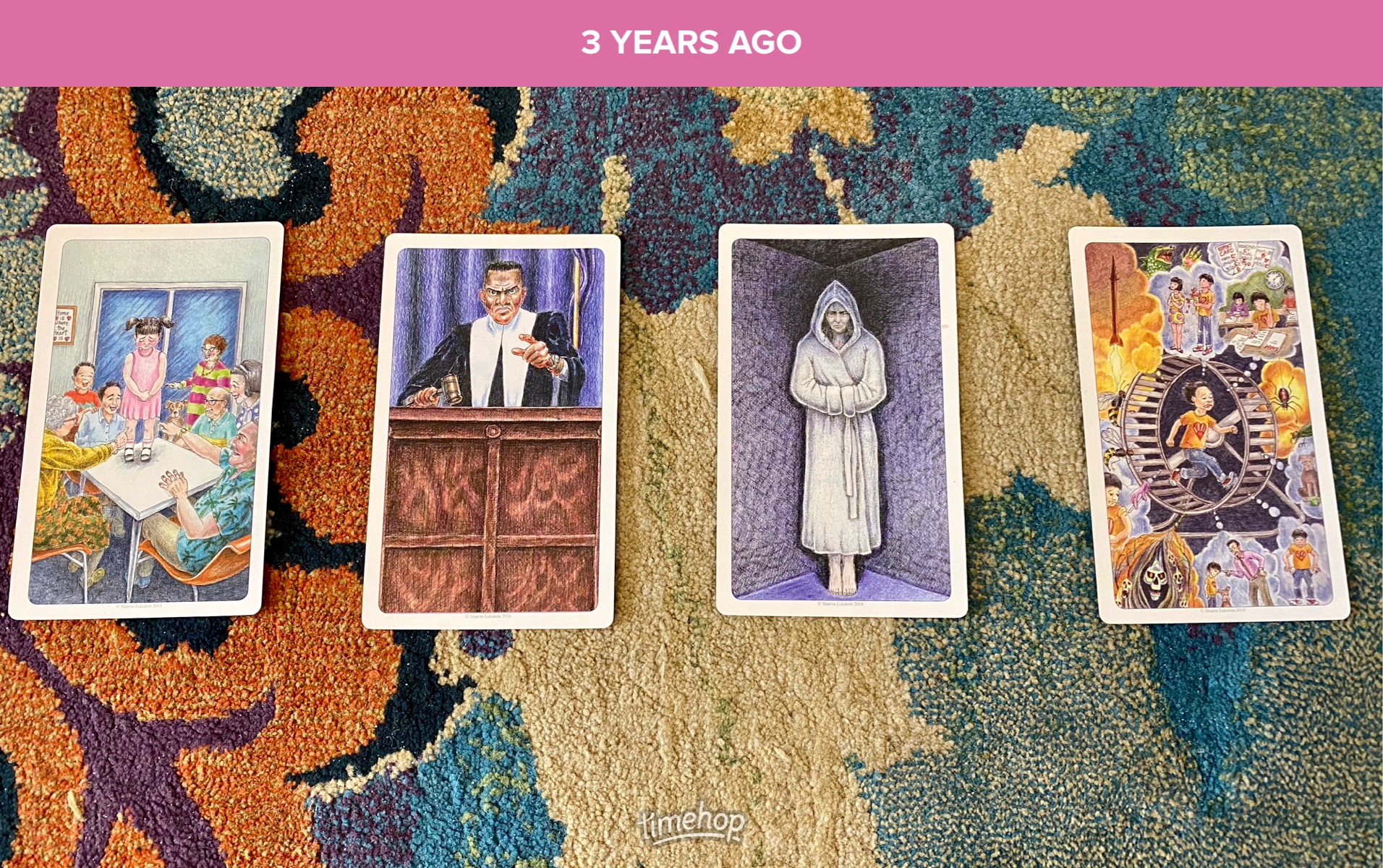
Today, one of the photos was a shot I captured in my therapist’s office three years ago. I remember that session well. She handed me a deck of cards with colorful, emotive drawings on them and asked me to sift through the deck and pull out any cards that resonated with me somehow. There were some fifty cards in the deck. When I finished, I had four cards in my hands. She asked me to show them to her and tell her why I had chosen them. It was one of the most eye-opening sessions I’ve ever had. Here are the cards:

My life in four depressing cards

The first card shows a little girl standing on a table while people around her, presumably family and friends, mock her. The second card presents a stern-faced judge issuing an admonishment. The third one is of a person alone, backed into a corner. The final one depicts a child running on a hamster wheel surrounded by scary and sad thoughts. Oof.

I explained the first card represented how I felt as a child. I was that girl on the table, red-faced, awkward, and singled out as wrong simply for being me. The second card represented the result of being that little girl in the first card. I am constantly afraid to do something wrong, to draw negative attention, to be chastised or called out. I’ve lived my life trying to fly under the radar, to not be seen lest someone catch me making an honest, human mistake or appearing naive or uneducated or imperfect and pointing it out. The third card told the story of how I usually feel on the inside as a result of the experiences I related from the two previous cards. I feel isolated, inherently broken. The final card represented the usual state of my mind. I’m a perpetual over-thinker. I spend most days in my busy brain either ruminating on past mistakes that come up because of a more recent, similar mistake or trying to figure out how to just be better because it’s obvious there is something wrong with the way I am. Yikes.

If you’d asked me when she handed me the cards what I thought was going to come of this exercise, I would have told you probably not much. I was so wrong. The feelings that came up for me when I saw those four cards explained where I came from, what that past created for me, how I felt around other people now, and how I lived my daily life. It was all negative and it was a lot to take in. As the session closed, I asked if I could take a photo of the cards I had chosen. I guess I thought I might want to reflect on them again at some other point. Apparently today was that point.

When the cards showed up in my feed today, they hit differently. Yes. I still recognize that little girl in the first card but, instead of feeling there is something wrong with her, I feel there is something wrong with the rest of the people in the scene. Yes. I sometimes still shrink when someone close to me points out my flaws, but other people’s opinions about my choices in my life mean much less to me now. Others don’t hold the map for my journey, and I know they are out of their lane. Sometimes I still feel alone and different, but I recognize the feeling will pass. I know we are all struggling and lost. It’s nothing unusual. And yes, I still run that damn hamster wheel in my head. These days, though, the thoughts are more appreciative of the me I am now rather than reproachful of the me I was.

The past three years have been something else for us all. They’ve been a little extra for me too, but I’m so stinking proud of myself. The work I put in is paying off. And I kinda kick ass.

Unfu*k Yourself, Already

I read a book last week. Yes. A whole book. It was a short book, but still. The book was Unfu*k Yourself by Gary John Bishop. To be honest, I started listening to the book on Audible, enjoyed the introduction delivered with the author’s no-bullshit, full-on Scottish attitude and accent, and then got on Amazon and ordered a paper copy because I knew I would want to highlight passages. When it arrived, Mr. Bishop and I got right back to work. The book, as you can imagine from its cheeky title, offers suggestions for those of us who feel stuck on repetitive hamster wheel of self-sabotage. It’s a book about unsticking yourself.

As I listened, a few things became clearer to me about my life, the consequences of my upbringing, and my future trajectory. First, there was the admission that I’ve been spinning and getting nowhere for about four years now. There are several life situations that coalesced to create a quicksand pit from which I have not escaped. The specifics about them aren’t as important as the fact that I was able to name them, which gives me a concrete place from which to get to work. You have to know what stopped you to figure out how to get around it. Second, the book prompted me to do a lot of thinking about the areas of my own modus operandi that work against me the most often. The result? The behavior that most often holds me back is fawning. I am a people pleaser. This does not mean I succeed at it. It just means I attempt to make others happy by doing what they want. I regularly set aside my own wishes to avoid conflict, to ensure other people are happy and comfortable, and to be palatable. You’ll often hear me speaking Fawn-ese: I’m good with whatever. You choose. Whatever works for you is fine with me. Really. It’s okay. Don’t worry about me. I’m flexible. I don’t want to be a bother. It doesn’t matter to me. I’ve got it. No worries. I can make that work. These statements (a product of being raised to believe I am the world’s most sensitive, overreacting, selfish jerk) make me feel like I’m being generous and thoughtful to others. In reality, however, I often say them because I’m so used to deferring to others that 1) I don’t know what I want or like, so I don’t know how to ask for it, and 2) I assume that letting others get their way will make me worth hanging around with. The truth is that my fear of speaking up for myself often makes me grumpy. Who wouldn’t be grumpy when they take on more than they can handle and often end up doing exactly what they don’t want to do? Unfu*k Yourself is about getting out of your own way and moving yourself into a better future, and Mr. Bishop outlines some key things you need to do to bring that about. And he does it by not pulling any punches and speaking directly to the multitudinous methods people employ to hold themselves back. In fact, the way he reads the book in audio form you can just about hear his frustration. I’m fairly certain he is tired of having to point out to people that the path to their best life runs only through them.

In one chapter, he discusses how we are wired to win. What he means by this is that we get what we set ourselves up for and expect. We are masters of the self-fulfilling prophecy. Spending your life bemoaning your history of finding the worst partners? You’re probably attracting all the wrong people because of something in your past. If you don’t fix what’s behind that curtain, you will keep winning at picking the losers to date. But, if you sift through the memories of your old relationships, perhaps you can pinpoint where they went wrong and do some work around your discovery so that next time you make a different choice. The bottom line is that when you’re wired to win, you can win at losing or win at winning. There’s a famous quote attributed to Jessie Potter that fits this idea: “If you always do what you’ve always done, you’ll always get what you’ve always gotten.” You can keep repeating your mistakes and blaming mysterious exterior forces that don’t exist or you can do the work, get your poop in a group, and do better in the future.

The chapter that I most needed to hear right now was entitled, “I am not my thoughts. I am what I do.” As a person who spends a lot of time in her head, thinking, rethinking, analyzing, overanalyzing, and reanalyzing those analyses, this chapter reminded me that I will never get anywhere good this way. I have to stop thinking and start doing. I’ve been unhappy with my fitness level. I can either sit on my sofa thinking about how I used to be in great shape and now I can’t seem to get motivated or I can haul my sorry ass off the sofa and put it on the seat of the Peloton bike and change my situation. I can whine about a relationship in my life that is dying but that I keep trying (unsuccessfully) to revive or I can decide it’s time to let it go and put my energy towards endeavors that may lead me somewhere I want to be. People who are successful have one thing in common. They stop talking and start doing. You can’t just hope things will get better. You need to look for solutions and then go out and do something to put you where you would like to be.

Now, I’m sure there are plenty of people who might read the book (or listen to the audiobook to enjoy the author’s delivery of it) and say, “Yeah. Yeah. This all sounds familiar. Nothing new here.” But that is kind of the point. If you’re still reading self-help books and saying they aren’t helping, maybe it’s because a book can’t change your life. YOU have to do that. And this book has some ideas about where you might want to start and why, if you don’t take action, you can continue to enjoy all the crap you feel life has handed you that you don’t deserve. If all I take away from this book is the mindset to get back to better health and get rid of relationships that don’t serve me, it will totally have been worth the paper it was printed on.

What was it Red said in The Shawshank Redemption?

“Get busy living or get busy dying.”

I am getting busy living. I will figure out who I am and what I want along the way.

My Autobiography: In Five Chapters

Along my path to a healthier me, a me who isn’t stuck operating from the trauma responses I adopted as a child, I found this poem. It has been my goal post as I move through the stages of recovery.

Autobiography in Five Chapters by Portia Nelson

Chapter I

I spent most my life unable to move beyond Chapter I. I was self-unaware. With no understanding the dynamics that had been in play when I was a child had heavy consequences, nearly everything I encountered was a challenge for my nervous system. Normal interactions and situations triggered my fight, flight, or fawn defenses. Without those defenses, I would have collapsed in on myself like a dying star. I had no real idea who I was underneath the overthinking, perfectionism, people pleasing, boundary ceding, bullying, and negativity. Worse yet, I didn’t see there was anything unhealthy about my MO at all. I was stuck for a long, long time.

Chapter II

Six days before my 46th birthday, I was sabotaged in public by a family member. Because my eleven year old son had been used as an unwitting pawn in the scheme to humiliate me, something in me snapped. It was my roller shade moment. After decades spent repressing abuse I endured as a child, the window shade I had pulled down to protect myself from repeated trauma flew up. I could not unsee what had been lurking behind it. I was bumped into Chapter II, forced to acknowledge my past and reckon with my trauma responses and their repercussions. I couldn’t stop using them to protect myself yet because I still needed them. So, I kept behaving mostly the same way I always had, only now I was aware how unhealthy my reactions to every little thing were. I didn’t know how to stop them, but I knew they were wrong. Every time I caught myself in an epic overreaction, the shame was overwhelming. I read a stack of self-help books and realized I needed to start regular therapy. Through therapy, I faced my past. It was painful and slow going. Every time I hurt my husband or my sons because I could not control my responses, I felt like the worthless person I was told as a child I was. I was a skipping record, stuck in a groove, doomed to repeat my patterns.

Chapter III

After some research, I decided to shift to a new therapist who offered EMDR therapy, which has helped thousands of people suffering from PTSD see their trauma in a different light. I’ve spent most of the past two years in this chapter. It has been an endless cycle of acting out my old habits, catching myself, acknowledging my behaviors and thoughts are not helpful, apologizing to myself and others for my missteps, and then forgiving myself and trying again from a more mindful place. Sometimes I would react in a more healthy manner immediately. Other times I had to sit with the negative pattern I had repeated for 5-10 minutes before understanding how I could do better and then ameliorating the situation for myself and those I had been unfair to. I saw my progress and was encouraged, but I also knew I could be in this chapter for decades until I was skilled enough spot the hole before falling into it.

Chapter IV

Recently, and with some extra assistance, I’ve had some legitimate success walking around the trauma hole. I can bump myself out of my well-worn groove and react differently in the moment. I’ve made it to Chapter IV. I don’t live here full-time, but I am finally here. I catch negative thoughts mid-stream and I make a choice to walk around that hole. Holy shit. There is no way to explain what a monumental life shift this has been for me. While I still stumble into my old patterns a few times a day, I also stop them a few times a day. I’m owning my mistakes because I know I’m not expected to be perfect. I’m beating myself up less, looking in the mirror and seeing myself in a positive light more than a negative one. I’m stopping my inner bullshit before it gets loose. I’m holding myself accountable. Best of all, though, I’m holding others accountable too. I differentiate between a me problem and a you problem. And I am able to stand up for myself, walk away, and let someone else deal with their own inner bullshit. I no longer think I am broken or horrible or perpetually wrong. I am still working but I am more present. I am proud of myself.

Chapter V

A lot of people have lofty goals for their lives. They know what legacy they would like to leave behind. Me? I don’t concern myself with any of that. I just want to get to Chapter V and hopefully live there for a bit, with a reasonable level of control over my actions, some mindfulness, and a lot less reactivity. If I get to a place where my childhood trauma responses are a faint whisper or dull memory rather than a full-fledged fire alarm, I will have walked the path I believe I was meant to walk. My goal in this life is to recover, to do better for myself, my spouse, and my children, to break a cycle.

The light at the end of the tunnel is growing brighter. I know someday I won’t have to negotiate my way around the hole at all because I will have already walked down another street.

An Ongoing Exercise In Dismantling Self-Doubt

“You’ll never be a first class human being or a first class woman until you’ve learned to have some regard for human frailty.” ~C.K. Dexter Haven, The Philadelphia Story

This week, my therapist and I began working on my ever-present self-doubt. Self-doubt, I’ve only recently come to acknowledge, has played a big part in my life. It’s not that I always felt confident or comfortable in my skin or my actions. I didn’t. But, through trauma, I became so adept at pretending to be sure of myself that I honestly bought my own fiction. I maintained this alternate sense of self that existed completely disconnected from my true self. My persona was a cardboard standee I would place in front of people, somehow absolutely convinced that they took my bravado at face value and would never peer around the side of the 2-D cutout I’d presented to them to discover there was nothing there to back it up. In fairness, I think some people figured out that my insides didn’t match the outside I presented to the world long before I understood that I had been play acting for others most of my life. Their superpower was being comfortable enough in their own skin to recognize an imposter when they saw one. My superpower was pretending I was perfect when, deep down, I felt like shit scraped off a shoe.

In my therapist’s office the other day, we did some guided meditation to address my lifelong self-doubt. First we did a basic relaxation technique, starting with visualizing my happy place. From there, she asked me to conjure up a meeting place, a place where I would feel completely at ease. I envisioned a warm, cozy room inside a log cabin house with a fireplace, a plush sofa, and floor-to-ceiling picture windows through which my view was the surrounding mountains in their fall splendor. When I was good and comfortable in that mental space, she asked me to invite my self-doubt to join me there. Self-doubt, my imagination decided, arrived in a dark cloud that obscured the sun and dimmed the room, making it feel chillier. She asked me to give the dark cloud a name, so I named it after the place where my self-doubt originated in my early youth. I was required to sit with my self-doubt with a neutral mindset, neither allowing it to overwhelm me nor allowing myself to ignore it. And that’s as far as we got in my session before we had to end for the week, but even that small effort made me consider my self-doubt in a new way.

I wasn’t born with self-doubt. Self-doubt was thrust upon me at a young age, the result of incessant criticism, which led to an understanding I was not good enough or worthy of respect, attention, or love unless I did what others thought was best or wanted. Self-doubt is what I got when I tried and didn’t reach the mark others thought I should. It’s what happened when, instead of being told, “You’re human and humans don’t always get it right and that is okay,” I was informed, “You should have known better” and admonished “You’re embarrassing yourself.” I have since come to understand that my relentless perfectionism is a by-product of continually being told I could and should do better, rather than being gently reminded that life is a process and you learn and grow over time. I wish I had heard more thoughtful “Go easy on yourself, you’re trying” and less demeaning “Everybody knows THAT.” The perfectionism I ended up with in a useless attempt to be good enough for everyone else (in order to believe I was good enough in my own skin) was backwards.

The truth is when you feel good enough in your own skin, you don’t have to be perfect for anyone else to appreciate you. You live your truth and know that you screw up sometimes but you also get it right sometimes. From that place, you learn to forgive yourself and others for the crime of human frailty. It’s challenging to think of myself 10 or 20 years ago, when I was 150% convinced through my perfectionist mindset that I was mentally healthy the way I was. I was throwing down that cardboard cutout of a perfect me as reality and challenging others the way I had been challenged. It was misguided, but it was all from a place of deep hurt and misunderstanding. I didn’t know who I was. I only knew who others thought I should be. And so, with my own sense of self dampened and obscured, I became full of self-doubt that could only be lessened by my attempts to be perfect at everything and for everyone.

Self-doubt is insidious. I know it plagues even the most well-adjusted among us, but it’s such a pointless place to work from, whether that place be a waiting room we occasionally occupy or the impenetrable fortress we inhabit. I’ve come to the place where I can acknowledge it’s a shame that I didn’t get better messaging as I was growing up, but I’ve also come to believe it’s incumbent upon me to give to myself the grace and forgiveness and gentleness and kindness I did not receive back then. It’s up to me to lift that dark cloud. No one else can do it for me.

Listen to Mustn’ts, child, listen to the Don’ts.
Listen to the Shouldn’ts, the Impossibles, the Won’ts.
Listen to the Never Haves, then listen close to me.
      Anything can happen, child. Anything can be.

A poem by Shel Silverstein

What Does It Mean When “The Shrink Next Door” Feels A Bit Familiar

Photo by Mark Williams on Unsplash

I’ve been watching The Shrink Next Door on Apple TV. It’s based on a true story about a New York psychiatrist who manipulates and then steals from his patients. What makes the telling of this story even more bizarre is that the horrible shrink is portrayed by Paul Rudd and the pushover he manipulates is portrayed by Will Ferrell. It’s a testament to Paul Rudd’s acting skills that he manages to lose all his charisma as People Magazine‘s Sexiest Man Alive to play a first class, narcissistic, social climbing asshole. And Will Ferrell shrivels his 6’3″ frame to become a meek and mousy shell of a man who is easy prey for his gold-digging shrink. Don’t expect any of the usual upbeat and hysterical nonsense from Rudd or Ferrell in this show. It’s serious as a heart attack.

When I started watching, I was drawn in by the train wreck, watching a poor schmuck fall deeper and deeper into the traps the “doctor” set for him. He loses everything as the doctor gaslights him into ditching family members, breaking up with girlfriends, renovating his family home, cutting down a cherished tree, and even creating a foundation that the doctor steals from. As I continued watching I became fascinated by the pathos of it all. For some people, the show might feel like schadenfreude. But I related to Marty, so his misfortune and missteps felt personal. I spent years of my life letting other people tell me what was best for me, going against my own wishes and intuition to make choices others presented as the right ones for me. So I have empathy for Marty. I don’t see him as a loser who was too stupid to see what was happening to him. I see him as a sweet (if naive) person who needed some confidence and help and was bamboozled by the person he trusted.

In the end, Marty does break free from Dr. Ike. Eventually he even manages to have Ike stripped of his license. We learn in the last episode of the show that Marty paid the doctor 3.2 million dollars for his services over their nearly 30 year relationship. It’s mind blowing. But at the end of it all, though, what I wanted more for Marty than punishment for the jerk who bilked him was peace. I just wanted Marty to figure it out and take his life back, and he did. I think that is the best ending any of us can ask for in this life. That one day we are able to see ourselves for who we are, treasure our best, and be willing to work on our worst so we can leave this world knowing we were awake. And that is why I am still in weekly therapy.

It’s okay, though. My therapist is way more professional and ethical than Dr. Ike.

Out Of The Rubble, Into The Reconstruction

My happy place

A few months ago, my sister sent me a journal so I can practice some narrative therapy. Narrative therapy helps an individual become an expert in their own life through telling the stories they have carried around. Putting the stories of your life into writing gives meaning to your experiences and influences how you see yourself and the world around you. When my sons were younger, I used my blog as a form of narrative therapy to help me rearrange my negative perceptions about their struggles and create a better path forward for all of us. More recently, I’ve used blogging to tell stories from my childhood as a way to validate those experiences and increase my own voice and messaging around those pivotal events that shaped who I am. Through these exercises, I’ve begun to understand myself more fully. I am more aware of why I am the way I am and more capable of making adjustments in areas where I’m not fond of the trajectory I’ve taken. The process is helping me have greater self-compassion because I understand that my fears, coping mechanisms, and judgments didn’t originate in a vacuum. These behaviors arose to protect me. Now that I understand why they existed in the first place, I can begin to jettison habits that once protected me but no longer serve me .

One thing my sister and I have challenged each other to do is start some reconstruction. We are creating lists that outline what we like so we can recreate ourselves fully as the people we actually are and not the people we were told we were. We are rewriting our stories. That may sound odd or even disingenuous but, when you have spent your life in a pattern of reaction borne out of the fallacy that you are not an expert on your own self, you need to start with the basics to reclaim your identity.

Today my sister threw a gauntlet down. She sent me a photograph of a page where she has started listing things she knows she likes. To keep things equitable, I too started a list. My criteria? Things that make me happy or give me a sense of hope and possibility. Here’s what I have so far:

  • sunrises
  • dogs
  • a sunny day in the mountains
  • medium roast espresso
  • attending concerts
  • puzzles and word games
  • all types of travel, including long road trips
  • writing
  • cheese
  • smelling lily of the valley and lilacs
  • long, hot showers
  • deep conversations about faith, life, death, philosophy, space, current events, politics, or anything that avoids the pointless drivel of small talk
  • skiing, camping, hiking, cycling, kayaking, snorkeling, being active out in nature and not in a gym
  • documentaries and foreign films
  • anything with the flavor of passion fruit
  • the color of a green apple
  • lectures presented by experts in their field
  • Coca Cola and Bugles
  • the Buffalo Bills
  • hammocks
  • Wes Anderson films
  • wool socks
  • satellite radio
  • flip flops
  • down comforters

I will keep adding to this list in my journal as items come to mind. In the meantime, I know that being bold enough to enumerate here these items is the first step reclaiming my story. I know who I am. I know what I like. No one knows me better than I do. And I’m finished letting others dictate to me who I am.

Not Quite Ready To Graduate From Therapy Yet

Photo by Jeremy Bishop on Unsplash

It can be difficult to know when you are ready to step away from therapy, either for the short or long term. Some days therapy is incredibly useful, and others you may walk out feeling like it was a waste of money. After my session today, though, I am fairly certain I know when I will be ready to call it good for a while:

  1. When I can get through a session without thinking to myself, even for one quick second, “Eeesh…do you hear yourself? Blah…blah…blah. Who cares? Get over it and shut up.”
  2. When I can walk out the door as the session is ending without thanking my therapist and apologizing to her for making her listen to me ramble on for an hour.

I did both of these things today, and it troubles me that I am still struggling to be compassionate to myself for being human and having emotions and thoughts I need to work through and I’m still not believing I’m worth the trouble I put my therapist through, despite the reality that I am paying her to listen and guide me to a better place.

The good news is that I am no longer in the dark about these things. I know the areas where I have room for growth, and I’m not afraid to explore them and move forward despite understanding the speed bumps ahead. This proves that I have become more mindful, so there’s that.

Just keep swimming, Dory said. And so I shall.

Let’s Abolish Mondays

Mondays can be rough no matter what. It’s hard to get going again after a weekend. My Mondays are even more sketchy because I have therapy sessions on Monday mornings. Depending on the type of session, I can find myself mentally exhausted before noon on a day when I typically have a ton to do. So, my Monday looked like this today, Dropped Thing 2 at school at 7:45. Drove the 20 miles home. Did a training session with the puppy. Showered. Drove 22 miles back to the city for therapy and did some tough, emotionally draining work there for an hour. Ran to the liquor store for beverages for a party we’re hosting on Thursday. Stopped by the bank. Drove to two stores to knock off some holiday shopping. Made it home by 2. Ate a little lunch, wrapped a couple gifts, and did some laundry. Left at 3 to pick up some items at a store before collecting Thing 2 at 4:15. I arrived home at 5, just in time to let the dog out and greet hubby who picked up takeout for dinner. The rest of my night has been a blur because I am spent, physically, mentally, and emotionally. I could have fallen asleep at the dinner table, but I powered through.

Steve and I were discussing tonight that the work weeks in the United States are insane. No one needs to be working 40+ hours per week. Wouldn’t we be a much better, healthier, happier, more relaxed, less bitter and homicidal nation if we worked 32 hour weeks and had a day off mid-week instead of just having two days on a weekend? I mean, I know it’s better now than it was back in the mid-1800s when people had to cut lumber to build their own homes and then dig their own wells and grow all their own food. I get it. We’re pretty cushy with our air fryer ovens and indoor plumbing and all, but it’s all what you’re used to. Our lives go at six million miles an hour these days, and it is taxing. It’s no wonder we live for Fridays and want to run away on Mondays. We are inundated with information and news and bombarded with ads and requests for our attention. And, in the midst of all of this, we try to maintain relationships and households. It’s no wonder pioneer folks had their kids working by age 6. They couldn’t do it all without help either.

I think my corgi puppy, Loki, summed Mondays up best when I tried to capture his photo this morning:

Monday mood

Adulting is hard.