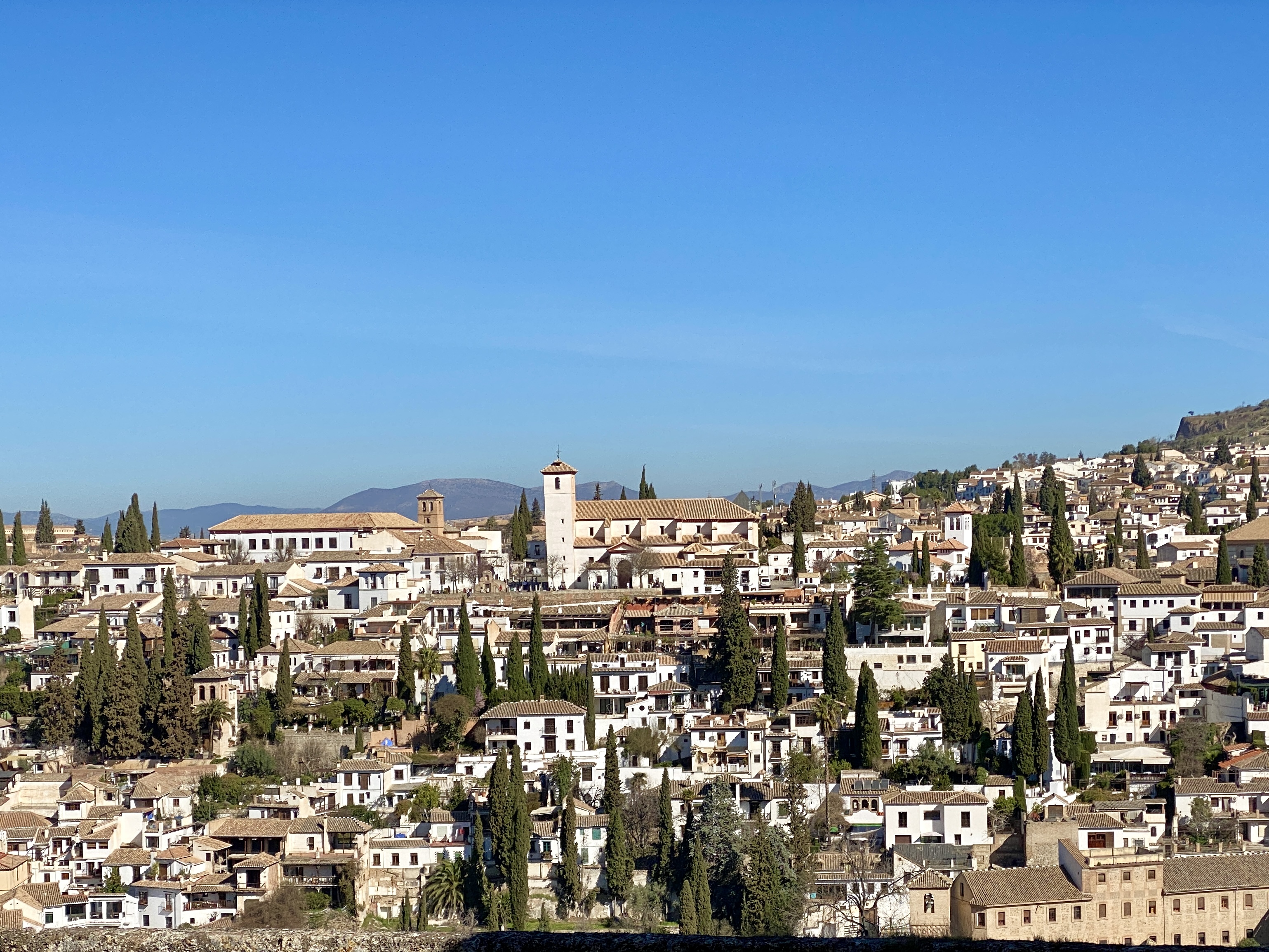
Hiking In The Dolomites: Day 2

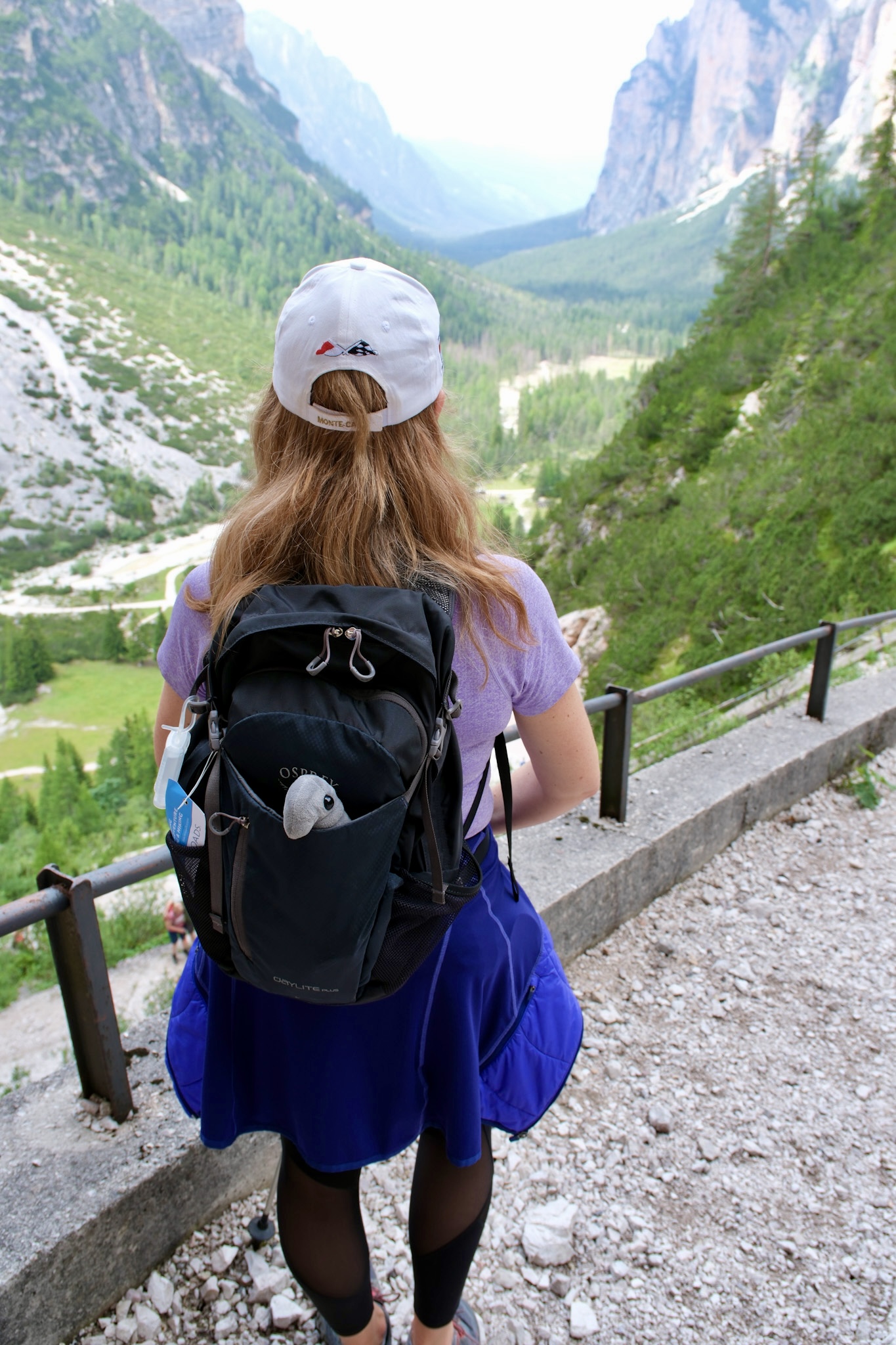
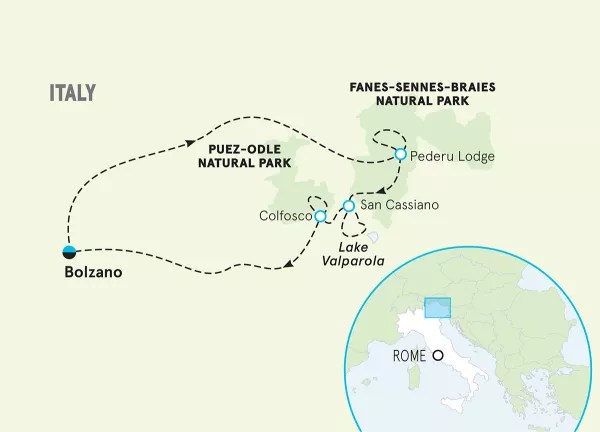
For our second day of hiking, our Backroads leaders had chosen the Sennes Loop, which would take us up 3000 feet in elevation. I had spied the road that would comprise the first part of our hike the night before, and I was already dreading the first part of the day. Still, I had breakfast to look forward to first, and breakfast on hiking days can be as indulgent as I want, right? Gotta have energy for the climb, I reasoned. So, after an Italian buffet breakfast of speck, cheese, fruit, and pastries accompanied by espresso, we were off. The road, which was unpaved and switchbacked its way up and over the valley, immediately became my Everest. It was steep. I am used to being the last one up a hill because I take medications that elevate my pulse rate, which means my heart often gets to racing more quickly in comparison with my fellow hikers. Steve was his usual gracious self, hanging with me each time I stopped and waited for my heart rate to drop again.

Although being the last person up used to make me feel bad about myself, I’ve learned to find the good in it. One of the best parts about being at the back of the pack on a trip like this one is you usually end up alone with a guide. Everywhere we travel, I find opportunities to have conversations, real, meaningful conversations, with people from the area we are visiting. The easiest way to do this is to take a tour and strike up conversations with the guide. On this day, we had Francesca and a naturalist named Lucia to walk with. Talking about southern Italian culture with Francesca, a native of Puglia, made my uphill battle less odious.

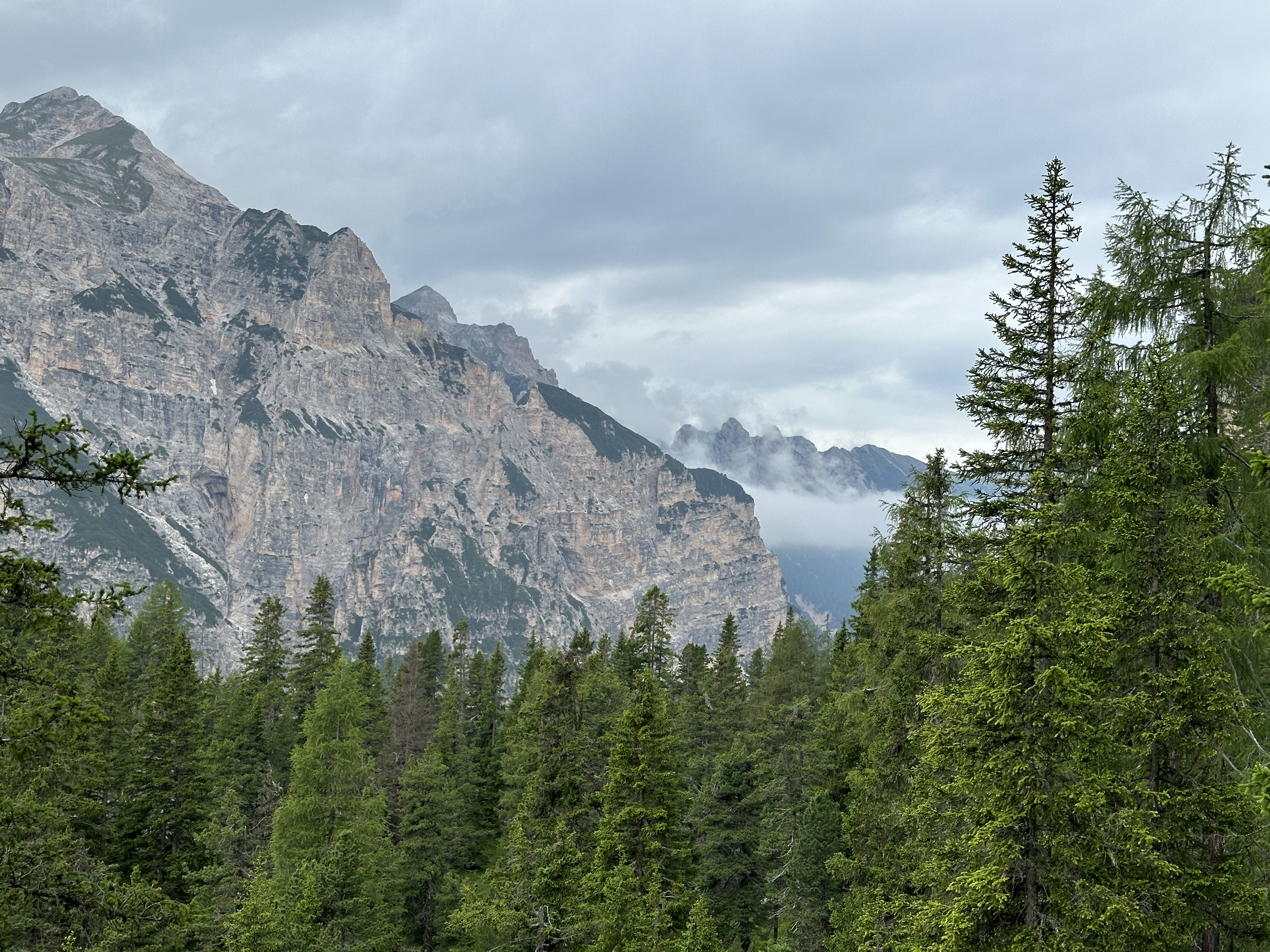
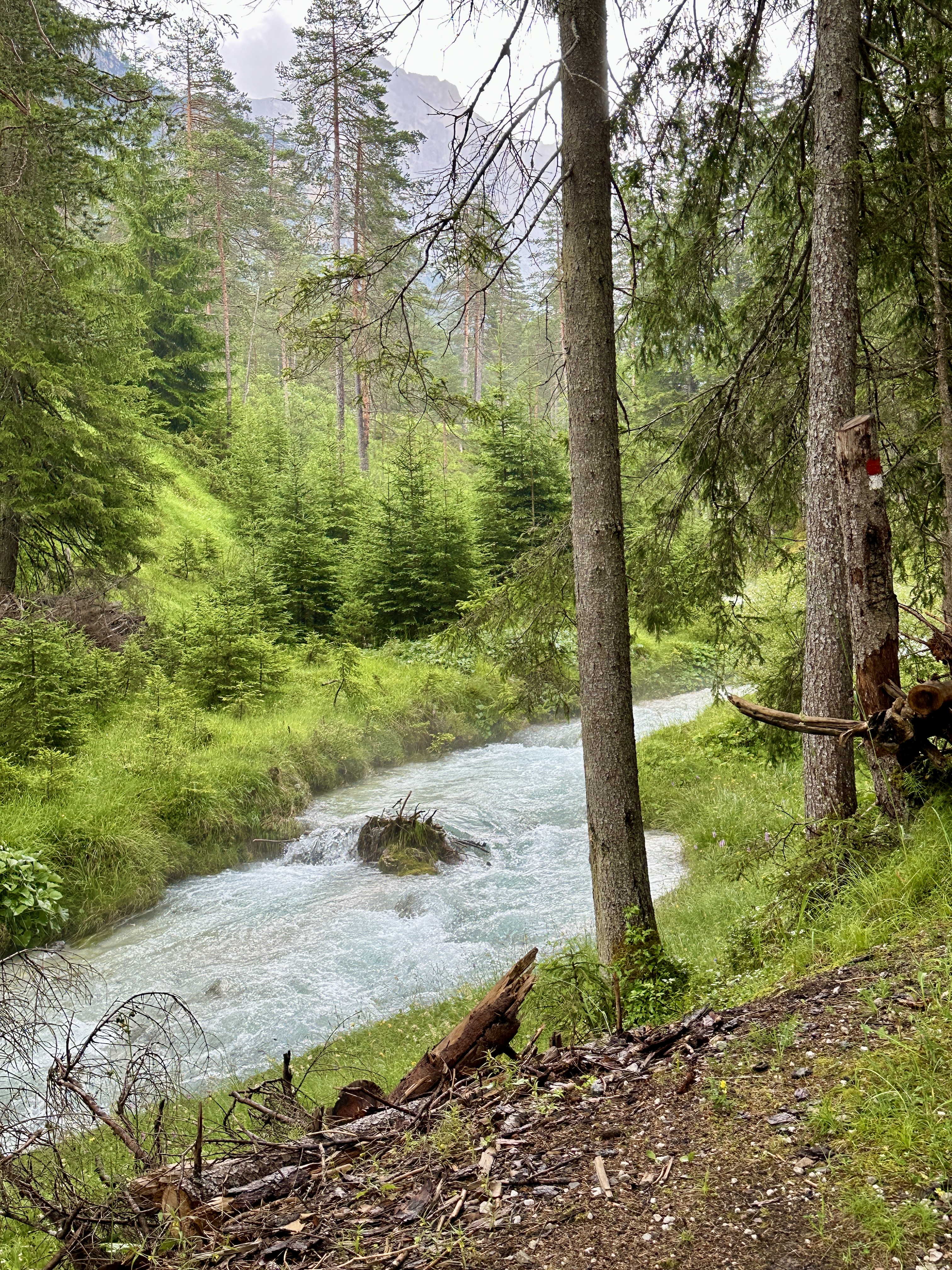
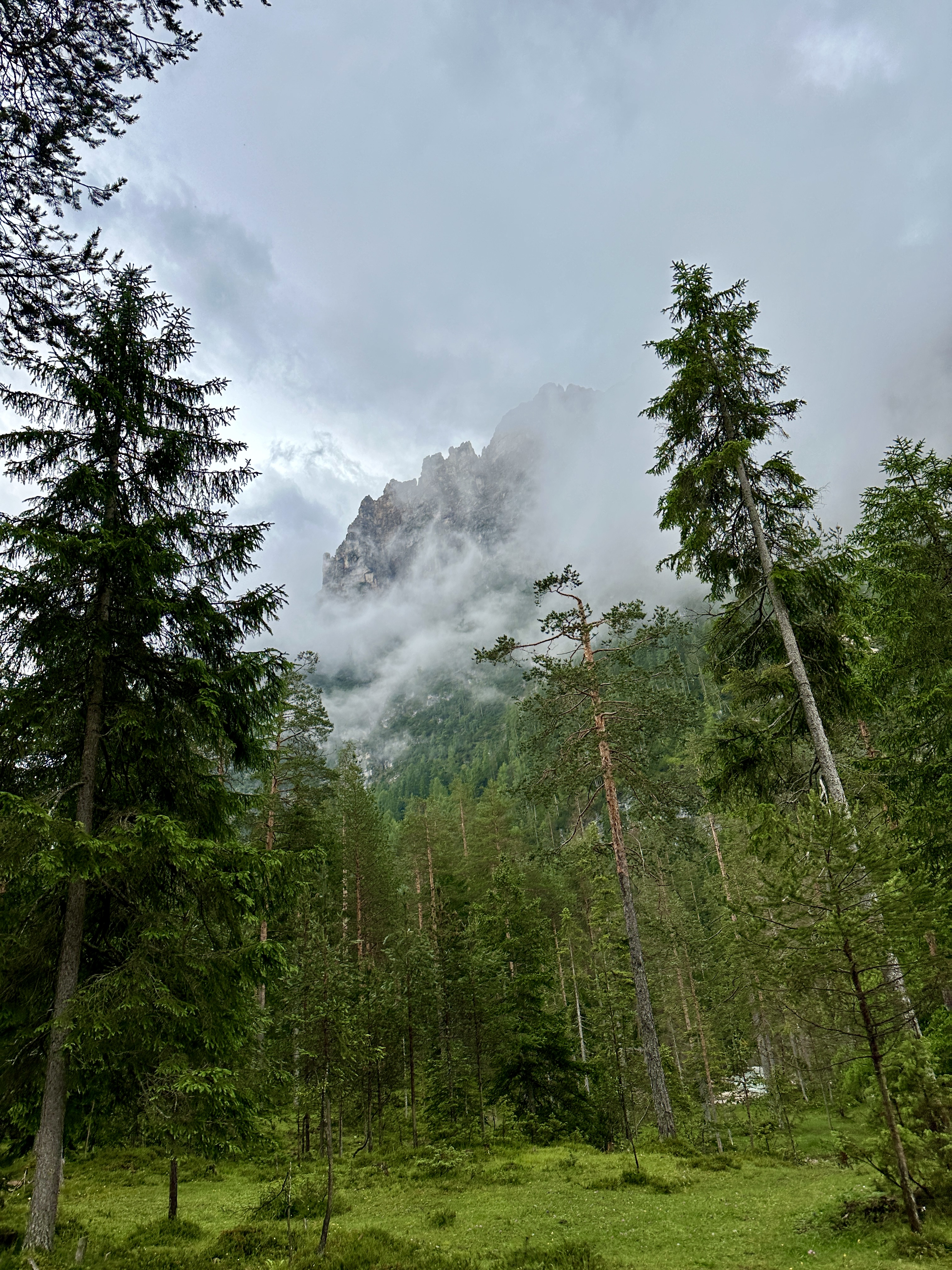
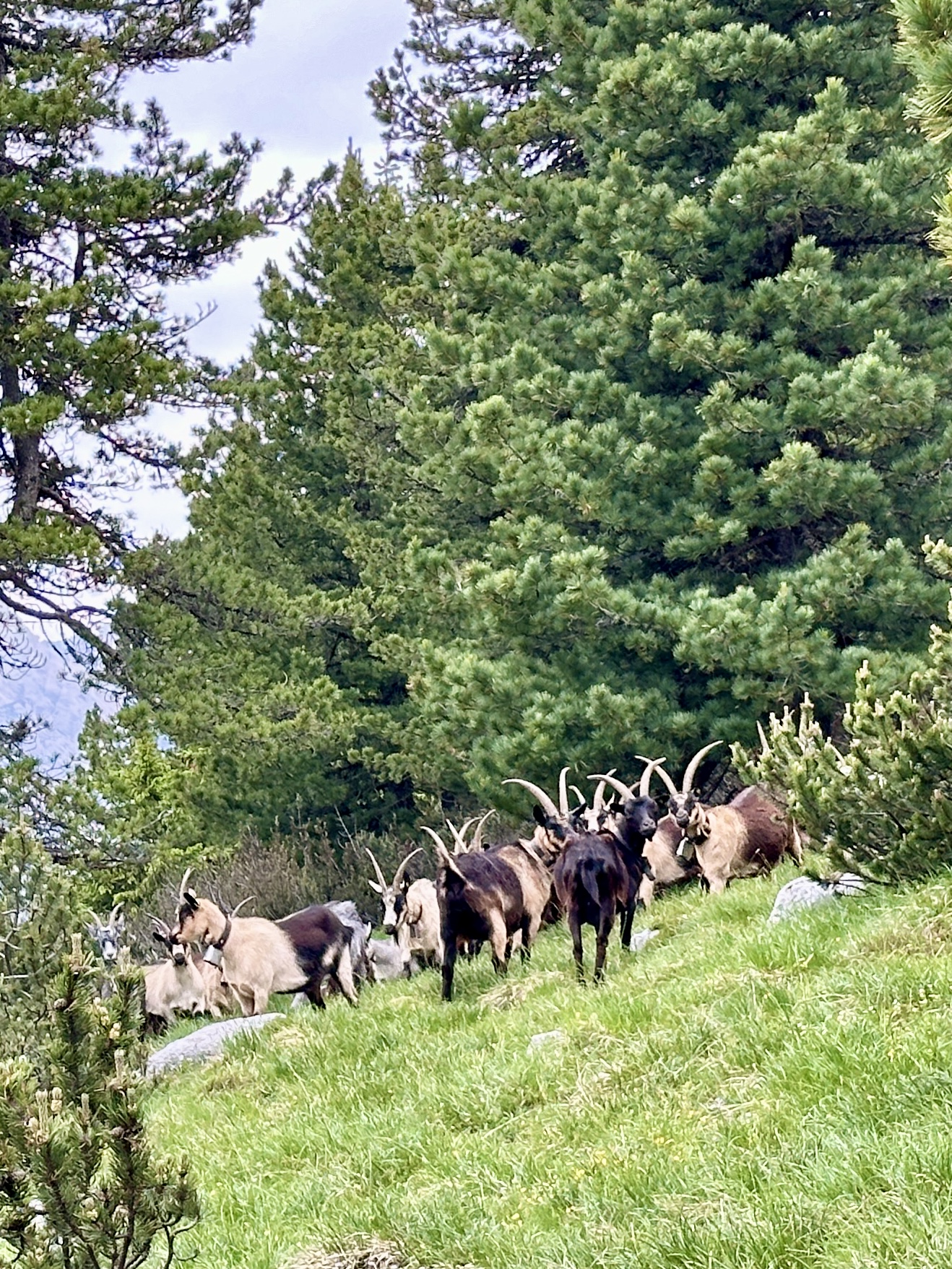
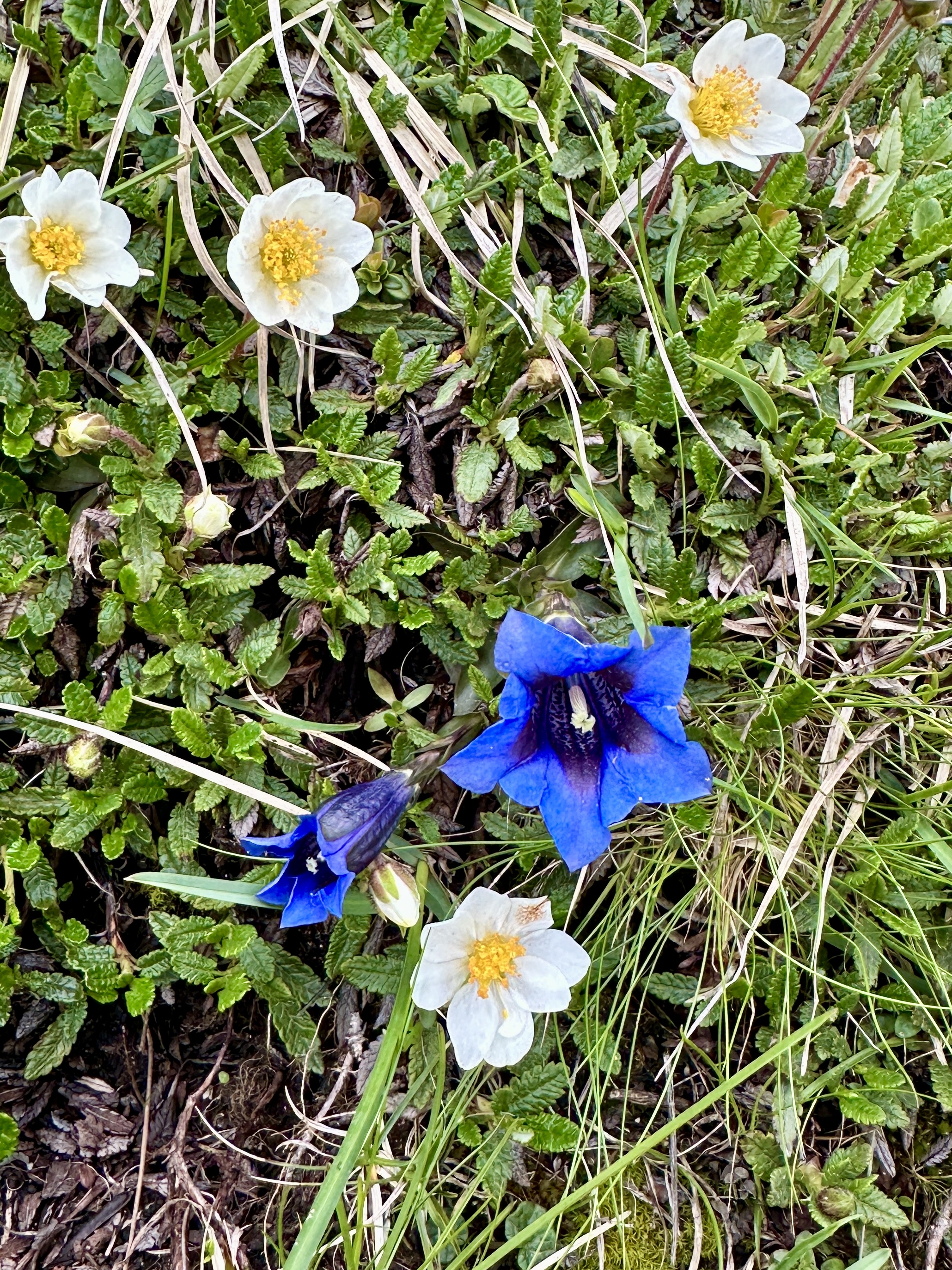
Once we got to the place where the road leveled off, we veered off onto a small path rather than continue along the road. We were taking the scenic route. It was cool and overcast, many of the peaks around us obscured by clouds. This pushed our focus to the green pastures and wildflowers. We walked along at a quicker pace now, trending upwards still and stopping to take photos as we went. We weren’t slowing anyone down, so why not enjoy? It wasn’t long before we heard bells ringing along the hillside. We were still below tree line, though, and I couldn’t see what was causing the racket. Then they appeared, a herd of goats with long, curved horns. They regarded us with some curiosity but no alarm, one following me up the path a bit before rejoining its amici on the grassy hill. I determined there is no hike more charming than one that includes animals wearing bells.
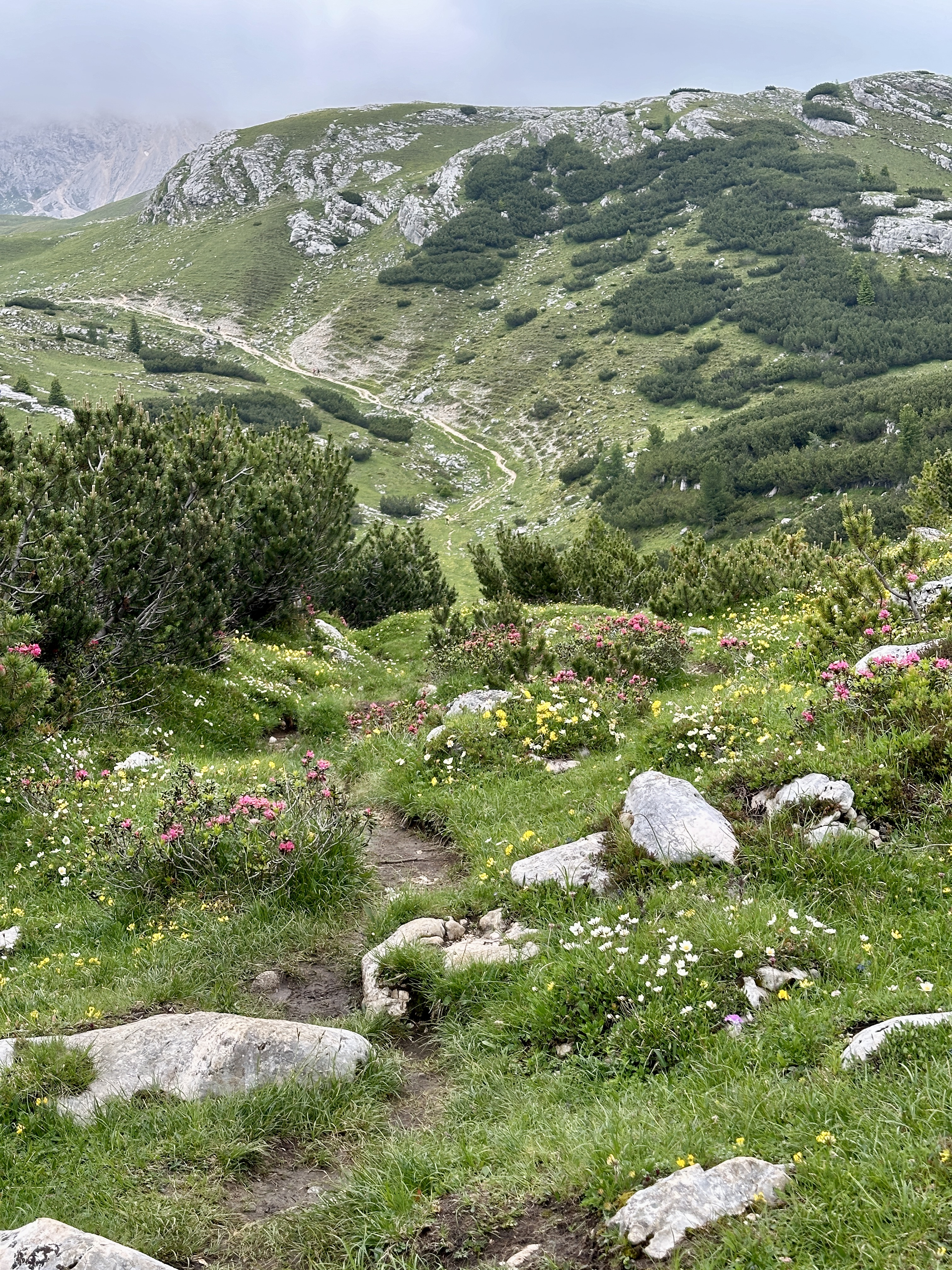
The path had become easier, and I was feeling confident about my chances of finishing this hike with zero problems. Then we came around a corner into a clearing and ahead of me I saw another damn hill. Yes. I knew I was in the Dolomites and there would inevitably be more hills. Francesca simply hadn’t warned me about this one which, in hindsight, was probably wiser. Ahead of us on the path, I could see some small dots, the rest of our group steadily making their way. This would be our last uphill I was told, and at the terminus of this section we would arrive at the Sennes hut where we would stop for lunch. I was all about lunch by this point, so I decided to attack that hill rather than saunter.
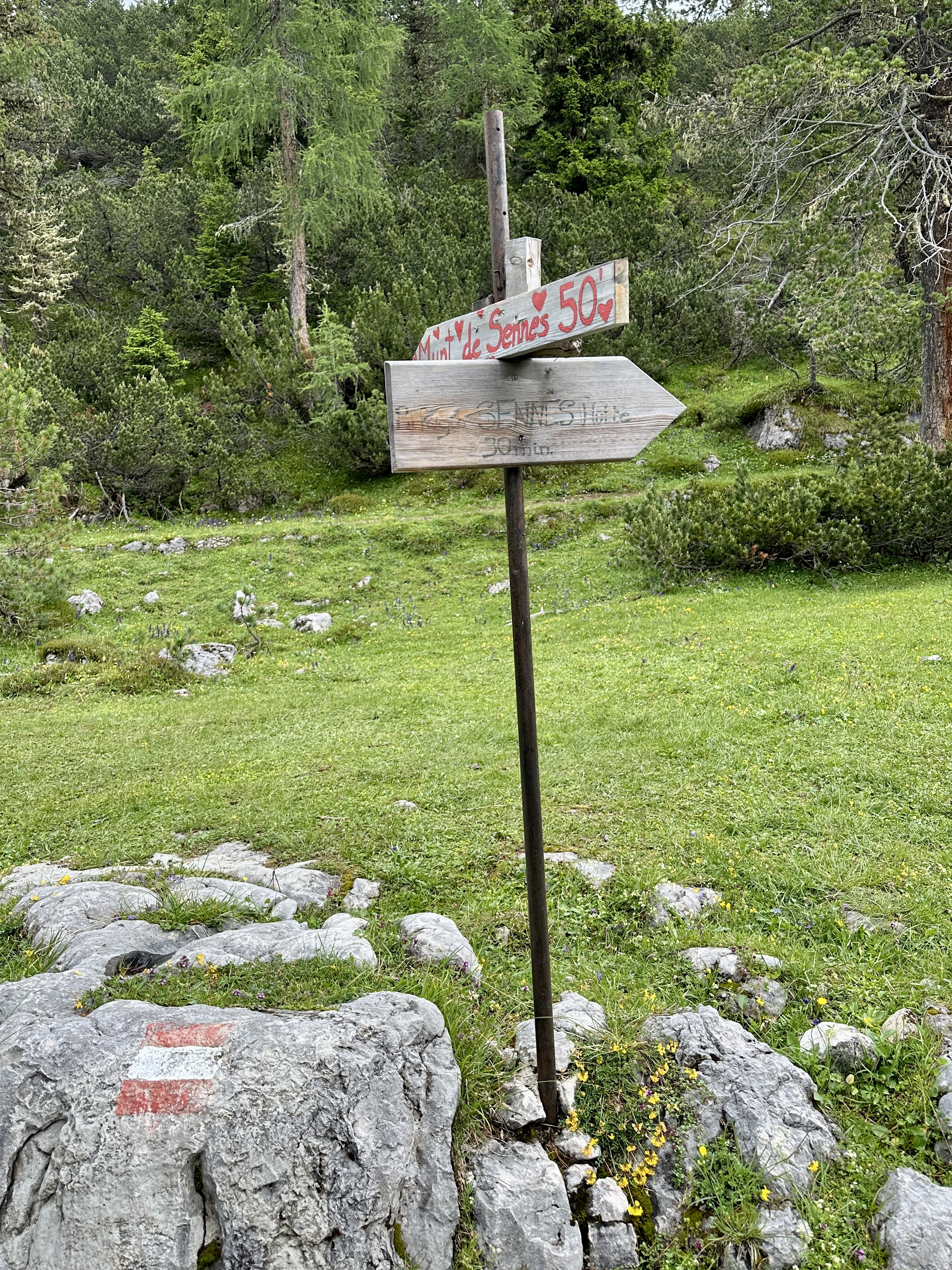
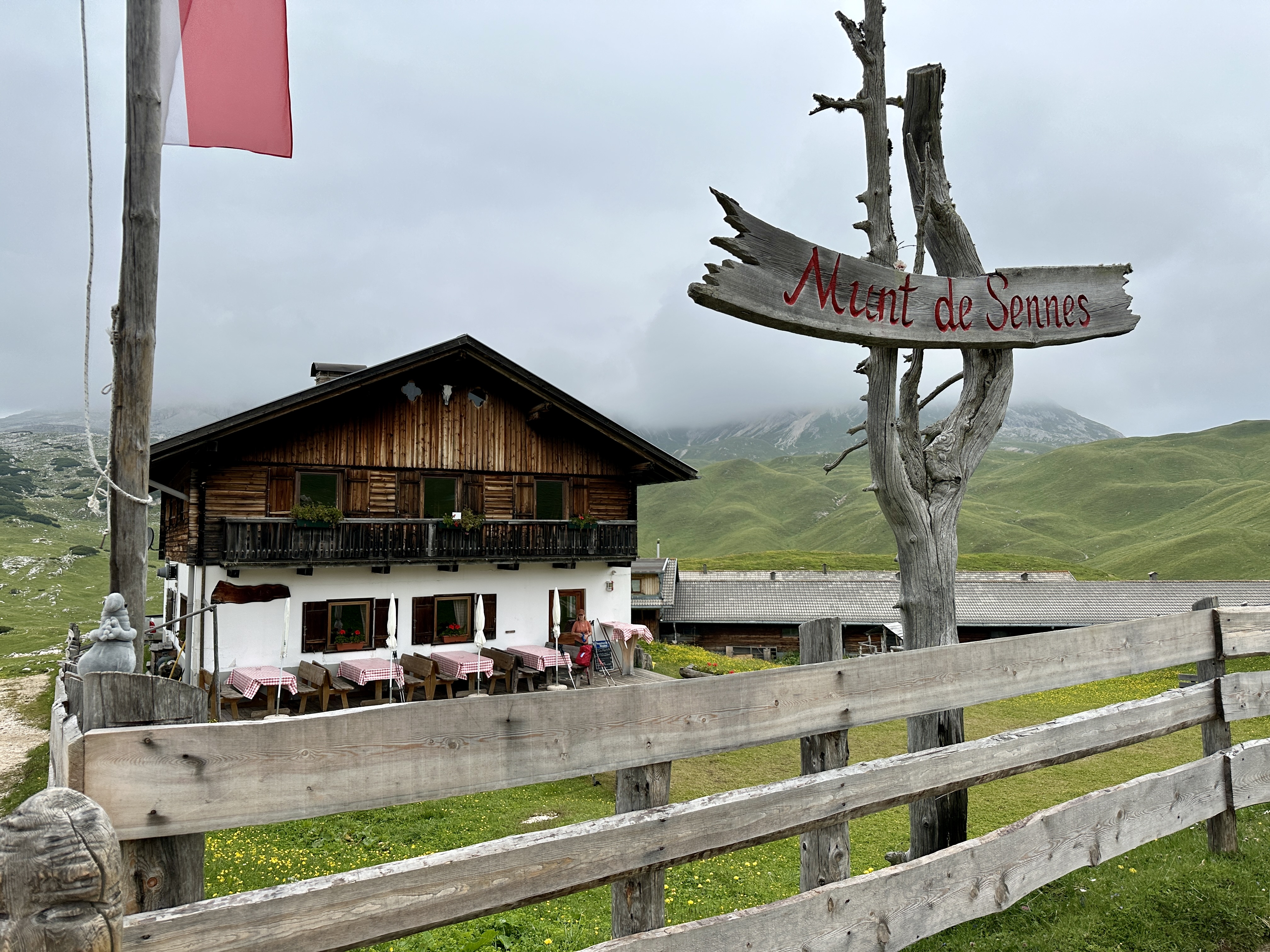
Near the top of the climb, Rifugio Munt de Sennes appeared around a corner. Hearty South Tyrolean fare loomed ahead, and I could not wait. Would it be another fabulous lunch feast with choices like beef goulash on polenta and fresh pasta with just-picked chanterelle mushrooms? Of course. We finished our meal with more strudel because vacation. I reflected for a moment about how hospitality is Italy’s gift to the world. I mean, here we were, hiking at 8000 feet, and continually happening upon establishments with comfortable rooms to rent, excellent dining options, and clean bathrooms with flushing toilets, in mountainous areas unreachable by car for part of the year due to snowpack. Damn, Italy. La bella vita, indeed.
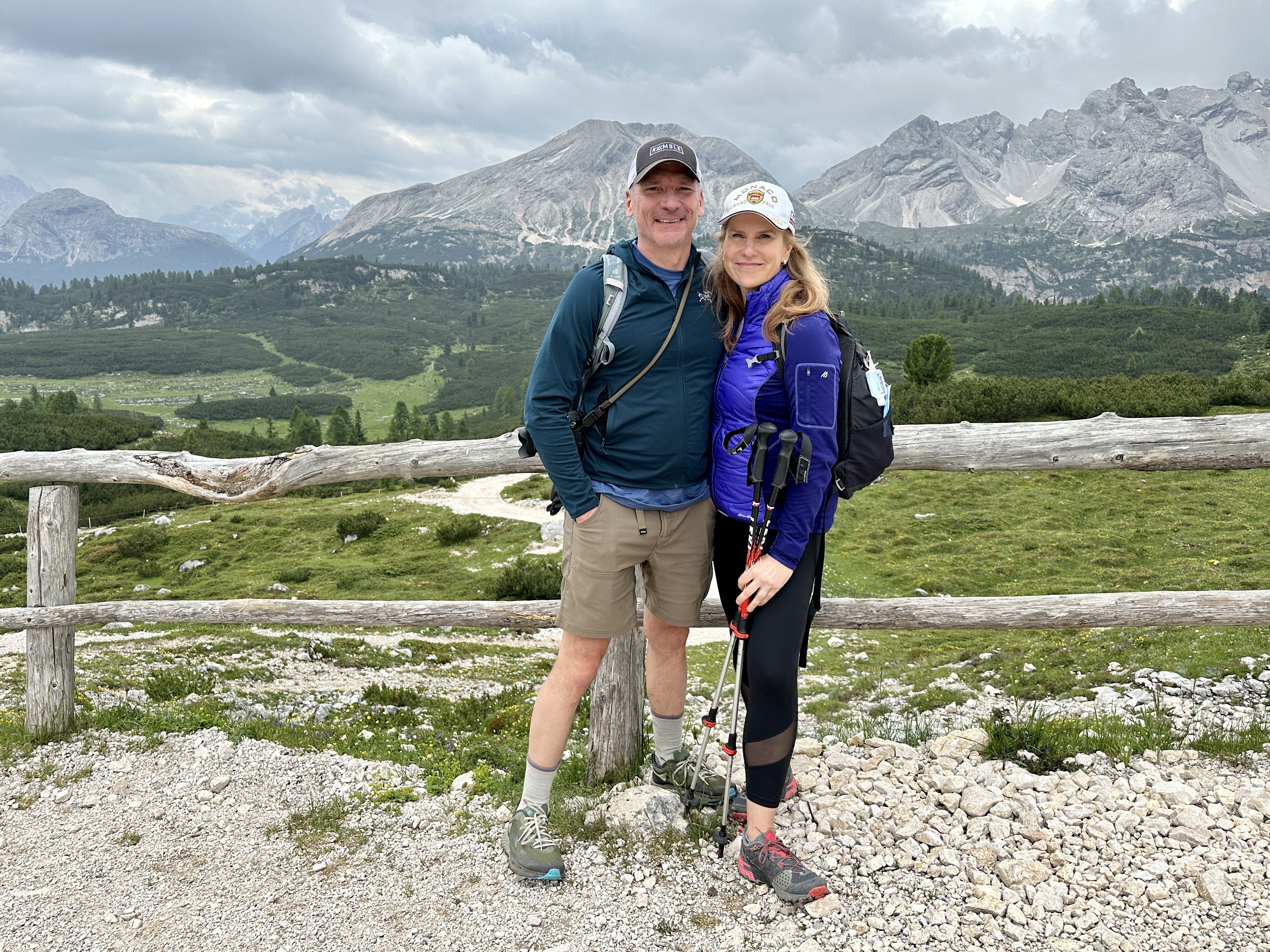
We left the hut and crested the hill just beyond it and were treated to a panoramic mountain view before we hit the descent to our overnight lodging. Lucia was with us for the afternoon, and she informed us about the political climate in Italy under far-right Prime Minister Meloni. She talked about peaceful student protests that had turned violent earlier in the year due to brutal police crackdowns on demonstrations. Lucia remarked it seemed eerily familiar to what she had learned about life under Mussolini. We discussed our mutual concerns regarding the slow but steady erosions of personal freedoms in our countries and what could be done to stem the creep of authoritarianism. It was a deep conversation for a serene day in the Dolomites, but it made the last few miles as much about education and global understanding as about exercise and nature.
When we finally reached our lodge, Petra told us we should soak our feet in the icy stream that ran in front of the hut. She said it was “medicine,” which would help us recover more quickly for the next day. So we dropped our packs in our room, donned flip flops, and padded our way to the stream. Certain my feet would thank me later, I braved the frigid water. I’m no stranger to just how cold a mountain stream can be, yet I was still surprised at how quickly I had to pull my feet out of that water and onto the dry gravel to regain feeling in my toes. Steve and I spent about 5 minutes there, making bets about who could hold their feet in the water the longest. Steve won. Those five minutes turned out to be about as difficult as my climb had been that morning,. They were also just as beneficial. I felt refreshed.
With our hiking chores done for the day, we went up to shower. Wine o’clock was calling, and we didn’t want to be late. The rifugio offered house wine on tap that was a meager €2.5 per generous glass. It would be a crime not to support this local business family by having a glass or two of house merlot before dinner, and then maybe another glass or two with dinner. Steve and I strive to be goodwill ambassadors for the U.S. while we are abroad. It’s a responsibility we take quite seriously.

Hiking In The Dolomites: Day 1

“Only where you have walked on foot have you really been.” ~Reinhold Messner

We’ve known for years that we wanted to visit Italy’s Dolomites. We’ve also known for years that we wanted to take an active trip with Backroads. Backroads, founded in 1979 and based in California, will conduct over 4500 guided trips in 2024, allowing travelers to cycle, hike, and kayak their way through stunning locales worldwide. The trips are not inexpensive, so we’d been dreaming of this for about a decade. When we learned our sons planned to stay in their college town in Washington for the summer, we realized we could use our usual 4-person trip budget on just the two of us and decided to splurge and turn our dream into a reality. With the destination chosen (we can’t seem to get sick of Italy), the next decision was whether we wanted to cycle or hike our way through the Dolomites. We settled on hiking and chose to do a “hut-to-hut” trip where we would traverse from valley to valley, up over mountain passes, getting a close-up, personal experience of nature rather than a whiz-by-on-a-bike experience of it. We made the right choice.

On this first morning, we met in the lobby of our designated hotel in our departure city, Bolzano/Bolzen, in South Tyrol, Italy, to begin our exploration of the northwest area of the Dolomites. The Dolomites have contained a blend of Italian and German cultures since the end of WWI when the area once held by Austria-Hungary was ceded to Italy. In Bolzano, approximately half the population speaks German as their native tongue, while the other half speaks Italian. Truth is, though, most people in the area speak both. Here you will find schnitzel, dumplings, and strudel on the menu aside polenta, risotto, and tiramisu. Best of both worlds, really. Our guides, an Italian, Francesca, and a Slovenian, Petra, gathered up the 15 of us, gave us a brief description of the day, and loaded us onto a bus that would drop us at our hiking trail. As we headed north out of Bolzano into the foothills of the Dolomites, the landscape began to change dramatically. The canyon walls got closer, the vegetation became more lush, and we encountered some light rain. We were dropped at the entrance to Fannes-Braies-Sennes, the Dolomites’ gorgeous nature park, a UNESCO World Heritage area. Backroads schleps your bags between lodgings, so we donned our rain jackets and small daypacks and began our adventure. We would hike 7 miles to our lodging, stopping for lunch midway.
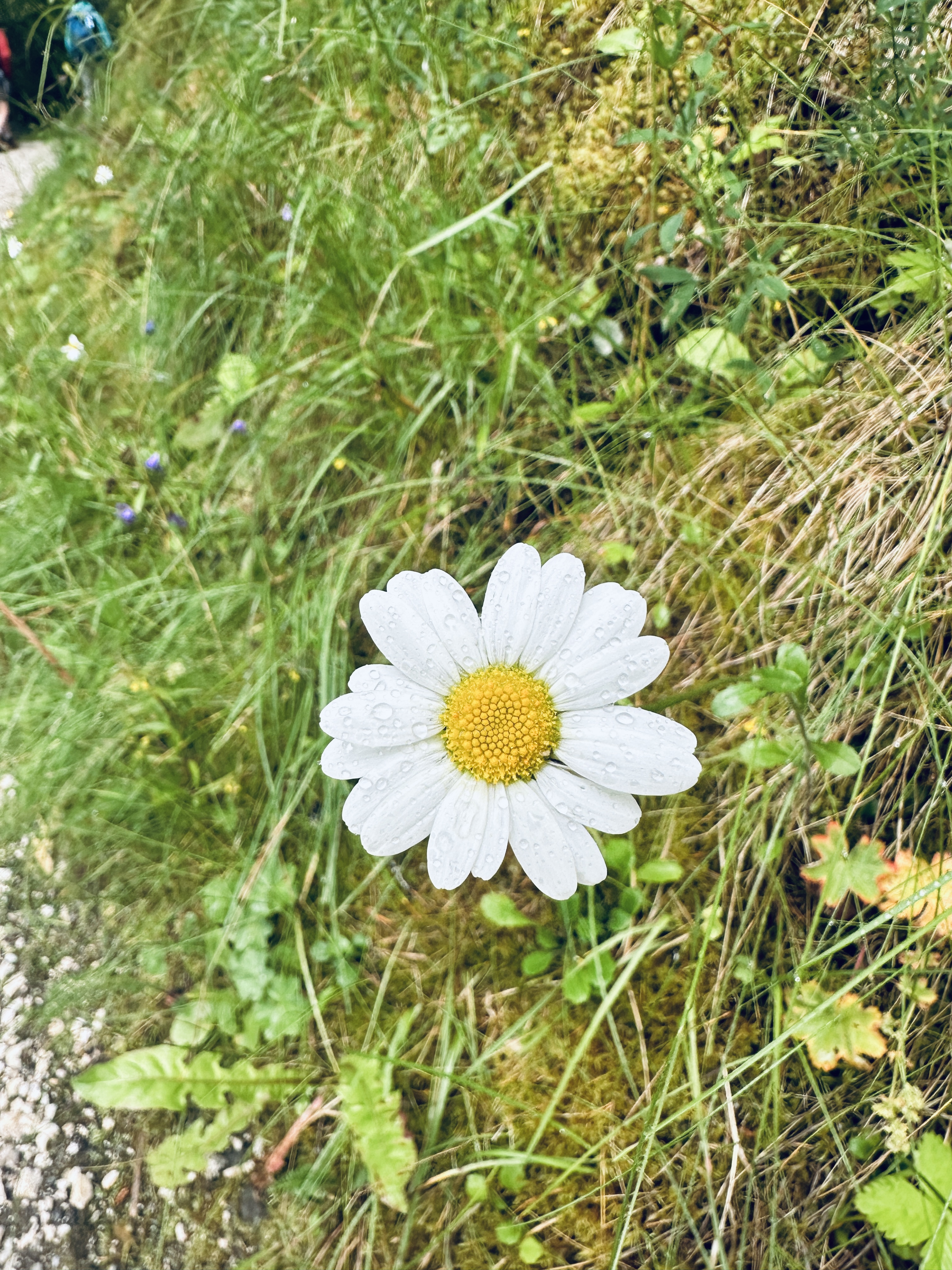
The rain fell lightly and we watched our footing, traversing cautiously over slippery tree roots and damp terrain. Wildflowers brightened the hike. We struck up easy conversations with our fellow travelers who hailed from across the U.S., from Washington to Vermont, Maine to Florida. We were hiking near a stream, under a canopy of tall pines, and the hike appeared to us like one we might do in our Colorado Rockies back home. The rain eased on and off repeatedly as we walked along. Soon we found ourselves at our lunch spot, set up outside a charming inn nestled in a cozy valley.

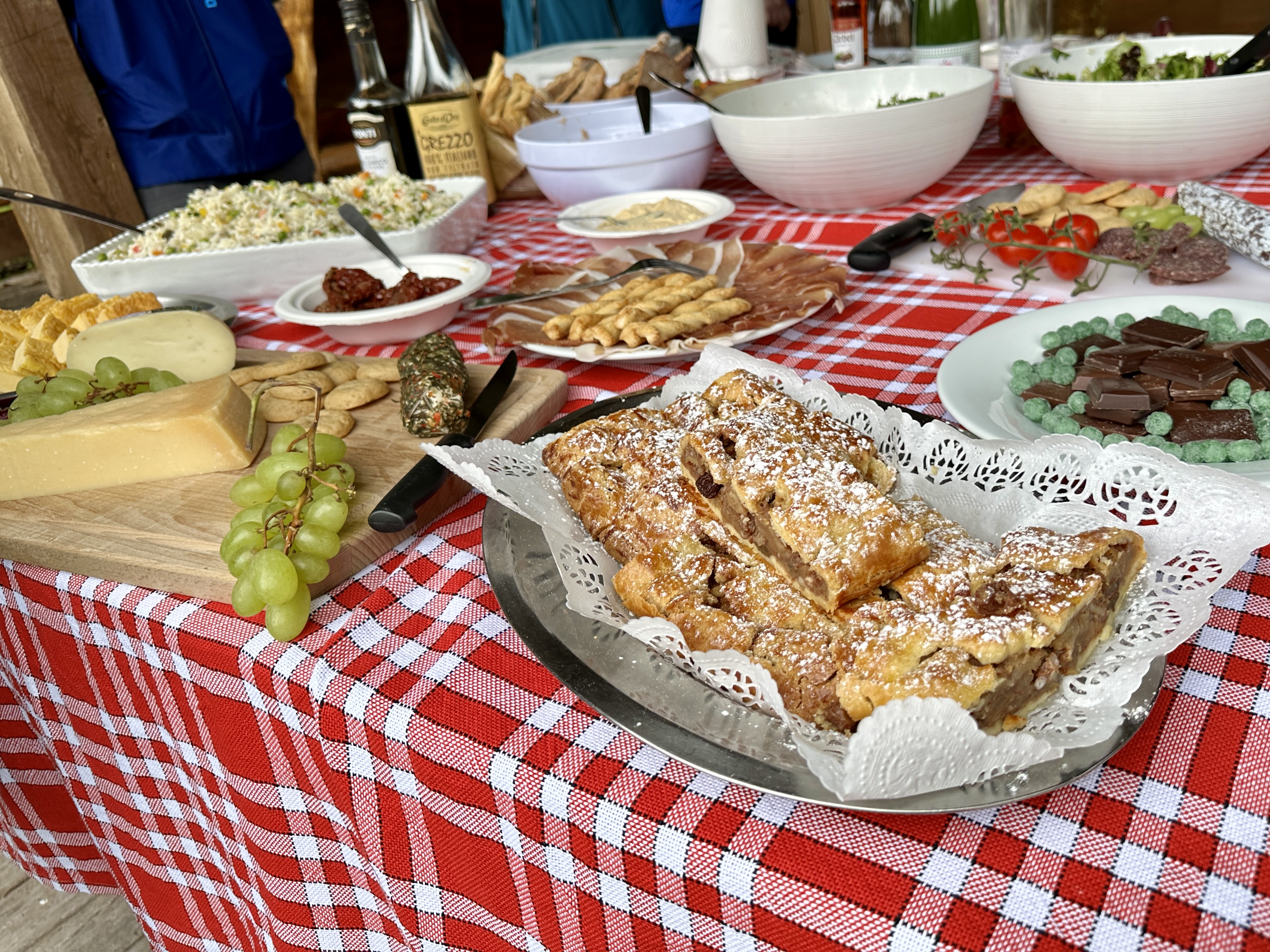
This was the first moment we experienced firsthand what Backroads does best. They spoil you. Waiting for us next to a small lake at the back of the inn was an elaborate picnic lunch set on two sheltered tables. The table was loaded with foods: sausage slices, cheese wedges, a variety of salads and breads, fresh fruit, and strudel. Petra told us it was our first strudel, not our last, and jokingly called our trip a strudel-to-strudel hike. Turns out she wasn’t kidding. So. Much. Strudel. While we ate, our guides shared with us a bit of information about the hearty Ladin people who live and work in the Dolomites and whose ancestors have resided there for thousands of years. Now a population of only about 30k, the Ladin people still employ their own, unique language and work to retain their cultural traditions and population by marrying within their community. These hardworking people maintain the land and the ski lifts and inns that dot the Dolomites. Their hospitality is gracious and efficient. Food is definitely their love language.

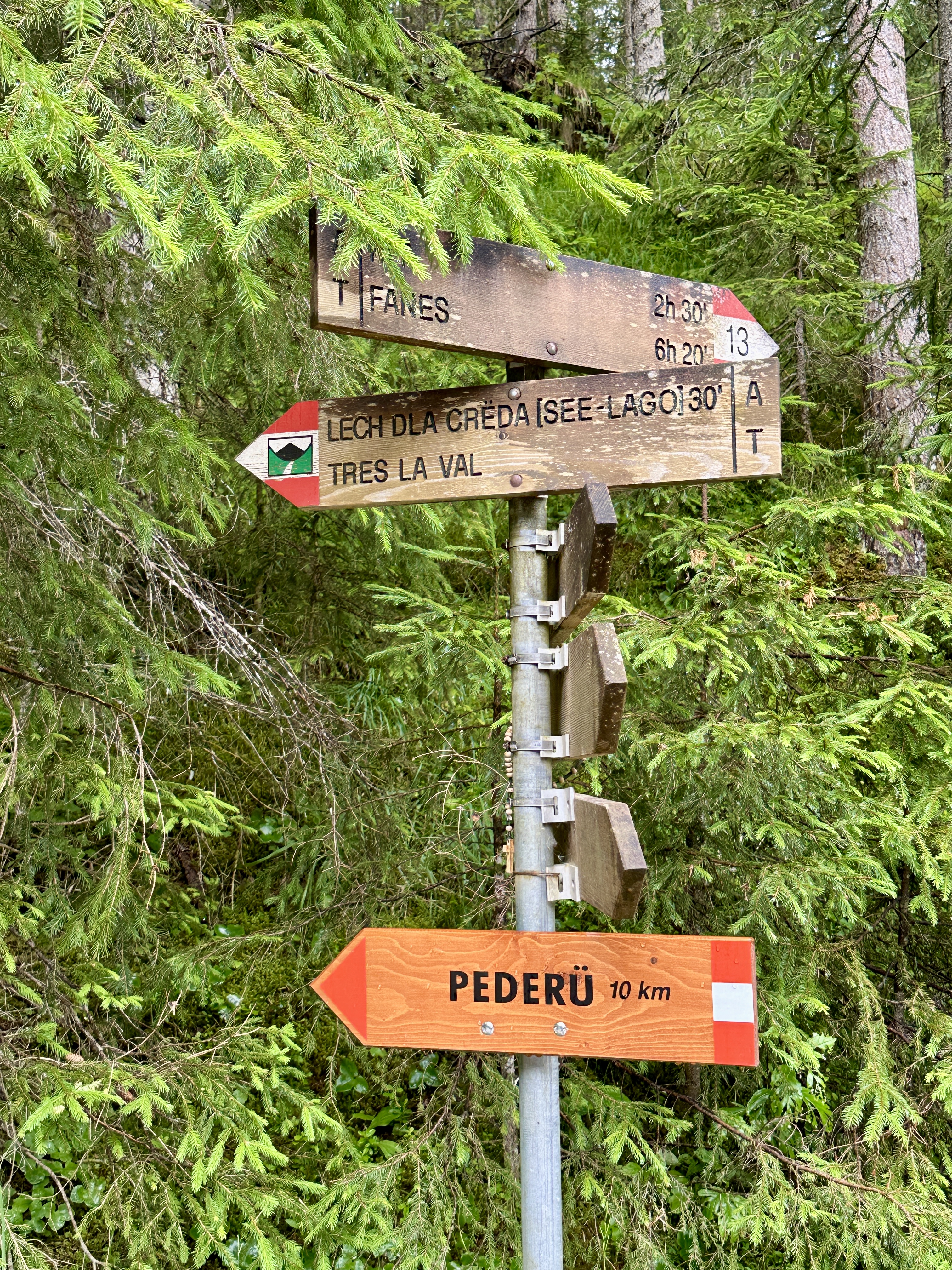
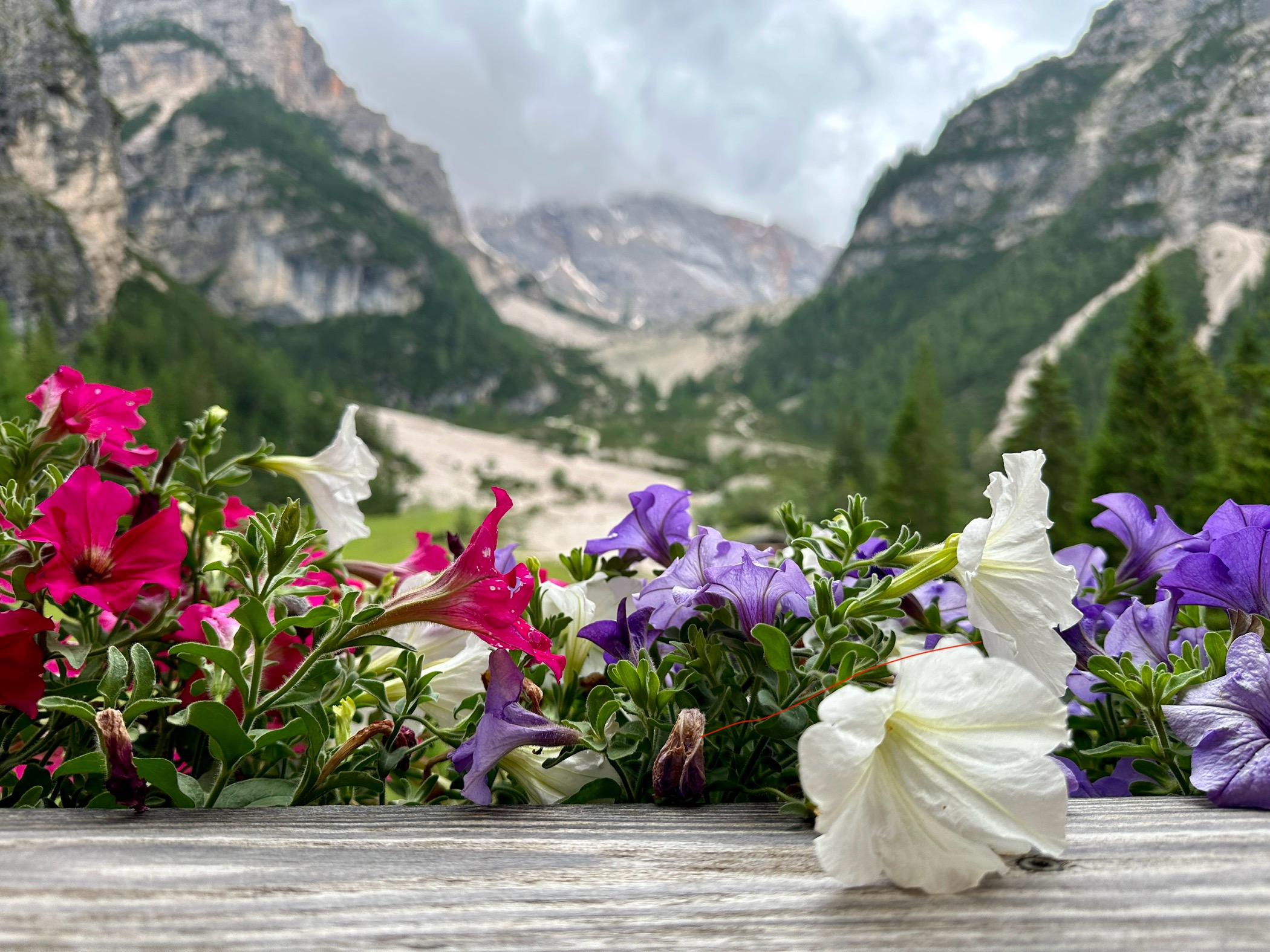
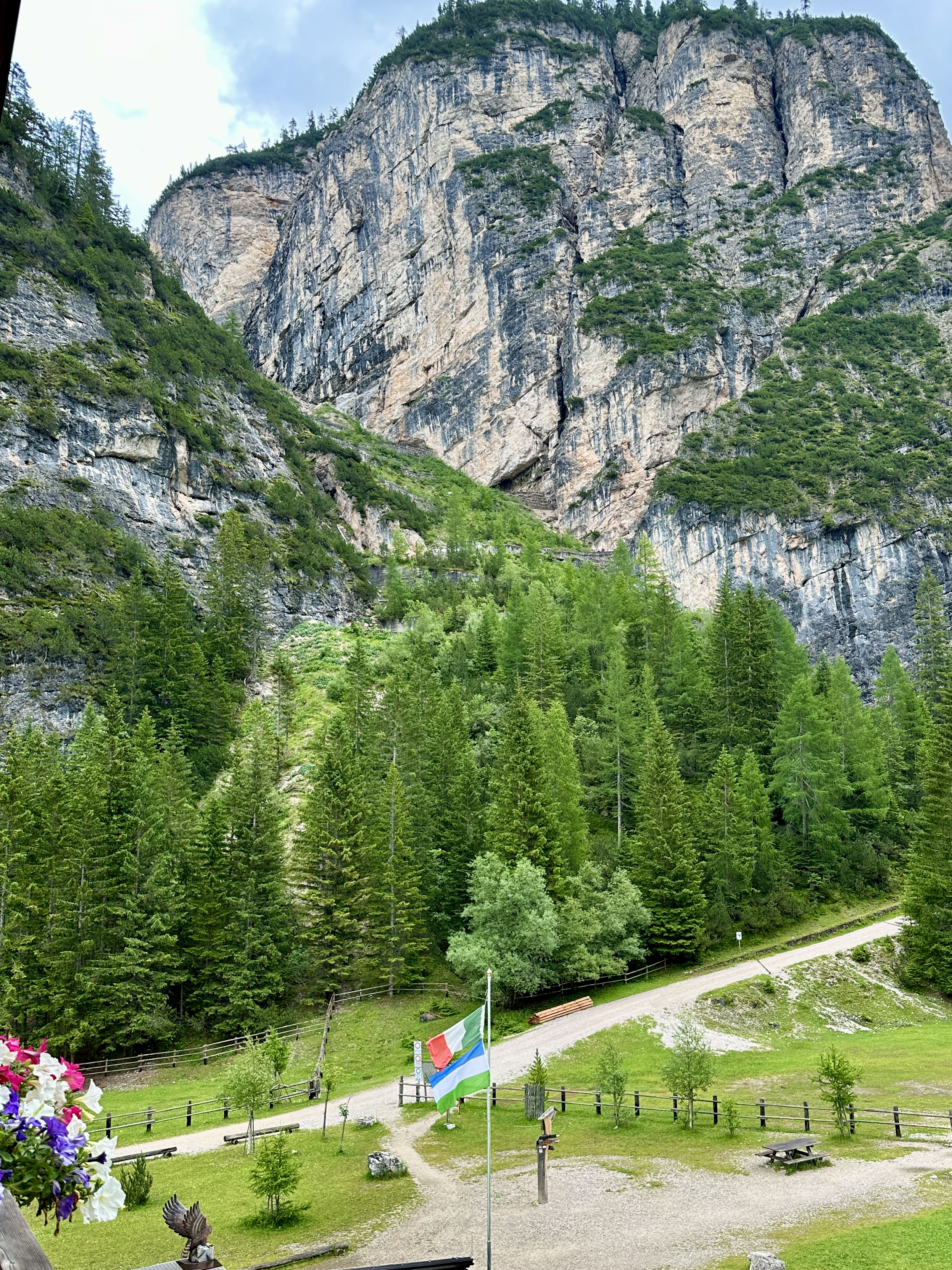
After we had polished off most of what had been presented, we picked up our hiking poles and set out again in the rain towards the Rifugio Pederü, our lodging for the next two nights. We were walking uphill, but it was a gradual climb and a perfect way to warm us up for the hiking that would follow the next two days. I was fully unprepared for the setting where we landed. The rifugio (Italian for “shelter”) was set at the back of a box canyon, which immediately made me a bit leery about how difficult our next hike might be. The only way out was up, way up. We settled into our room on the top floor (stairs are good practice for the climbing, right?) and opened the shutters to the most picturesque view from our balcony. We’d been told our lodging would become increasingly more impressive, but I was struggling to imagine how.

These “shelters” are rustic on the outside but well-equipped on the inside, so we helped ourselves to long, hot showers and headed down to dinner in the restaurant where we were treated to a welcome champagne cocktail and a menu as heavy as the one in a Cheesecake Factory. I’d recovered from my huge lunch on the hike and was so hungry by then I didn’t even bother to take a photo of my meal. Come to think of it, I didn’t return from our trip with many food photos at all. So at each meal I must have been too weak from hunger to lift my phone or too eager to wait. One thing about a Backroads adventure, there will be no lack of food or opportunity to earn it if that is your desire.

After dinner, we returned to our room and set out clothes for our early morning breakfast and departure. I’d spied our path out of the valley earlier in the evening and knew the next day was going to test me, so I checked off the accomplishment of Day One and mentally prepared myself for the challenge of the Day Two. So with the sun at last setting and the windows and drapes open, the fresh air of wild Italy filled our lungs and sent us off to sleep.

May These Memories Break Our Fall

“If there’s one thing I’ve learned in all my years, sometimes you gotta say ‘What the fuck,’ make your move.” ~Risky Business

On the 2nd of January, I said “What the fuck, make your move” and clicked Purchase on two resale seats for an Amsterdam date on Taylor Swift’s Eras Tour. Buying resale concert tickets can be risky business, indeed, but missing this record-breaking concert event would be something I would regret, I told myself. I have grown to loathe feeling regret and avoid it when possible. So, I sold my soul to the demon I despise and paid StubHub a ludicrous sum, rationalizing I had no other choice. It was a personal imperative. For the past few years, Taylor Swift had been propping me up as I dealt with a lot of real life shit. The Tortured Poets Department became the final rung on my climb to catharsis. This concert was going to be a full-circle moment in part of my life’s journey, the launching pad for the next phase of my life.

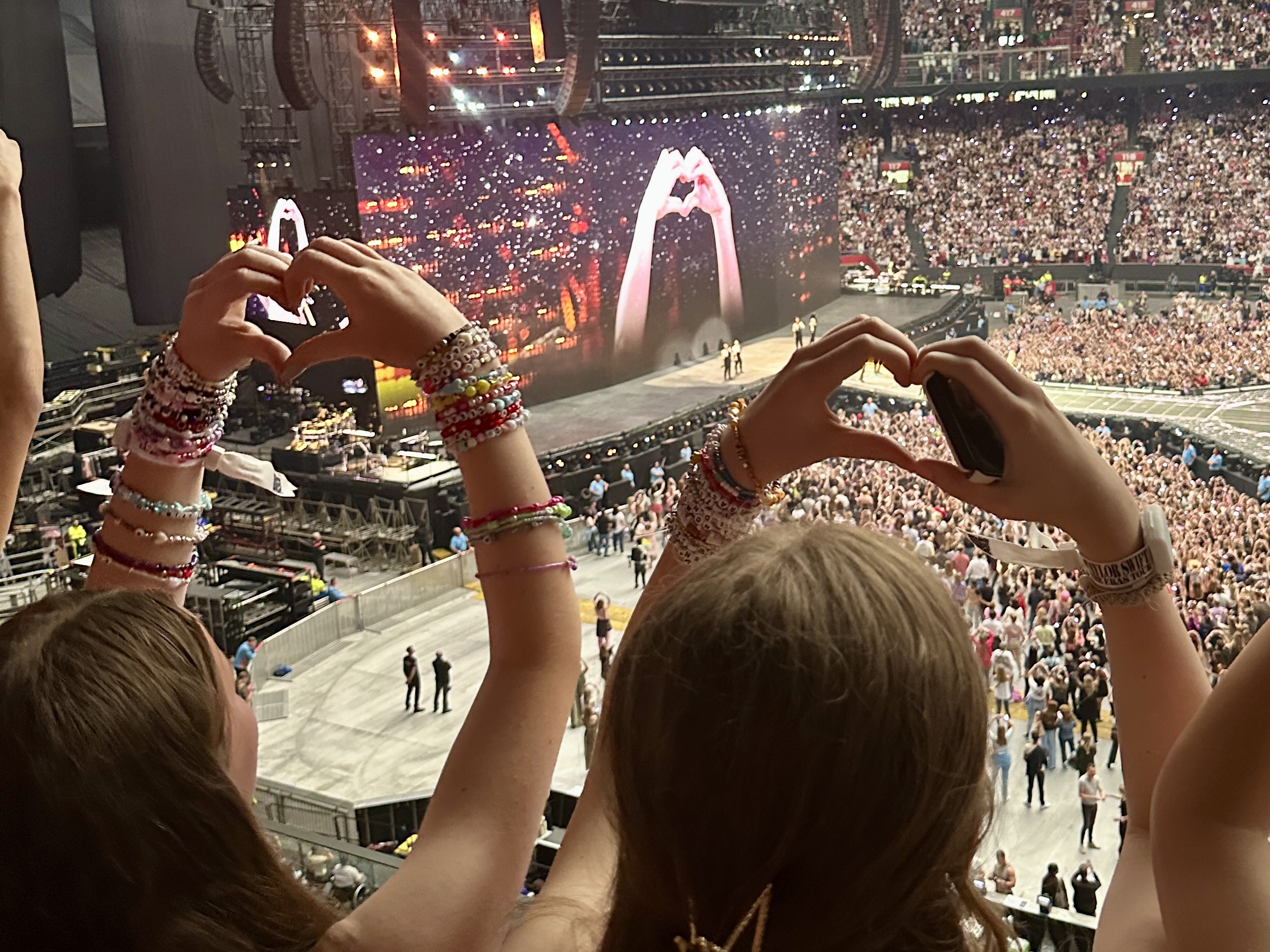
In the months leading up to our tour date, we told our dirty little secret only to a select few because you never know if you’re actually getting inside a concert with a second-hand ticket. As I stood at our kitchen island making friendship bracelets and changing my mind umpteen times about which era I would choose for my concert attire, in the back of my mind the nagging thought we might not gain entrance at all swirled. I made my peace with the notion of listening to what we could hear from outside Johan Cruijff Arena and being grateful to be part of the tour in whatever small way we could, all while quietly reassuring myself seeing this concert live was a destiny that would be fulfilled.

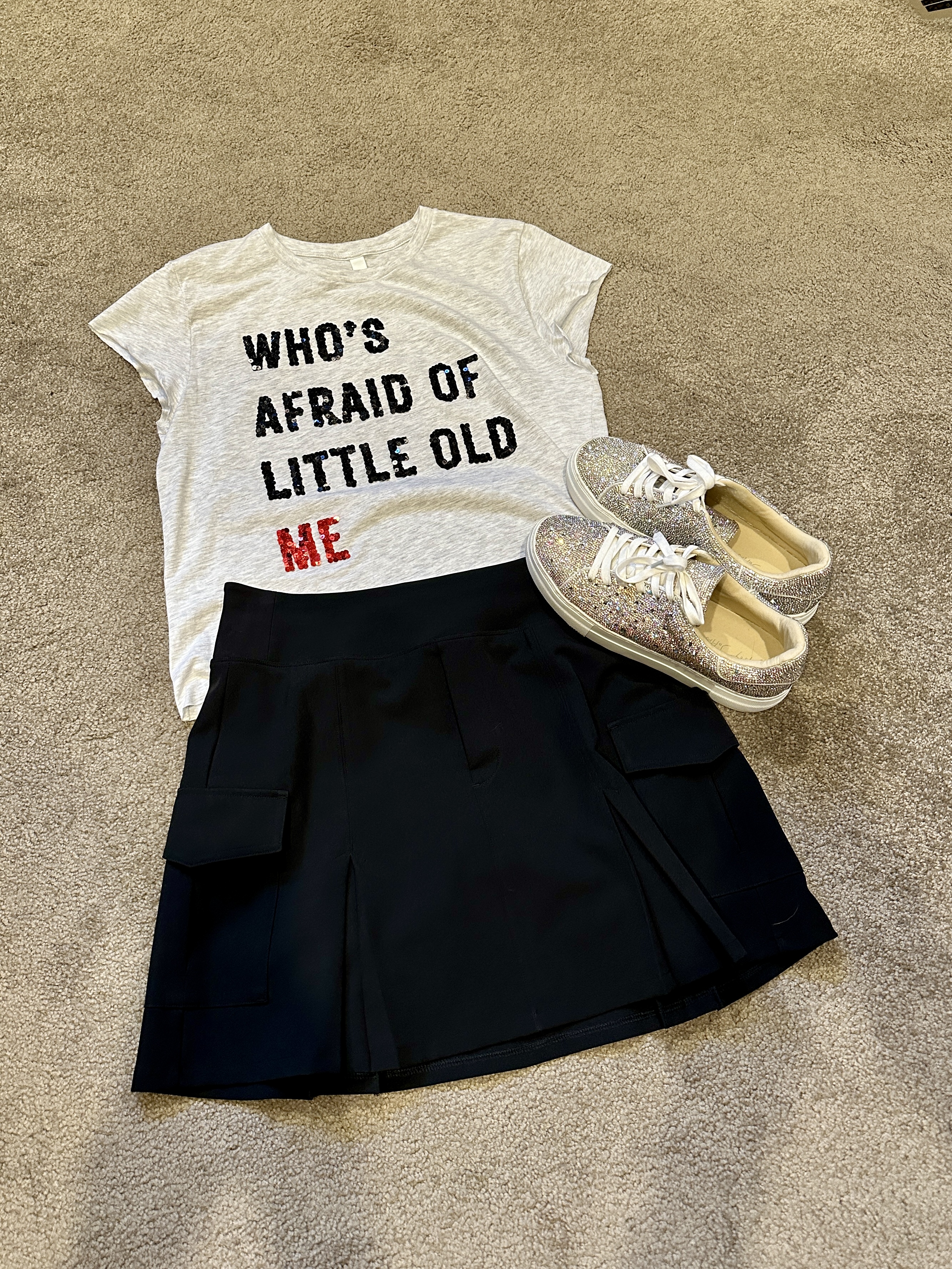
At 5:30 pm on July 5th, wearing a black skirt, a “Who’s Afraid of Little Old Me” sequined t-shirt, and rhinestone sneakers, I crossed my fingers, scanned my ticket, and pushed through the turnstiles of Ajax Arena. Steve and I seeped into a throng of Swifties inside. I breathed a deep sigh of relief and looked around. It was perhaps the most gentle and respectful crowd that arena has yet seen, fans politely inching past each other towards their designated spots. I’d chosen seats in the lower part of the upper deck close to the midpoint of Taylor’s massive stage. On one side of us were the New York City Gen Z’s from whom I’d bought our tickets and on the other side was a Belgian couple in their forties with their two teenage daughters. We exchanged some bracelets and easy conversation. Paramore, the opening act for the European leg of the tour, did their best to work the stage and warm us up for Taylor, but not a being in the place needed warming for Taylor. We were ready for it.

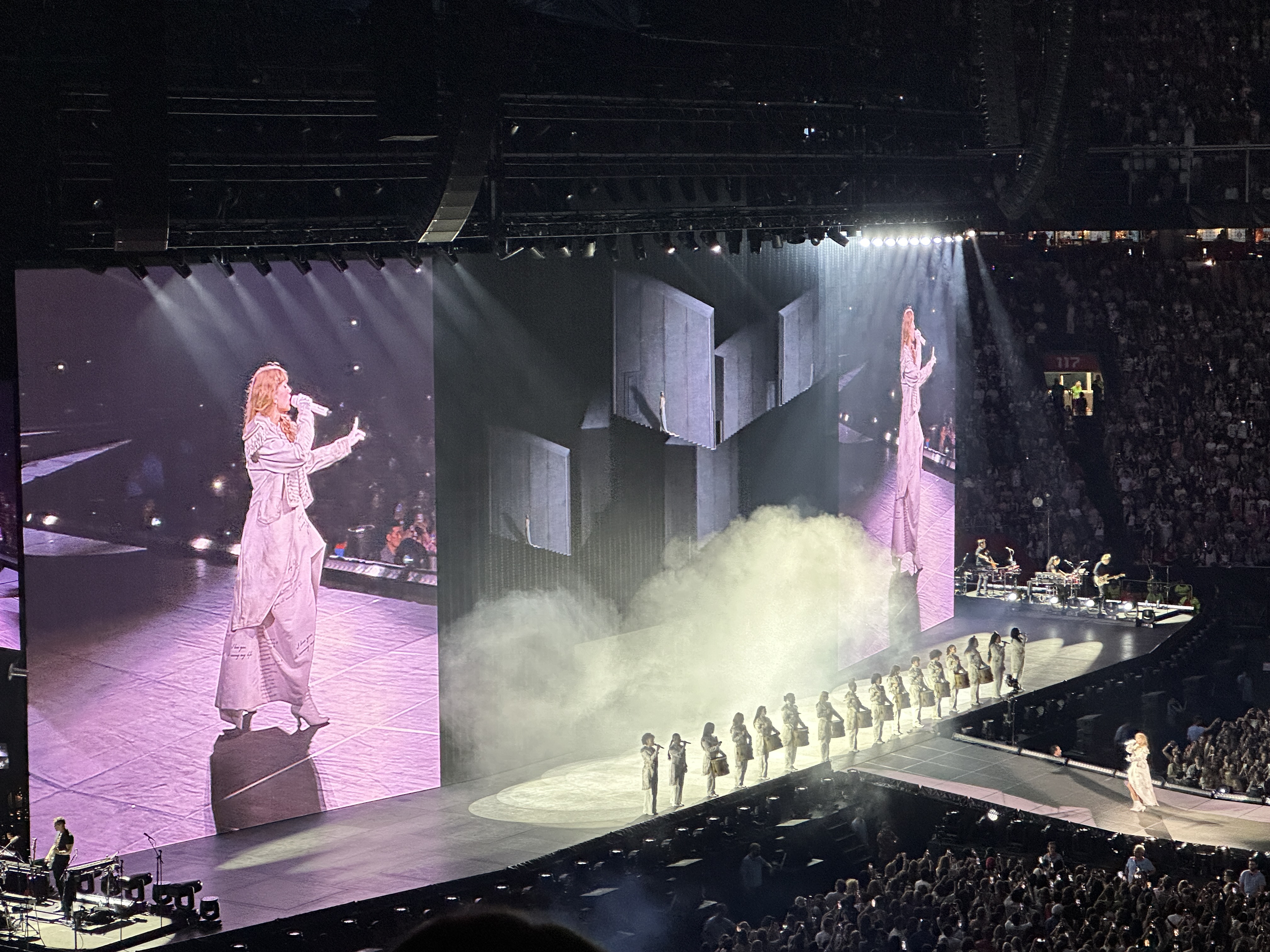
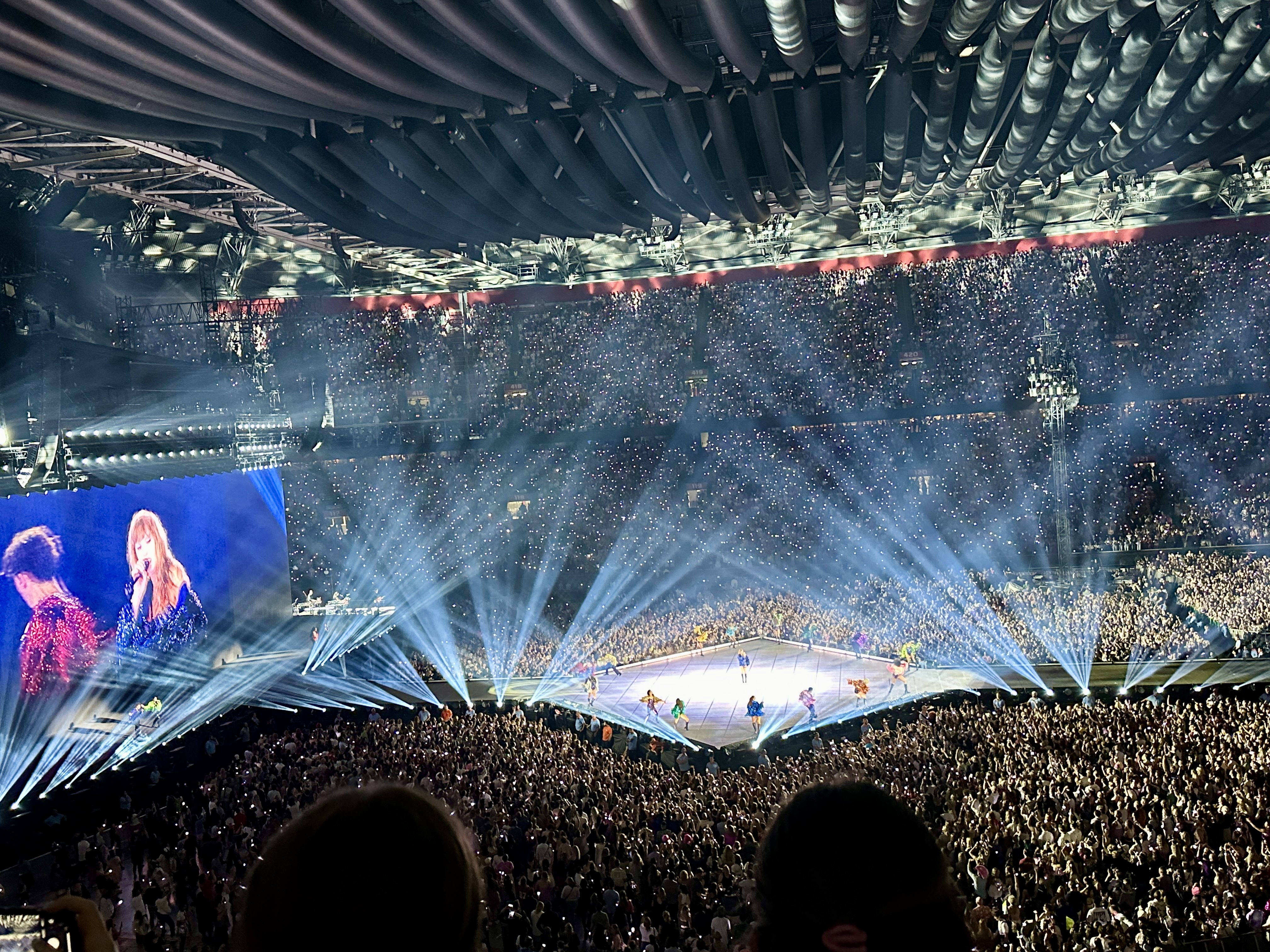
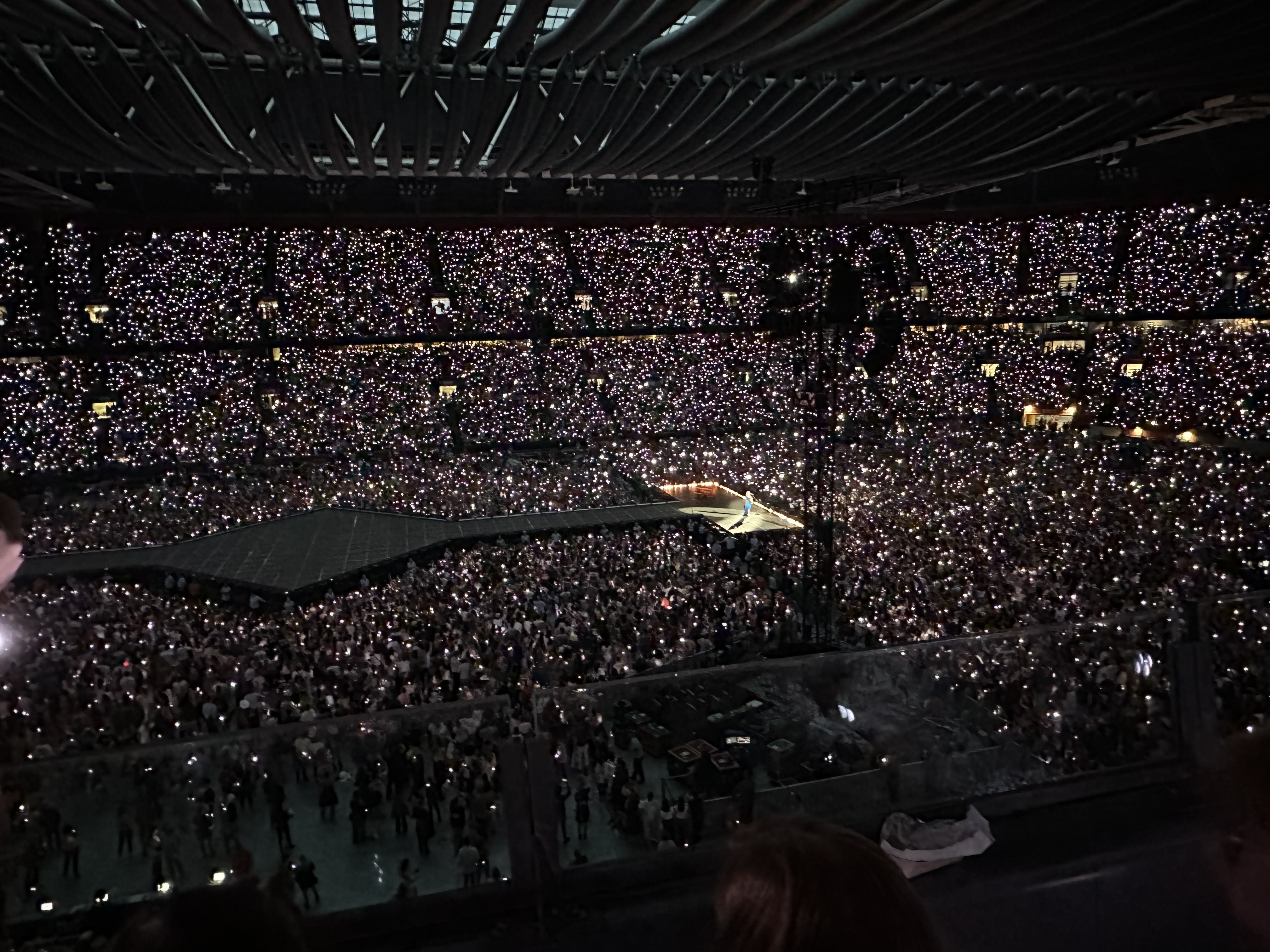
The clock appeared on the massive screen that ran the length of the stage. When it hit 13, the crowd began counting down aloud. I got goosebumps. The dancers appeared with their pastel parachutes undulating like flower petals in a breeze until they eventually settled into their spots, bent down, and allowed the fabric to carpet the floor. When the dancers stood again and revealed Taylor among them like Venus in the shell in Botticelli’s famous painting, the crowd roared. I teared up. I told myself I wouldn’t cry, but I was really there. This was really happening. I took a minute to survey the arena. Fifty-five thousand Swifties in all their Eras glory, singing along to “Miss Americana and the Heartbreak Prince.” I was enchanted. “Here we go,” I told myself as I settled in for the three-plus story hours of love, heartbreak, drama, revenge, and redemption. I reveled in every minute of the show, taking care to be present by limiting my desire to record the moments on my phone. When the crowd began jumping to “You Belong With Me,” you bet your ass I jumped too. Well rehearsed, I shouted along during the fan participation parts, yelling “one, two, three, let’s go, bitch” during a break in the intro to “Delicate” and inserting my triple claps in “Shake It Off.” When Taylor got to the acoustic set, I allowed myself a moment to record the crowd. I said, “Remember this moment” in the back of my mind. And when she’d reached her last song and the band played the first notes of “Karma,” I gave up and let the emotion roll over me. The night had been timeless, but it caught up and it was time to grab our souvenir merch and head to the exit. So I closed the chapter on this era and stepped outside and into my next era.

It’s been 27 days since our Amsterdam concert, and I’ve been struggling for all 27 of those days trying to decide what to write about it in this post. The Eras tour has a film. When it wraps, it will have been seen in person by a staggering 10 million people, give or take. It has been reviewed innumerable times and myriad ways by Swifties, celebrities, bloggers, and publications. YouTube has countless videos of the show. Taylor Swift made the cover of Time with her ragdoll cat, Benjamin Button because of this tour. There is little I can say about it to add to what already exists in the world. There is no way to encapsulate the experience of standing among tens of thousands of fellow fans, belting out every word to every song, and vibing with strangers you’ll never meet whom you know somehow understand a part of you even some of your closest friends don’t get. It was worth every penny we spent, and I’d spend them all again. Taylor’s Eras Tour story will end in Vancouver on December 8th, and I will forever be grateful that as a middle aged, relatively new Swiftie I decided to ignore the haters and give myself the opportunity to be part of it. Life’s short, people. So, as Taylor says, “Make the friendship bracelets. Take the moment and taste it. You’ve got no reason to be afraid.” After all, taking a risk is only risky business until it pays off.

“Hold on to spinning around, confetti falls to the ground, may these memories break our fall.” ~Taylor Swift

Cinque Terre: Hiking From Manarola To Vernazza

Our second full day in the Cinque Terre was earmarked for hiking. Our group was split on the routes. Because Julie and Alec were leaving for Rome the next day, they planned to hike from Monterosso back to Manarola. I had zero interest in a hike that long, so Steve and I opted for a hike to the town just to the north, Corniglia. The Blue Path, which requires a Cinque Terre hiking pass, is the easiest route to Corniglia. It’s a 1.5 mile hike with 428 feet of elevation gain. Sadly, that route has been closed for years due to a landslide. The alternate route to Corniglia takes you up the hill rather than around it, sending you through the town of Volastra, before descending into Corniglia. It’s classified as difficult because it’s twice as long and there is 1338 feet of elevation gain. Steve and I figured we were up to the challenge, being used to the rarefied air of Colorado and all. Our legs might fail us before our lungs.

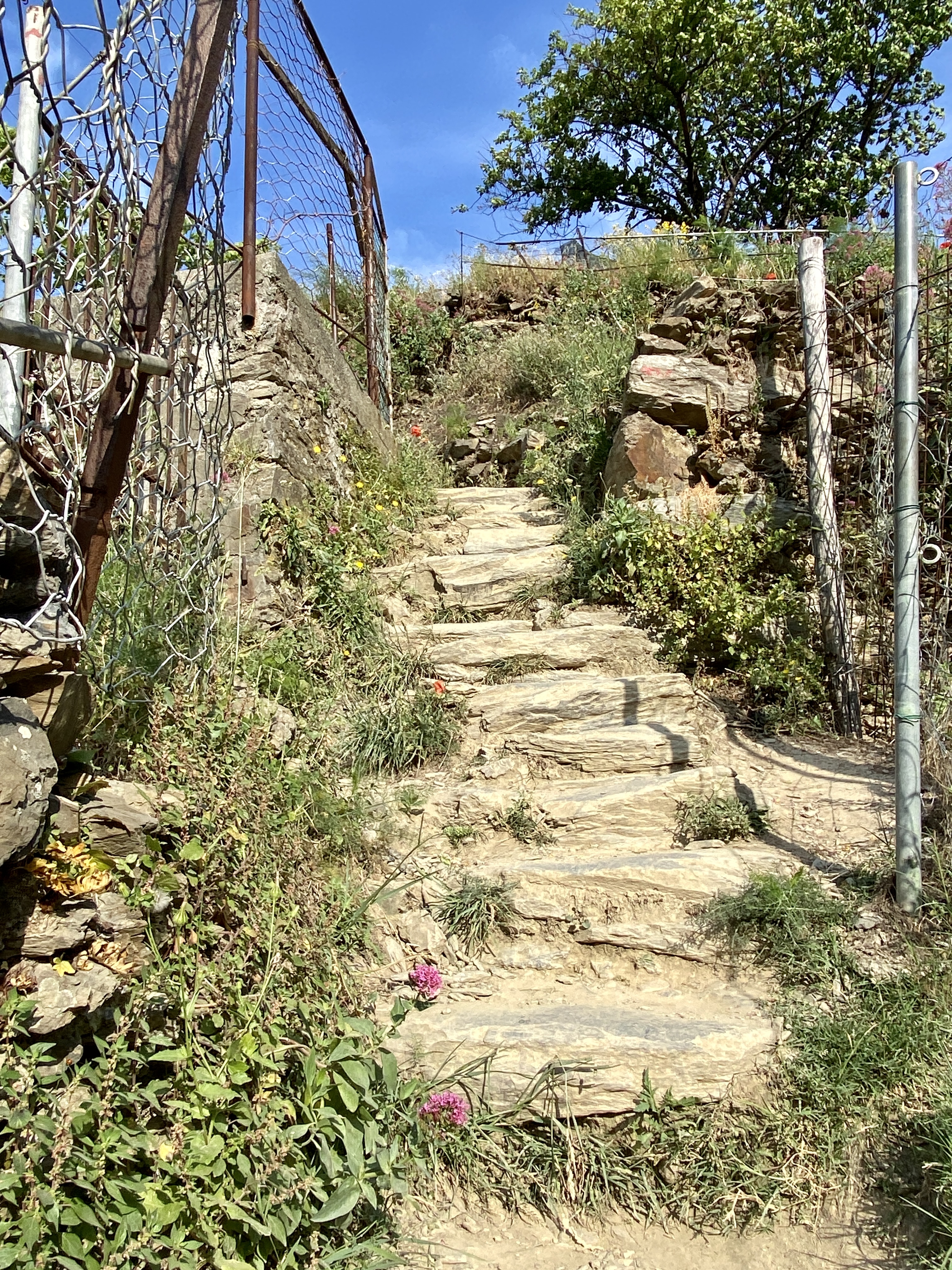
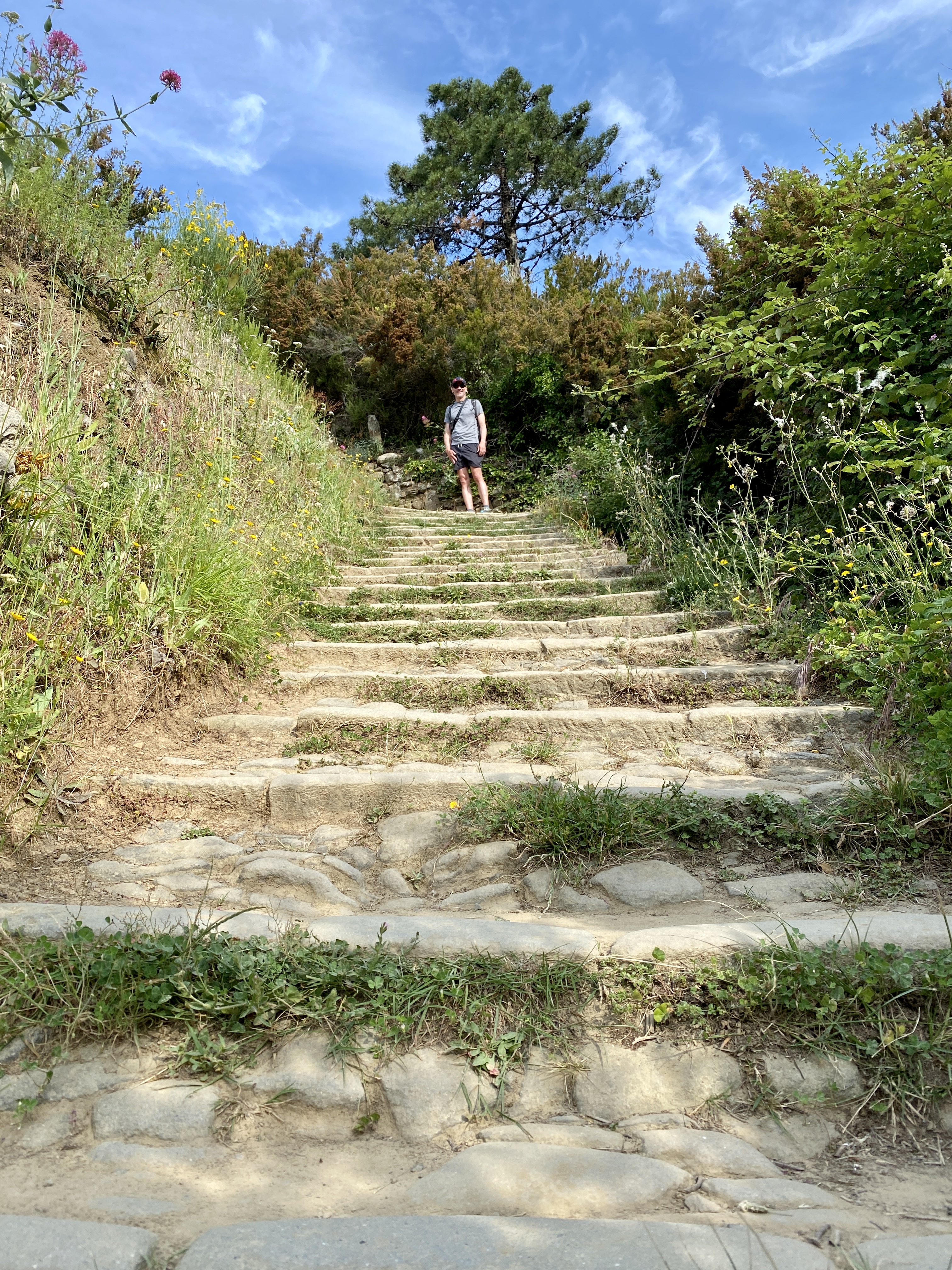
To avoid the heat of the day, we began before nine without any espresso on board. We decided that espresso in Corniglia would be the reward for our efforts. The hike begins relatively flat. Then you reach the steps. These are the steps. Well, this is a small section of them anyway. They are not level. They are not all large. Good hiking shoes are a must. We wore new trail runners with plenty of grip. Still, I was fairly certain my legs would be sore the next day.

The first part of this hike gets you up and above Manarola. As we climbed, I stopped to look behind us and capture a few photos. (Can’t reiterate enough that photo breaks are the key to resting while not appearing you needed a rest). The lower section of Manarola closest to the sea disappeared from view early on. I was able to pick out our rental and its balcony from this viewpoint.

We reached a flat spot with the view I had been waiting to see, up the coast to Corniglia and beyond. Alas, we were not finished gaining elevation. Volastra was still uphill and out of view, so we kept on trucking.

At last we reached Volastra and glimpsed Nostra Signora della Salute (Our Lady of Health) church, which dates back to at least 1240 AD. Volastra is very small, two main streets, so you aren’t in it long before you are back on the path, which opens up and allows you to spy Corniglia as she looms larger.

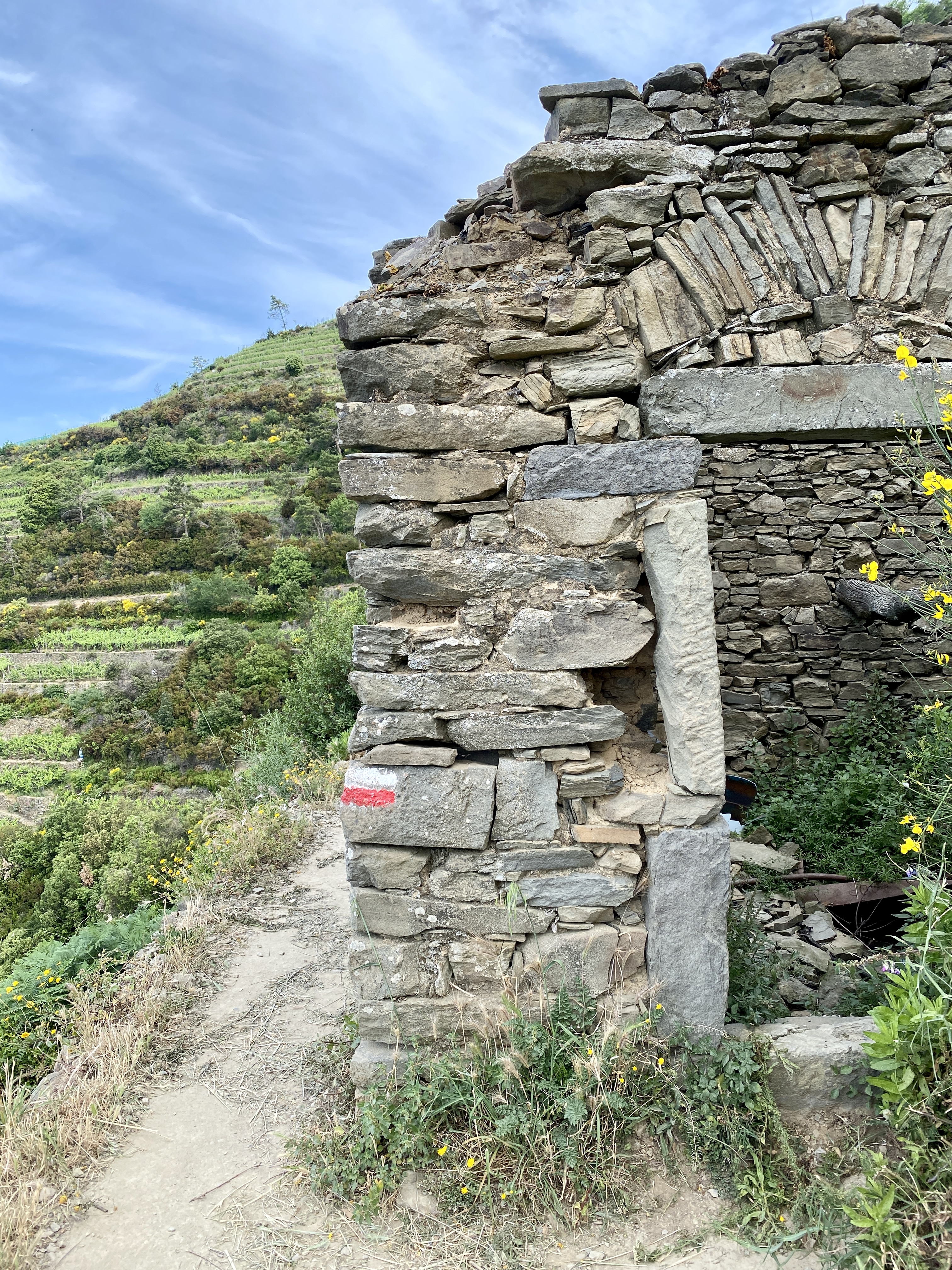
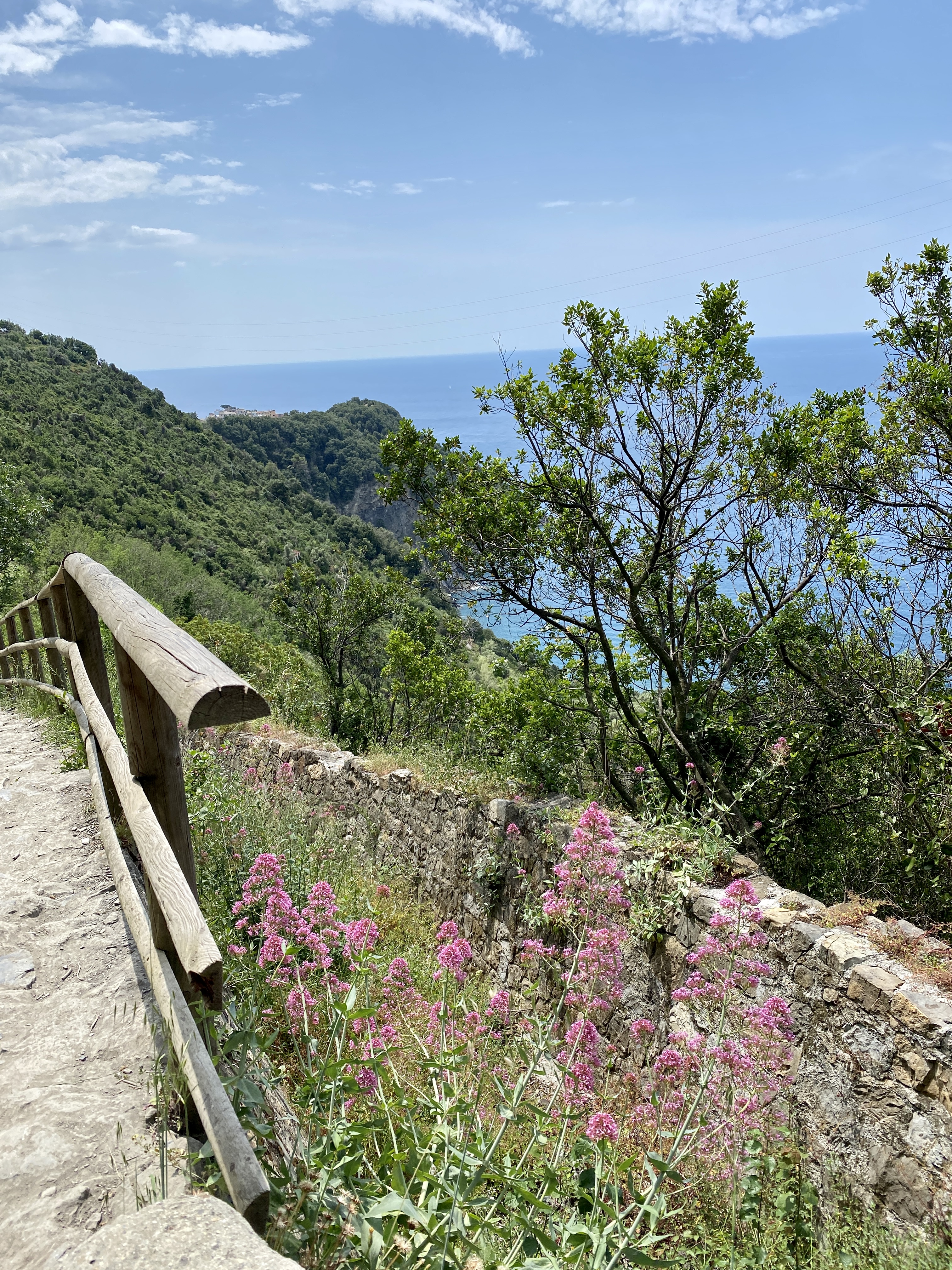
From this point, the trail skirted the sides of the terraced hills, weaving its way between vineyards growing the grapes of the Cinque Terre’s famed wine, Sciacchetrá (sha-keh-TRA). A sign found among the vines beckoned: “The vines of the Sciacchetrá find you on the road to celebrations. Here the grapes are born for a wine for special occasions. Come and try it.” Sciacchetrá is a sweet, dessert wine, often enjoyed with biscotti that you dunk in the wine. It’s tasty and became my go-to dessert. Think of it as Italy’s cookies and milk, but drunk. Parts of the trail beyond Volastra found us walking near the edge of cliffs above the sea. The railings made it feel slightly less precarious, but only slightly. We kept our eye out for the marker, two stripes (white over red), that let us know we were still on the right path.

We began our descent towards Corniglia, becoming more and more driven by our desire for our morning coffee. The trail took us through a small, forested area with lush vegetation before Corniglia grew increasingly larger in our field of view. We’d made it!

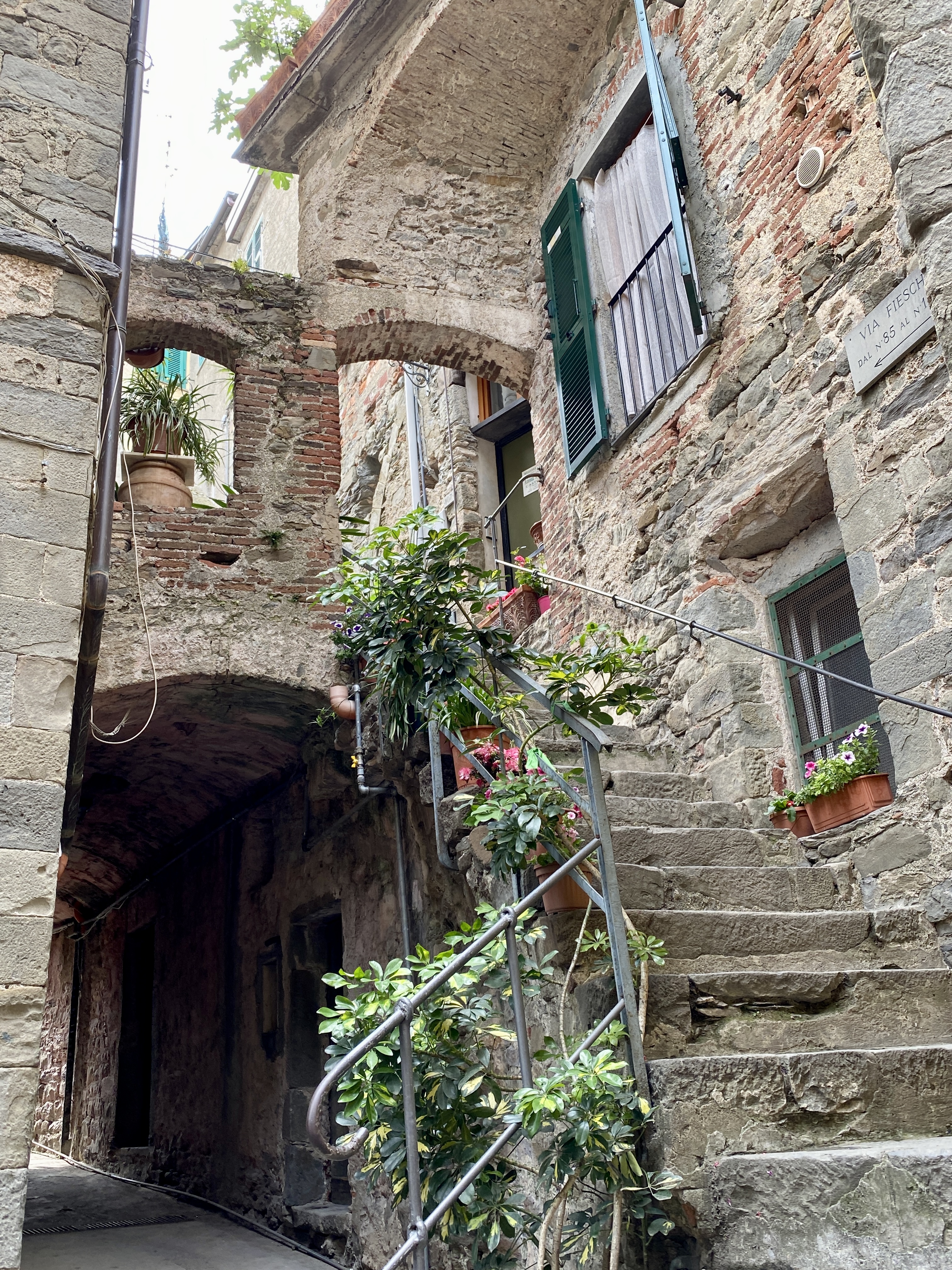
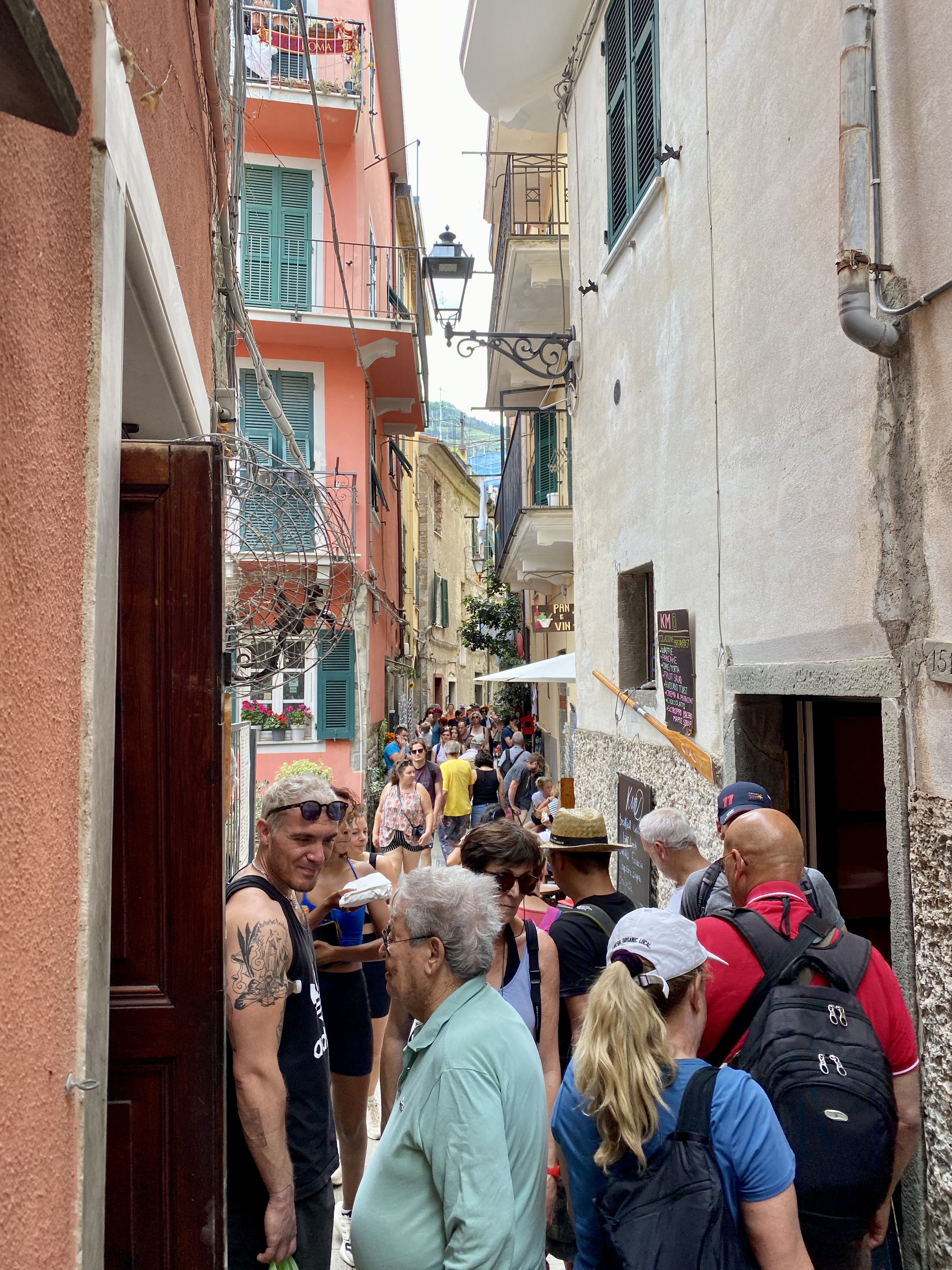
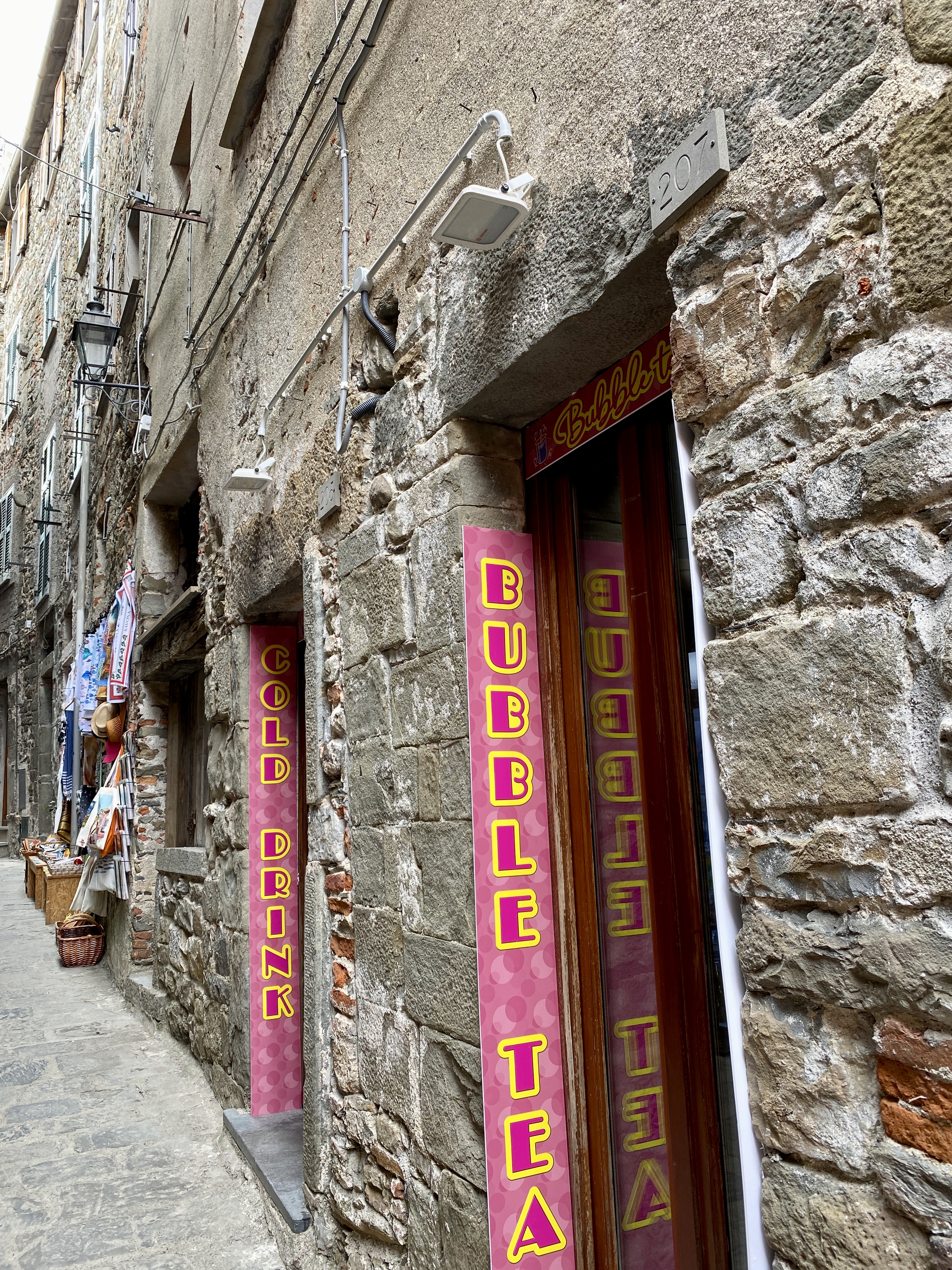
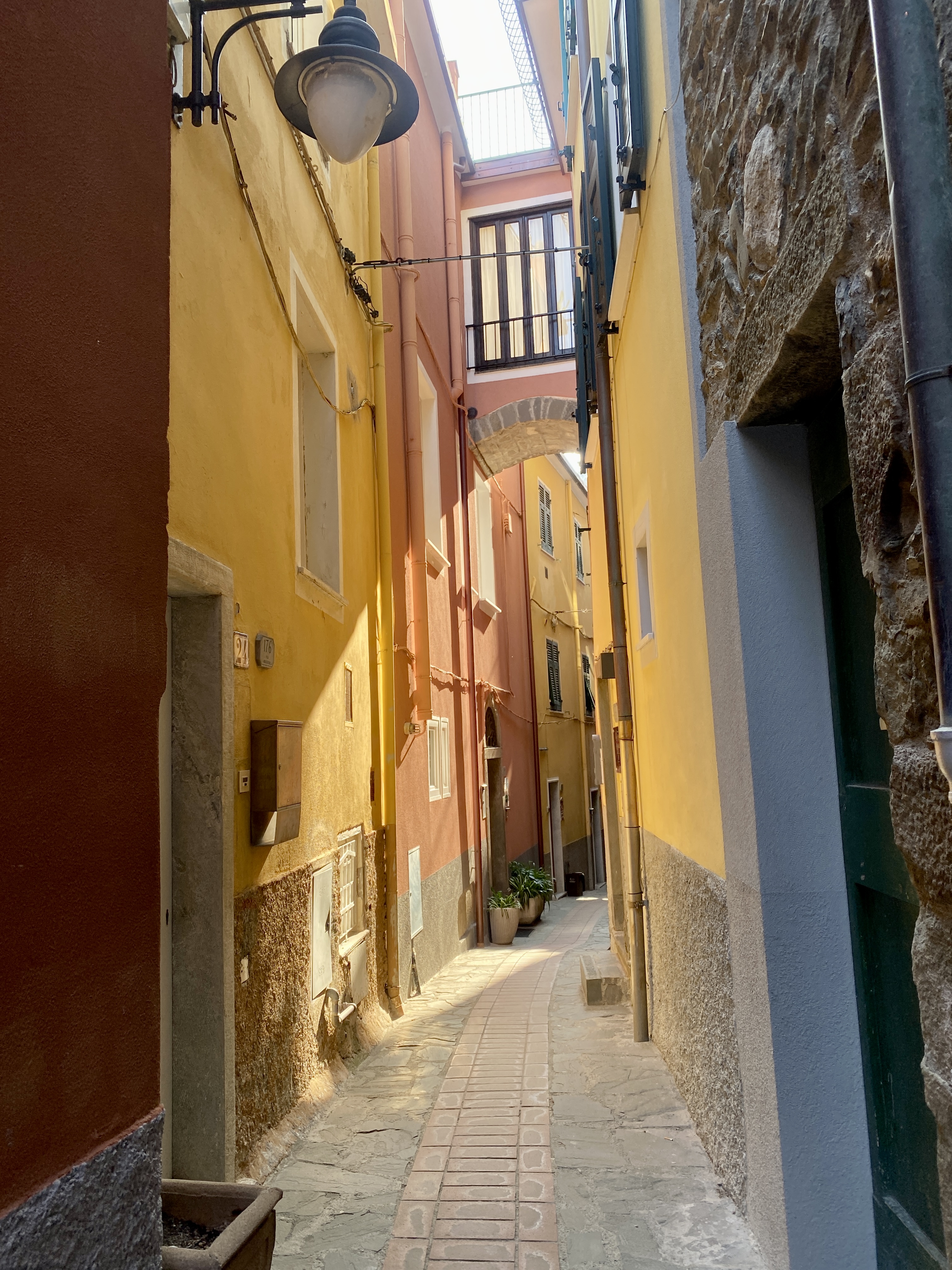
Corniglia, the smallest of the Cinque Terre towns with approximately 150 residents, was beginning to see an influx of travelers who had arrived by train. We wove our way through them and found a small cafe serving avocado toasts and espresso. We took a few minutes to enjoy our caffeine, Steve with his cappuccino and me with my doppio espresso, before beginning our exploration of life in a small town. We traversed the quaint, narrow passageways and found it to be not so different from life at home. Traffic. Laundry. And the ubiquitous bubble tea establishment.

We had planned only to hike to Corniglia but, when we checked our messages, we learned the rest of the gang were nearly finished with their hike to Vernazza. So, we thought, “What the hell? Why not hike there? It’s all downhill from here.” We pointed ourselves toward the trailhead to Vernazza we had seen on our way in.

The hike to Vernazza was along the Blue Path, so we got to show our hiking pass to the guard before we headed out. We felt very official. This hike was was 2.1 miles and rated moderate. Aside from the rising temperatures as we pushed towards noon, the hike was indeed easier and we had picked the right direction from which to start. Because it was later in the day, there were many more people on this hike than on our previous one. Still, the views were good, and I was excited to step foot in our last of the five towns.

We reached the heights of the town after descending what felt like hundreds of stairs. On our way to meet everyone, we passed a quaint restaurant with a patio overlooking the town and made a mental note of it. We found our people hanging out near the beach, where my sister, Julie, had made good on her promise to get into the sea. I wanted to wander around a bit and shop, but Vernazza was packed. It was, by far, the most crowded town we visited. We wandered down to the sea to get a photo of the town and then tried in vain to find a restaurant with an available table close to the water, but no luck. By this time, we were all famished from hiking, so we set off back up the hill to find the place Steve and I had passed on our way down. It was one of the happiest random choices we made on the trip. When we arrived, they had only recently opened for lunch, so we had our pick of seats. We chose bar top seating facing the sea and ordered Aperol Spritzes. While we were enjoying our well-deserved beverages, it began sprinkling. Fearing another deluge like the previous day, we asked if we could move further in, under the patio structure, to avoid having Julie get soaked again. That also turned out to be a good choice as the rain began to fall steadily as soon as we began ordering our meals. We’d taken the last tables under the shelter, so today it was someone else’s turn to get wet. Steve ordered the white lasagna and I ordered trofie al pesto, a local specialty I formed a deep and lasting relationship with. The plan had been to share the food between the two of us, but we each loved our own dishes so much we refused to share, although we did agree to one bite each.

Stuffed with pasta, the others decided they didn’t need to do any additional hiking that day and en masse we opted for the short train ride back to Manarola. We bought some additional groceries from the local store and trudged our way back uphill to our apartment where we planned to prepare dinner later and enjoy another sunset from the patio.

After dinner, Mother Nature gifted us a gorgeous sunset before we tucked ourselves into bed. We were exhausted. Just before I put my Apple watch in its charging space for the night, curiosity got the best of me and I checked my exercise stats for the day. No wonder Steve and I were wiped out. I hoped my legs would be up to hiking up and over the hill between Manarola and Riomaggiore in the morning.

Side note: The next day my brother-in-law sent me this photo of me hiking up toward Volastra the day before. I think it gives a good perspective as to our uphill stair climb.

Cinque Terre: Ferry Ride To Monterosse Al Mare

On our first morning in Manarola, Steve and I left the apartment early. It’s well documented that early morning exploration is one of our favorite things to do in Italy. Before 9 a.m., towns and cities are still quiet. It’s a perfect opportunity to get to know the area, as well as take photos not filled with hordes of travelers. Plus, the early bird gets the espresso. That morning, the sky was clear, the photo ops plentiful, and the espresso perfetto.

As a group, we had decided the previous night that we would spend our first full day in the Cinque Terre getting an overview of the towns so we could decide which hikes we wanted to do the next two days. We planned to take the quick, two-minute train ride to Riomaggiore, explore for a short bit, and then take the ferry from there to Monterosso al Mare, thereby seeing all the towns from the sea. So, after some espresso and pastries from a local shop, we headed out.

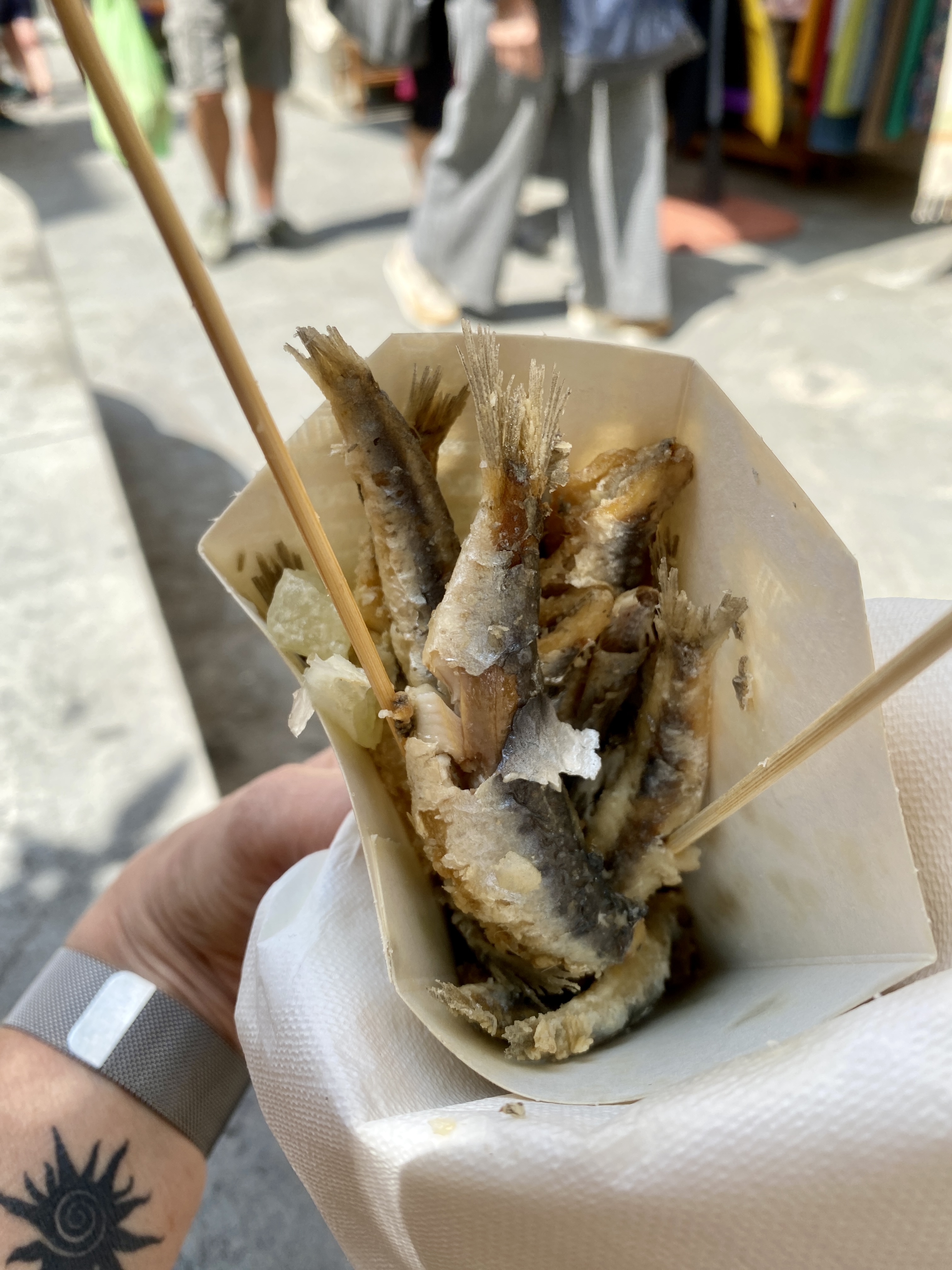
It was around 11 when we arrived at Riomaggiore. The first thing I noticed is that the main street in town was not nearly as steep as the one in Manarola. It was dotted with shops and restaurants. We had been told by friends we had to try the fried anchovies in the Cinque Terre so, feeling a bit peckish, we got some and a couple lemon granitas to share. The anchovies came wrapped in paper, heads missing but tails in place. I am not the biggest fan of fish, but I gave it a go and ate three. While they were not my favorite food of the trip, I could understand the appeal. We spent about an hour exploring the town before buying our ferry tickets and heading to the dock.

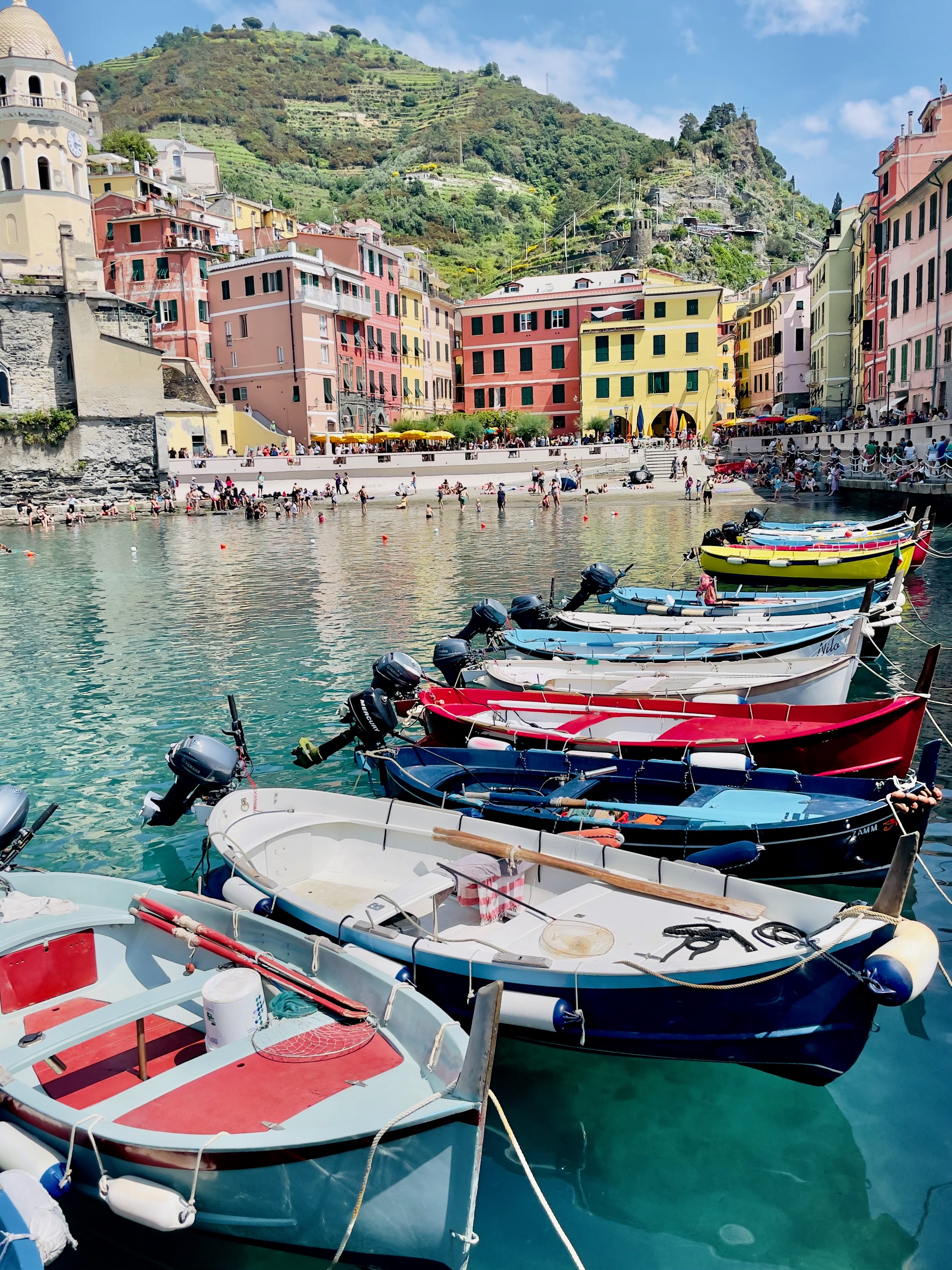
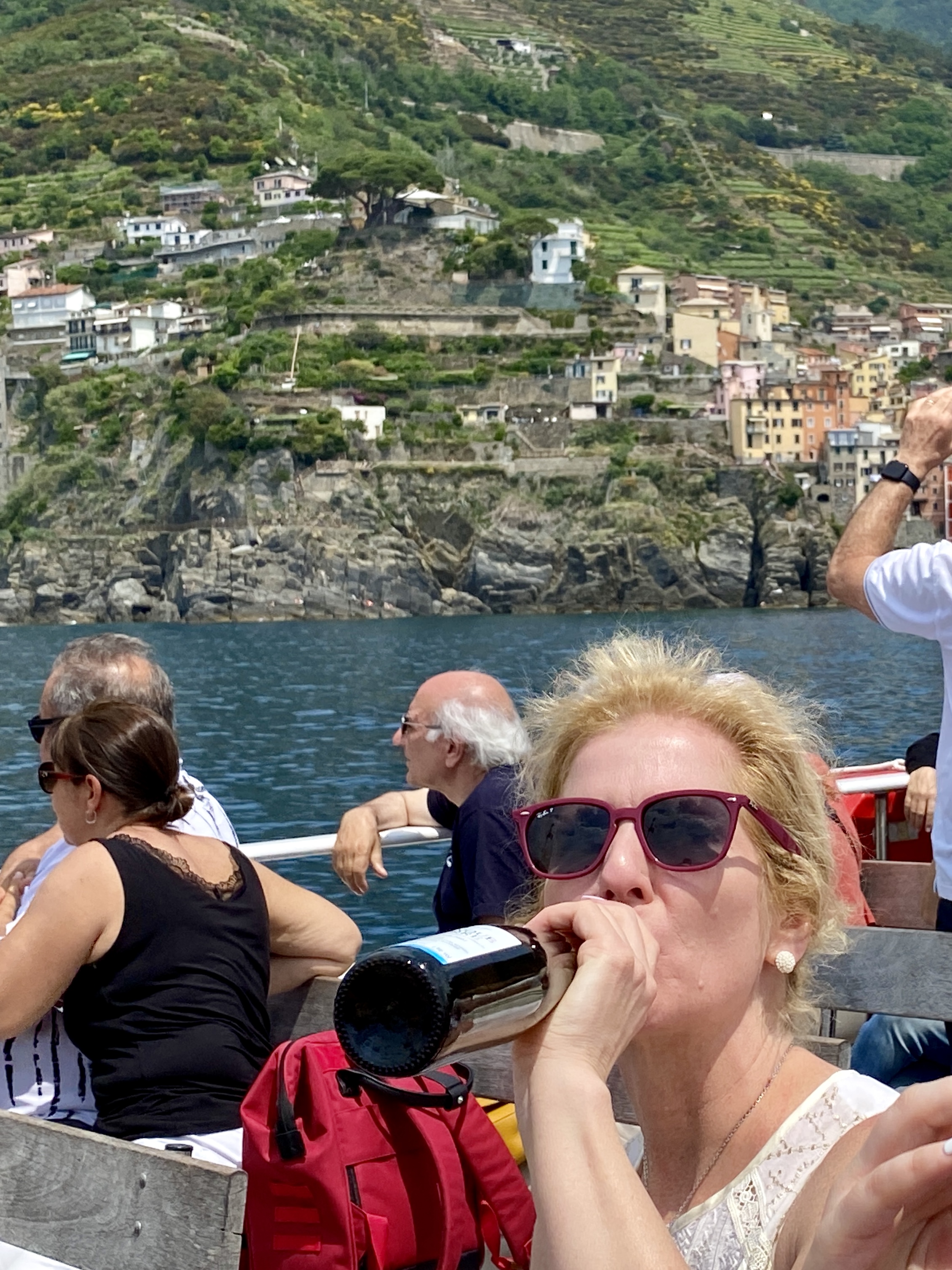
My sister’s boyfriend, Alec, unbeknownst to most of us, had set a goal for himself on the trip. As it was his first time in Europe, he decided he would have some wine on every train. That also applied to boats we found out, when at the dock he pulled a bottle of wine from his bag. Once we boarded the ferry and were on our way to the port at Manarola, Alec opened the bottle and we shared it. We had no cups, so we were swigging straight from the bottle. We got some sideways glances, but it made the journeys more interesting. I decided Alec is welcome to vacation with us anytime. The ferry trip from Riomaggiore to Monterosso al Mare takes about 45 minutes, stopping at Manarola and then Vernazza along the way. Corniglia is perched high on a cliff, so the ferry does not stop there. It’s honestly amazing how close to one another and yet how isolated they are, at least in terms of space between them. The trains and ferries make travel between them simple now, but the view from the sea made me think about how much harder it would have been to have to hike to exchange goods or see family in the other towns.

The first thing you notice when you reach Monterosso by sea is that it is the flattest of the five Cinque Terre towns. We disembarked and headed toward the bustling shops and restaurants waiting for us just beyond the beach chairs, umbrellas, and swimsuit-clad vacationers. We walked through shops and narrow alleyways trying to figure out where we wanted to eat. As we were waiting for a table space for the six of us to be cleared, it began to rain. As we were being seated, the sky let loose a deluge and people started ducking into any doorway or open shop they could find. We were happy to have seats under a couple awnings right along the wall of the restaurant. Others scrambled while we perused the menu. We ordered drinks. The rain continued. We ordered lunch. The rain continued. Lunch arrived, and still the rain did not relent. We were all staying fairly dry except for my sister, Julie, who unfortunately ended up just beneath an overlap in the awnings where rain eventually began to overwhelm the canvas and seep through in an annoying trickle onto the table near her. The food was delicious. I had some large, house-made gnocchi covered in local pesto, and my husband and I shared a Caprese salad with fresh mozzarella. The rain finally did abate right around time for dessert. All in all, it could have been a much wetter experience for us in Monterosso. We were grateful to have escaped mostly unscathed.

After lunch, the sky was blue again and the bustling crowds had dispersed with the rain. We wandered the two parts of town, which are connected by a tunnel that allows both pedestrians and the occasional vehicle. We spent a fair amount of time strolling through the old section of town with its cramped alleyways and side streets. My sister and I stopped to buy some linen clothing for ourselves and souvenirs for others before we walked en masse through the tunnel to emerge at an even larger swim beach along a flat coastline with the pristine water of the Ligurian Sea. We talked about returning later to rent some chairs and have a swim before we departed the Cinque Terre.

We took the train back to Manarola and cleaned up. The guys discovered they had all packed essentially the same shoes for dining out. We were starving again for our dinner at Da Aristide. One thing you can’t do enough of in Italy is eat. The entire country is a giant buffet. The most difficult part of any meal is simply choosing what to eat and then trying to save room for the tiramisu you know you are going to have because you can’t not have it. You’re in friggin’ Italy, for Christ’s sake. Mangia!

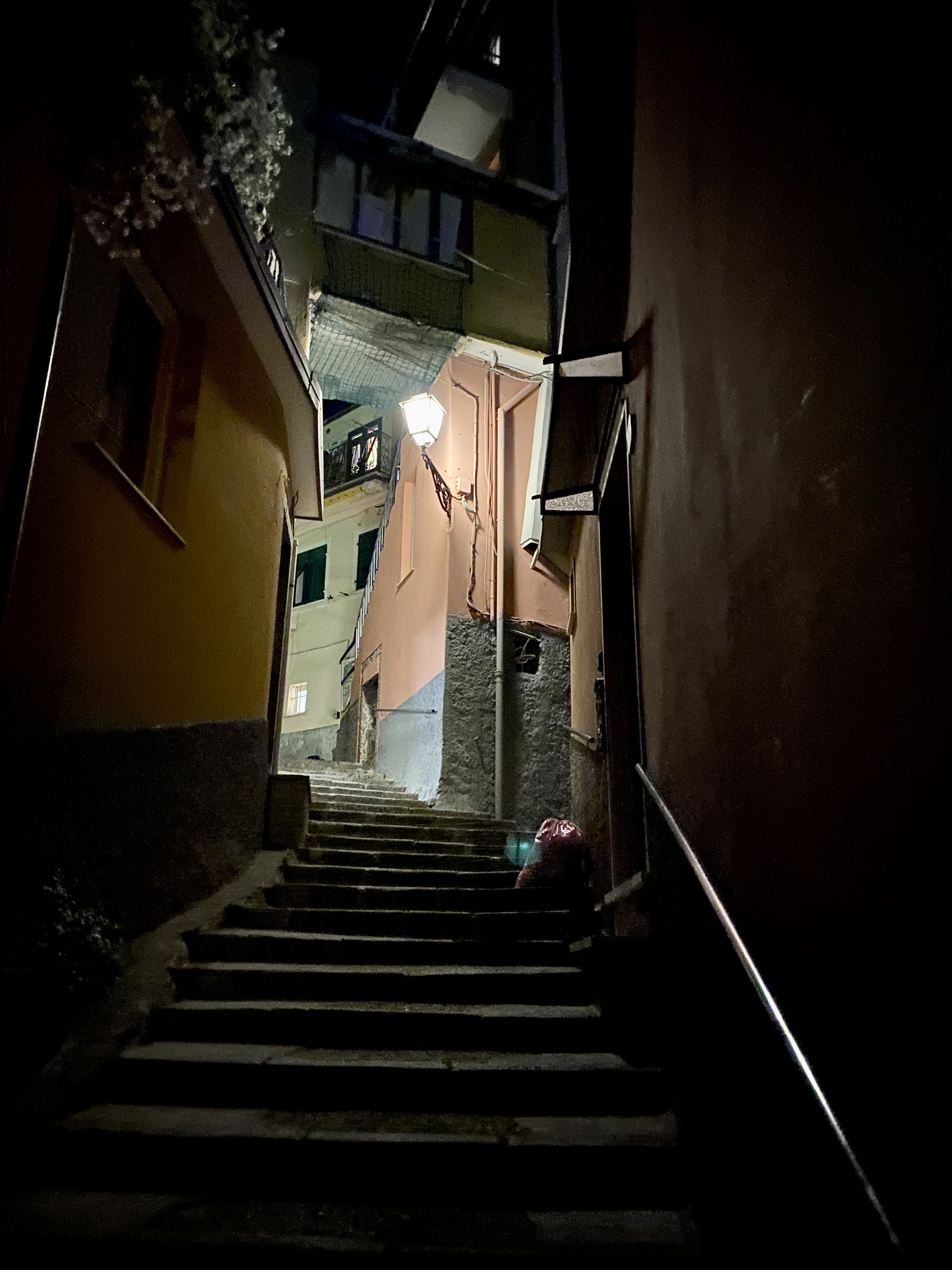
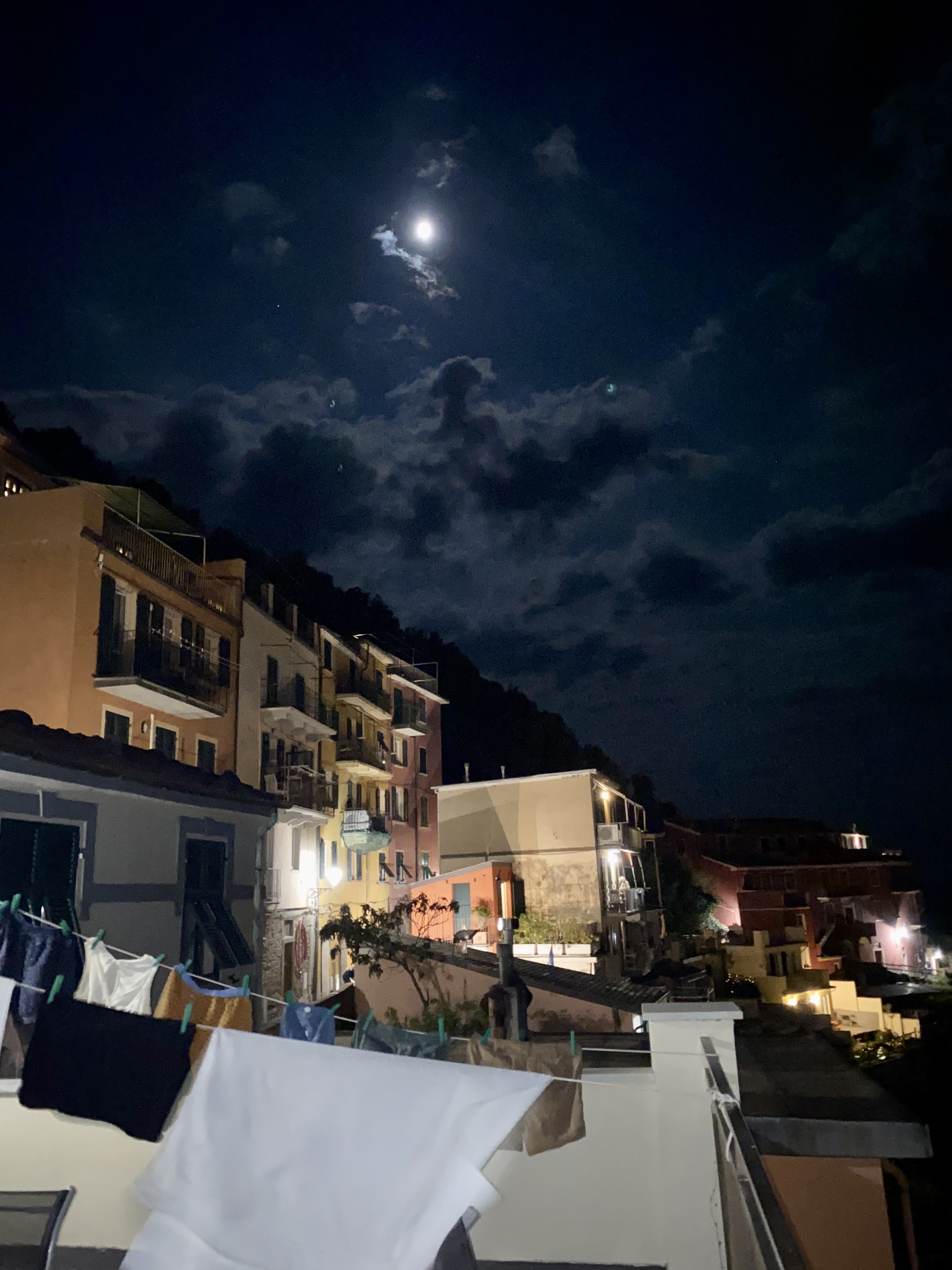
Fortunately, after dinner we had our steep, uphill walk to the apartment to help us work off some food before bed. The night was cool, clear, and lovely. I had to stop a few times to take photos.

(Insider travel tip: a photo op is the best excuse to stop and rest without letting anyone else know you are stopping to catch your breath. You’re welcome.)

Cinque Terre: Our Stay In Manarola

Photos don’t do it justice

As if our once-in-a-lifetime trip to the Monaco Grand Prix had not been enough of a proper birthday celebration, we’d decided to follow it up by heading to the Cinque Terre. My sisters didn’t have a preference for which town we stayed in. After a lot of research on my end, I decided to go with Manarola as it was consistently listed as one of the most picturesque. I felt pretty comfortable about my choice after having eliminated the other four for various reasons: Corniglia (too small and not on the water), Monterosso al Mare and Riomaggiore (too big), and Vernazza (too packed with visitors). I absolutely made the correct choice. Manarola is big enough to have some wonderful restaurants and cute shops, but small enough to be peaceful at night. The size of our group necessitated reserving a large lodging. I chose one with a sizable terrazza with picture-perfect views down into town and on to the sea. At least that is what the Airbnb photos led me to believe.

We arrived late afternoon after a day spent on trains, which hugged the Mediterranean Riviera coastline offering either jaw-dropping views or no views at all (tunnels). The towns of the Cinque Terre are car-free, leaving only charming pedestrian streets to wander. They can more easily be accessed via regular ferry service and frequent trains. We landed on the platform in Manarola with nothing but mentally saved Google images creating expectations.

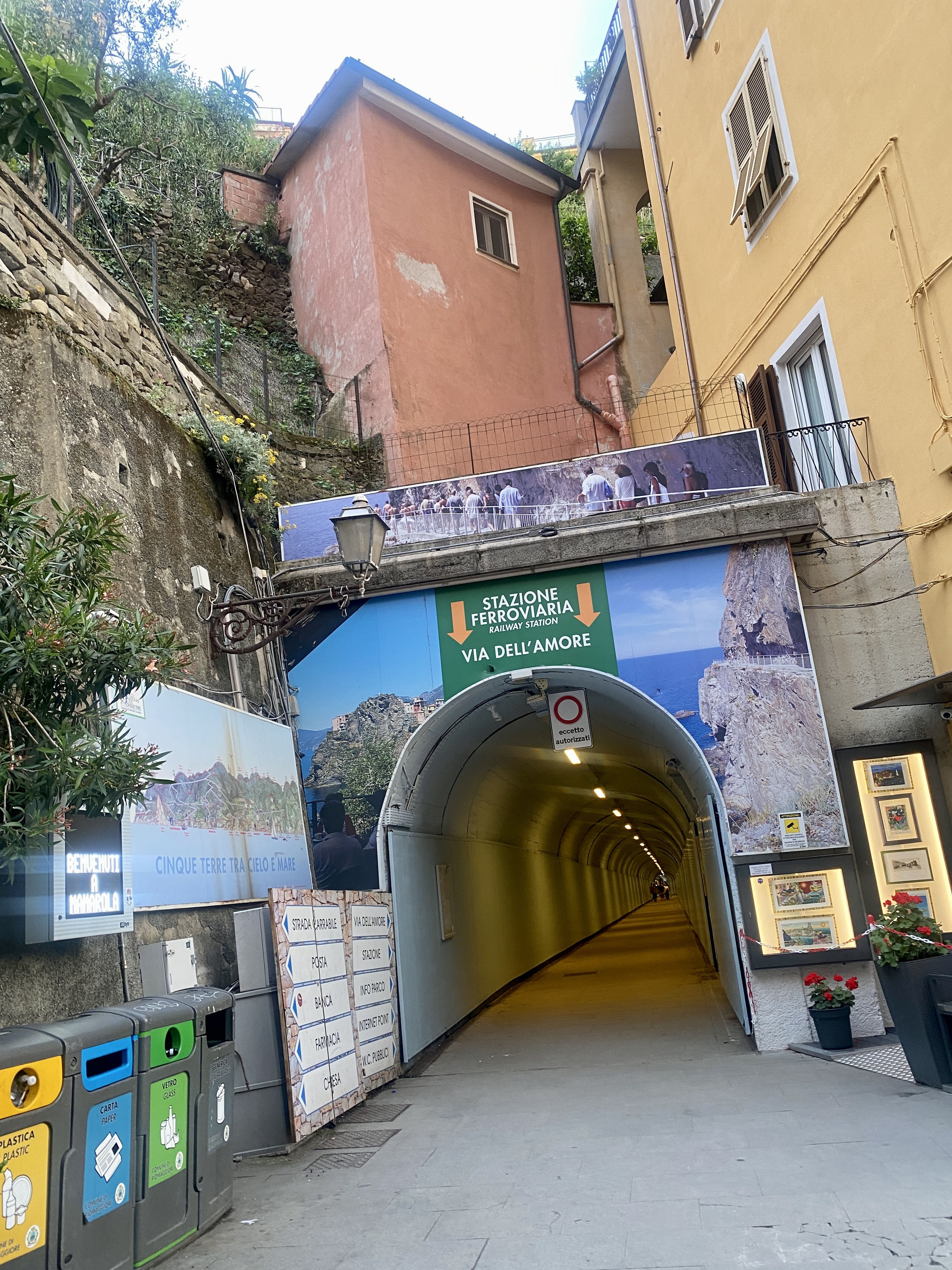
The town side of the tunnel

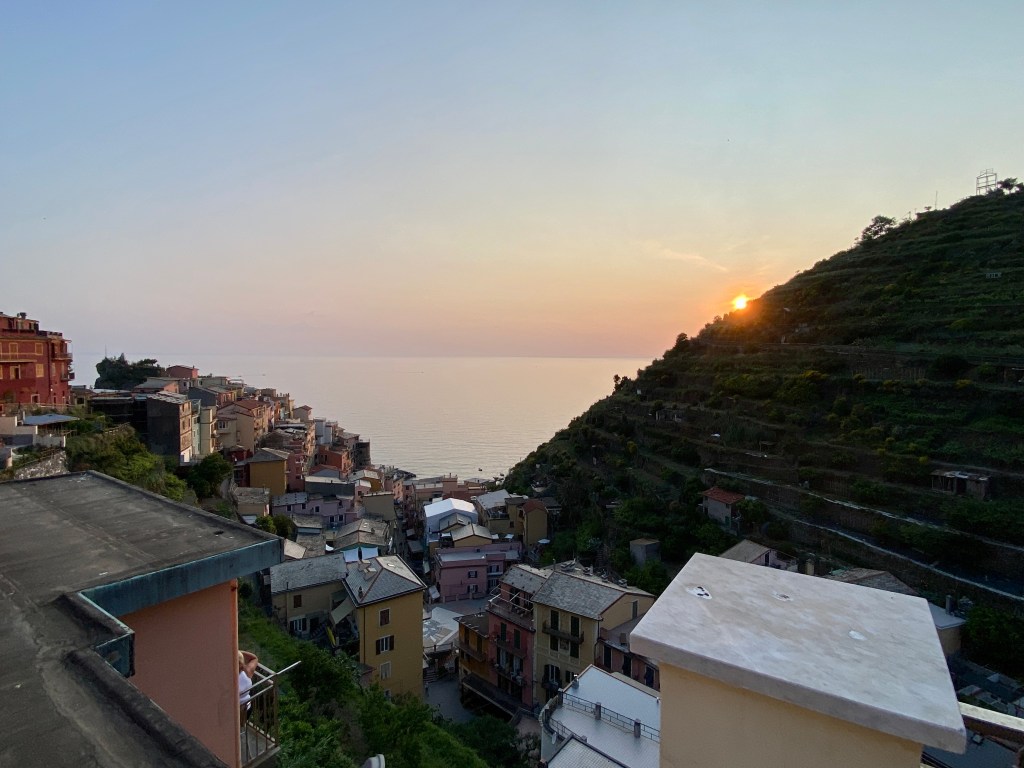
We followed the crowd of travelers from the full train down stairs and then up stairs on the other side of the platform. From there, it was a long tunnel walk to the vantage point on the other side where we were able at last to view Manarola. Much like my experience with Positano, it was love at first sight. The town is set in a narrow valley between two terraced hills and ascends precipitously from the sea, providing dining, shopping, lodging, and grocery options along the way. Part of the town exists to the left when you exit the pedestrian tunnel, closer to the sea, but the majority of the town rises beyond the tunnel on your right.

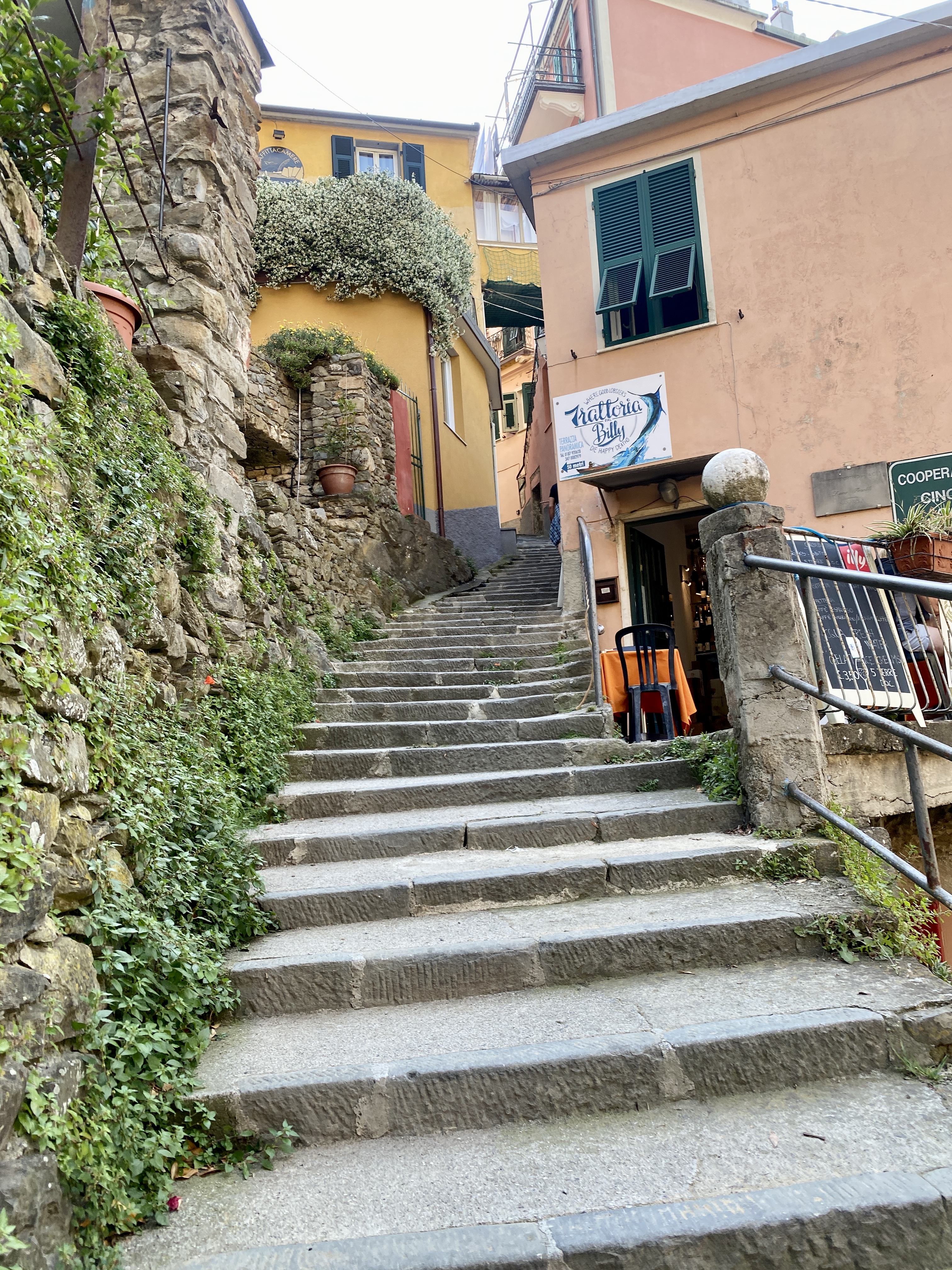
Part of the return to our place

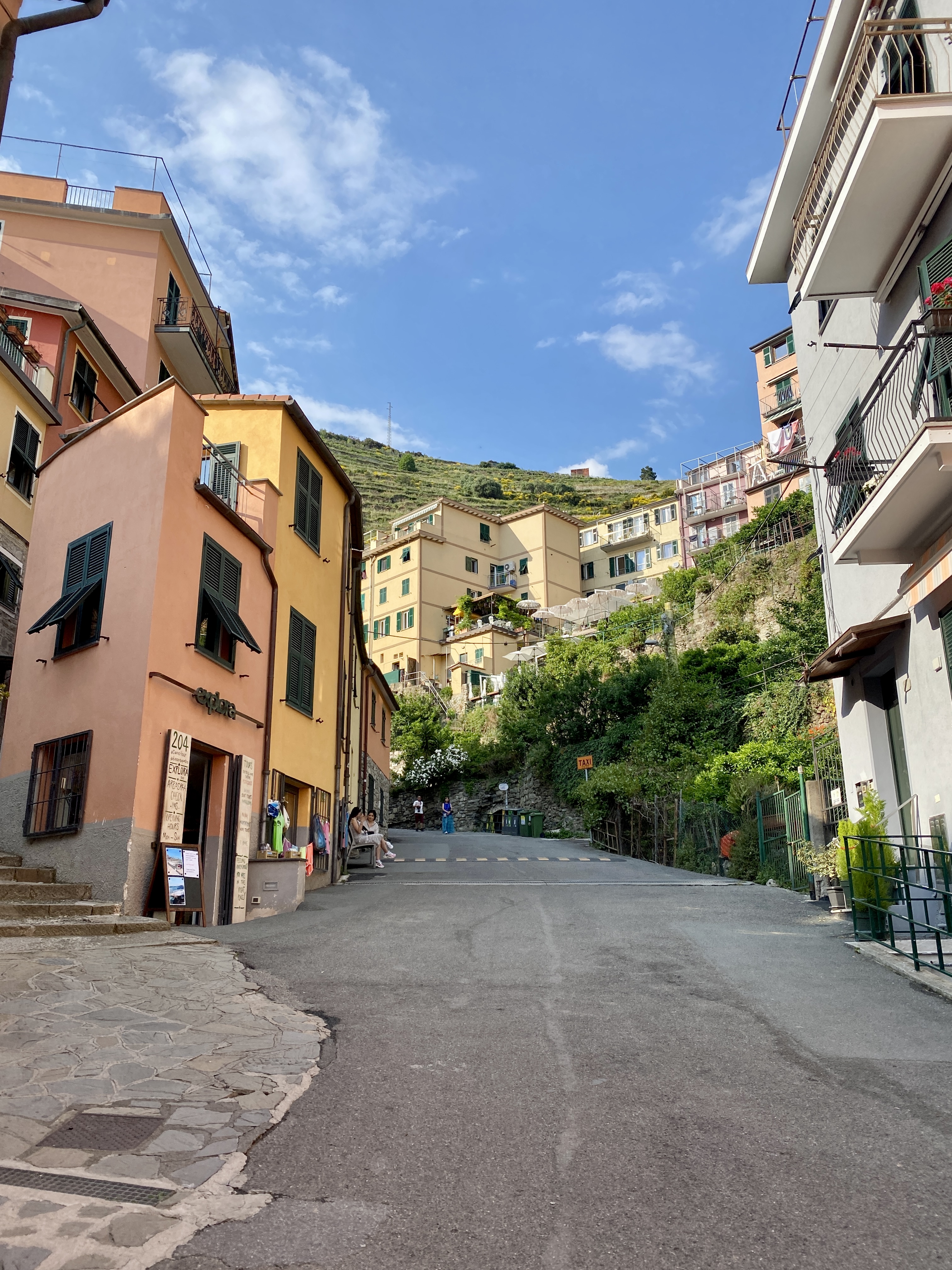
We met the rental staff for our lodging and began the climb with him to our temporary residence. If you want a view, you have to go high, right? To be honest, I knew the town would be uphill, but I really did underestimate exactly what that meant. To reach our rental, we climbed up the steep, well-paved street from the tunnel, which then rounded a sharp bend and continued up to the town church. Beyond the church, the road ended in a fork, one branch leading to the area where cars were parked behind a gate at the top of the town and the other branch heading up a stairway, wide at the bottom and narrow as you entered the pedestrian street. I never counted the number of steps, but I am certain it was at least 30. It was an insult-to-injury kind of situation.

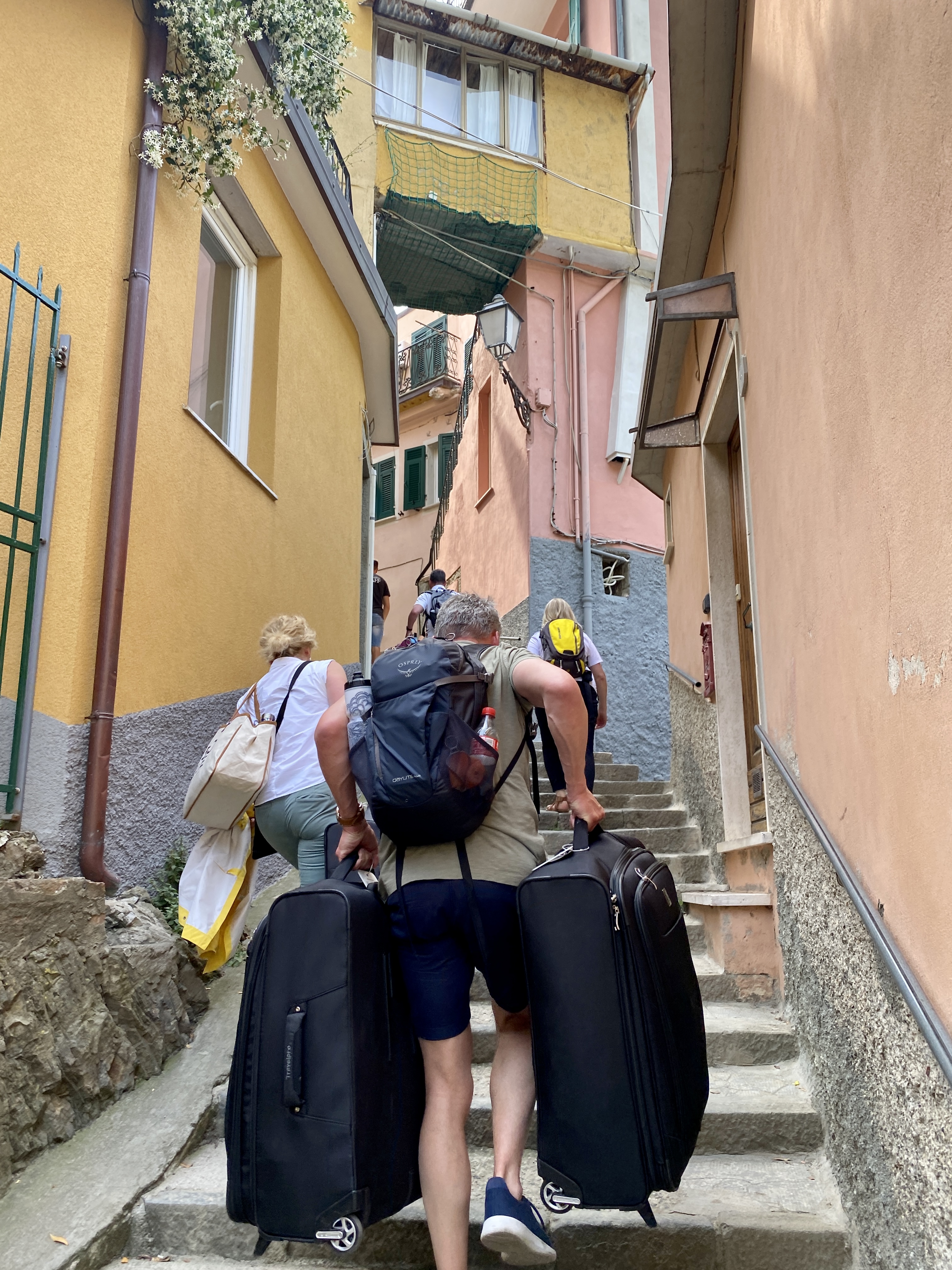
Sweet hubby carrying my bag too

We had been able to roll and pull our bags for the first part of the uphill journey, but the real muscle work hit when we had to slog 35-45 pound bags up those stairs. You may wonder if we wished we had packed smaller bags, and the answer is of course. Sadly, the trip we had arranged, a combination of F1 race, fancy dinners, and hiking in the Cinque Terre required bigger bags. I mean, you can’t exactly hike the Cinque Terre in a dress and heels, but you wouldn’t want to eat at a Michelin restaurant in Nice in shorts and hiking shoes. Still, we were grateful we were only going to have to traverse the stairs two times with bags during our visit and hoped the daily climbs to the apartment would become easier as the days rolled by.

Our guide led us to our door and showed us how to work the lock and handle. Doors in Europe don’t uniformly unlock and open the way ours do here in the US. With one door in Spain, we had to spin the key three times in the lock to get it to open. Here we had to turn the key and then put the handle in either a 45 degree angle up or a 45 degree angle down depending on if we were locking or unlocking the door. We were worn out from our Grand Prix weekend and our day of travel, so we nodded and said we understood it all and he left. We went in and checked out our digs. There were three bedrooms and three couples, so to keep it fair we drew numbers for the opportunity to choose from the rooms. From there, it was straight onto the terrazza we had fallen in love with through the rental listing. Would it prove as scenic as it had on the Internet? Definitely. I patted myself on the back for my find.

When we had settled into our new environs, we descended into town to get the lay of the land and to find a grocery store from which to purchase food and wine suitable for dinner on a warm, early summer day with a view. We happened upon a gelateria, of course, and some of us (the men) decided to have a pre-dinner snack. You can’t really blame them.

My sister made us pose for this

When in Italy, you gelato. Gelato consumption is compulsory before you are allowed to leave Italy. They have sensors at the airport that separate those who have eaten it from those who have not. Those who have skipped out are required to ingest some from an airport vendor before boarding their international flight. This is how they ensure you will return to Italy.

Next up was a stop near the harbor to take in the town from below. It was every bit as picturesque as I had been led to believe. A first Cinque Terre selfie was a must before heading back uphill to the store to choose ingredients for charcuterie and salad, you know, dining-on-the-patio food. I love shopping for groceries in Europe, be it at large open-air markets or small corner stores. Their choices are almost always more fresh and their packaged foods are prepared with better ingredients. So with fresh tomatoes, local cheese, basil, olives, crostini, pesto, salami, prosciutto, mortadella, a few bottles of red wine, and some limoncino in hand, we went home to enjoy the pleasant evening on the terrazza and wait for the sun to set on our introductory day in the Cinque Terre. Oh…and to drink too much and play Never Have I Ever and learn more about each other.

Mode Push: The 2023 Monaco Grand Prix

Wine in an airport bar
A race-day French macaron

We got into F1 racing the way the most Americans have and in the most American way possible. We watched the Netflix series, F1: Drive to Survive. We began watching in January of 2022. I became way more entrenched in the sport than I ever imagined. I chose a favorite team. It’s Scuderia Ferrari. (I am a fan of the Buffalo Bills, so I am accustomed to cheering for an underdog.) I zeroed in on a couple favorite drivers, Charles LeClerc and Carlos Sainz. I didn’t choose them because they were the current leaders. I chose them because they seemed like good, solid guys, not unlike Josh Allen and Jim Kelly. We got an F1 TV membership and began watching the races on race day. I have followed along with live updates of qualifying sessions and have watched races on my phone when I wasn’t near a television. I have woken up multiple times at 5 a.m. to watch a race happening across the globe in real time. I may have issues. There is so much more I have yet to learn about the sport, but I’m hooked.

Qualifying Day

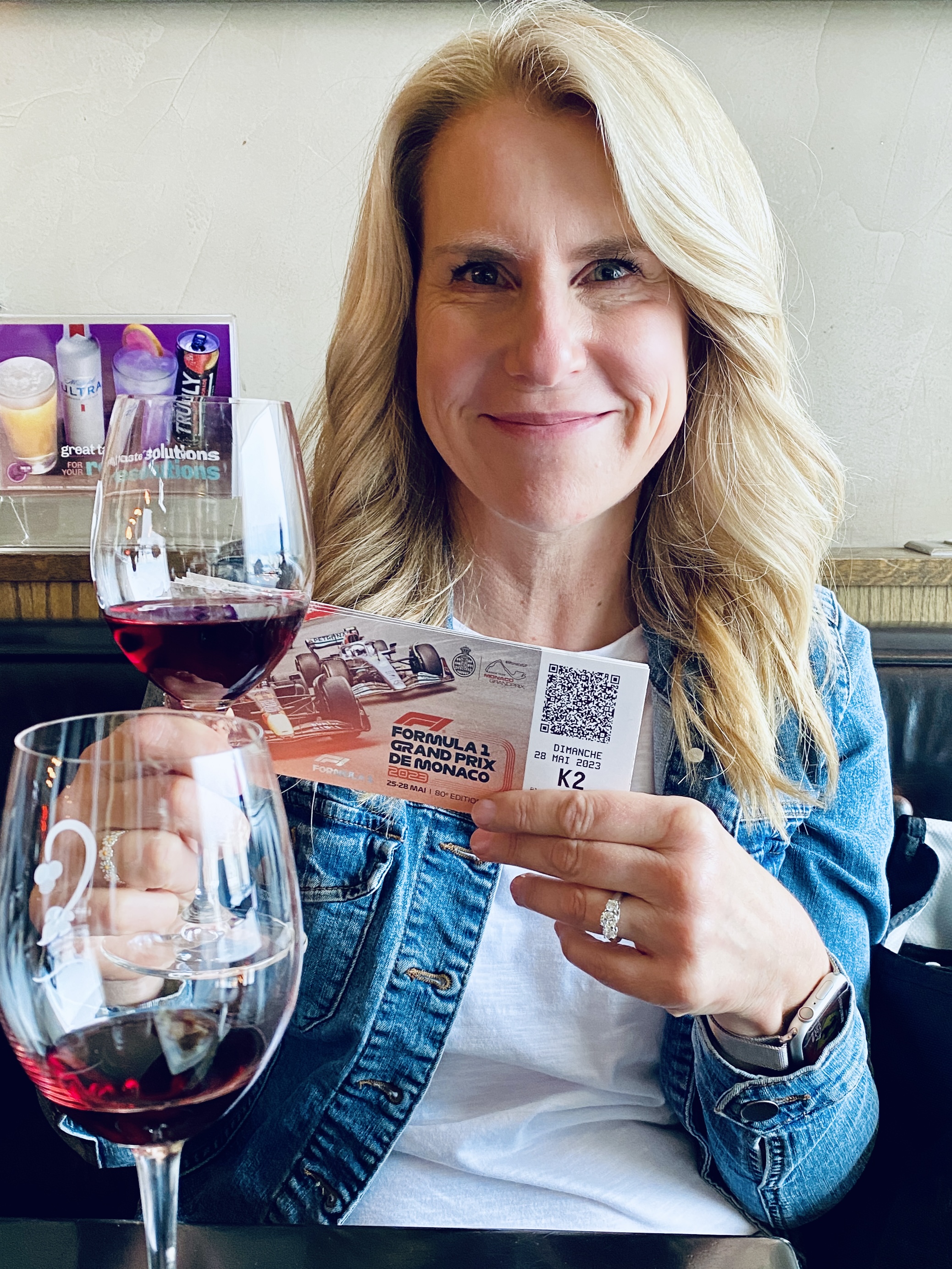
Years ago, my youngest sister told us for her 50th she wanted to experience the Monaco Grand Prix, and it was her wish we would join her in this adventure. We started researching and saving. Last fall, I got online an snatched up grandstand seats for us. Then I secured lodging in Nice because, well, we aren’t A-list celebrities with A-list bank accounts who can stay in Monaco. I bought some Ferrari merch. We were really going to do this. On May 25th, two days before my 55th birthday, we landed in France, F1 tickets in hand.

It’s not easy to encapsulate what happens in Monaco on Grand Prix weekend. The city state of Monaco, encompassing an area of land roughly 60% the size of New York’s Central Park, swells from 37k residents to roughly 200k people. DJs pump club tunes through speakers. It’s not a place for agoraphobics or claustrophobics. Myriad fans in all their team paraphernalia follow signs through winding, fenced passageway and, in some cases, over recently constructed bridges over the race track, to reach the grandstands. Each grandstand offers a unique vantage point of the race. Ear plugs are a wise choice. I got the chills the first time I heard the cars in the midst of their first practice. I could not believe I was actually there. None of us could. The race is iconic. The location is beautiful. The yachts are plentiful. The mix of languages being spoken is mind boggling. The excitement is palpable everywhere you walk.

My husband and I attended two practices and qualification to prepare ourselves for race day.

Video from Free Practice 2 on May 26th (Grandstand L)

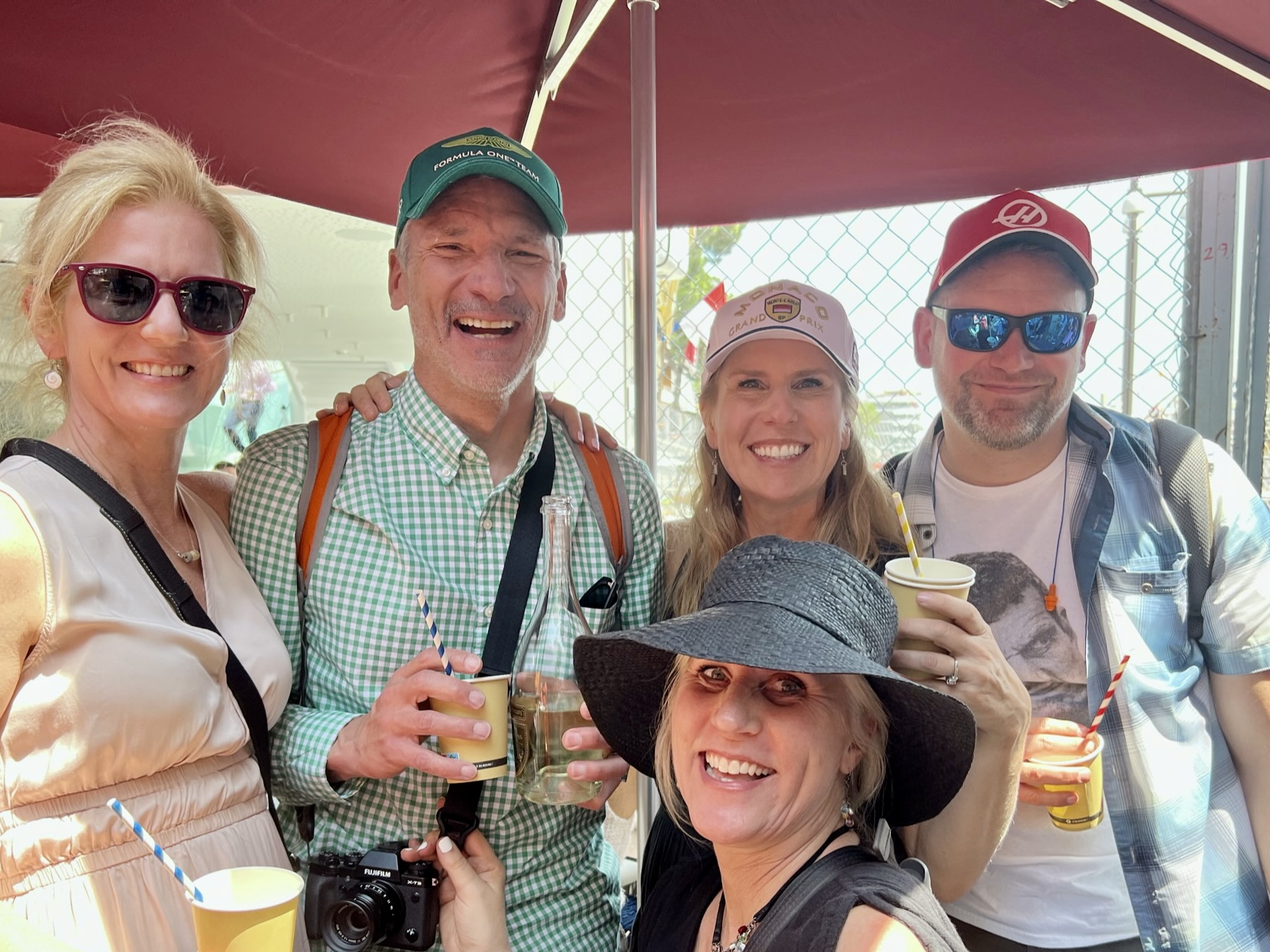
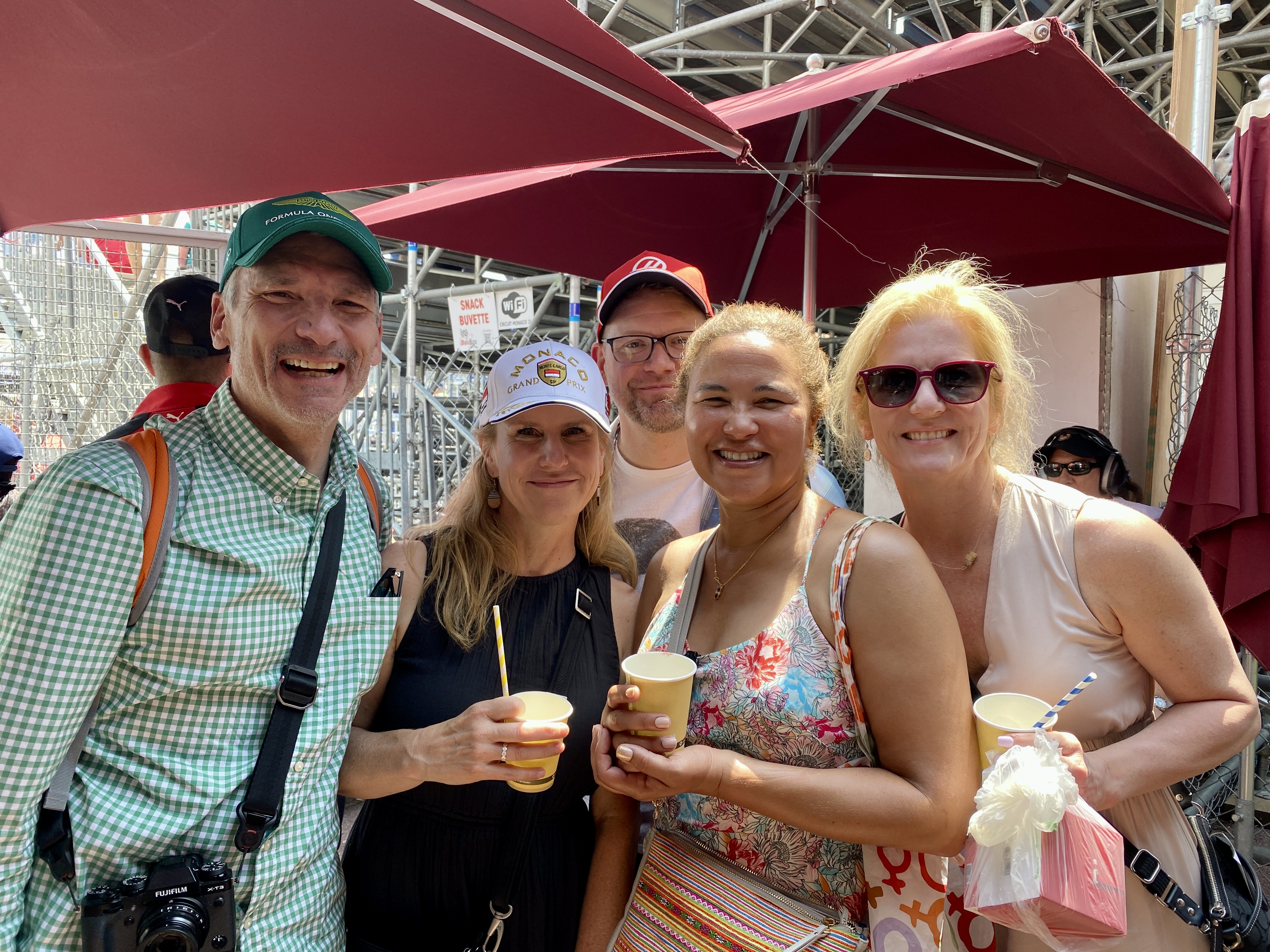
Between the driver’s parade and the race, Steve and I decided the Monaco Grand Prix experience would not be complete without some libations. We noticed you could purchase an entire bottle of champagne. Done, thank you very much. With paper cups and straws in hand, we texted our group our shaded location and told them to hurry. We started pouring and when everyone had a cup we tried to made a toast to commemorate our day. A woman who was standing nearby offered to take our group photo. Okay. That happens all the time, right? Well, this particular woman wasn’t just a kind onlooker. She was a gem, the kind of person my sisters and I would love to be friends with in real life back home, bold, hysterical, and smart as a whip. We stood conversing with her for a while after she took the photo, learning she was at the race with her daughter and husband. She’s from Virginia. We gabbed and giggled with her like we were long-lost friends. We gave her a cup and asked her name. She told us we would never forget it. She was right. Blythe was fabulous. Before she went back to her husband and daughter, I asked if she’d be willing to be in a photo with us. Of course she would. Sometimes I really do love Americans. We promised we would toast to her for the remainder of our trip and we did. Each night we raised our glasses and toasted Blythe, the kind stranger who became an instant friend.

As for the race itself, F1 fans will tell you Monaco is not the most exciting race on the calendar. It is a narrow road circuit and passing is risky in the few places where it is possible. Two-time World Champion and current 2023 championship leader, Max Verstappen, started on pole position and with the fastest car on the grid was basically assured a victory. I watched Carlos and Charles, hoping one of them would make it onto the podium at the end of the race. A little more than halfway through the race, Max was well ahead of his closest competition. We’re talking like 17 seconds ahead. Max would whiz by and what felt like an eternity would pass until the next driver appeared. Max was stomping the competition like they were buildings in Tokyo and he was was Godzilla. We began to pray for rain to make things more interesting. About ten laps later, the sky opened up. Boy-Scout-level-prepared, I had ponchos for all six of us. We donned them, sat in the stands while the rain fell steadily, and watched driver’s slip around the Tabac Corner. Despite a few incidents among other drivers, Max won again to the delight of many fans in the crowd.

When the race was over and the cars were taking their final lap, the yachts in the harbor began sounding their horns. It was something else. While the race had not gone the way I hoped, the experience of the Monaco Grand Prix was everything I’d hoped for.

Celebration at the end of the race

It’s never lost on me how fortunate I am to have “once-in-a-lifetime” experiences filling my memories. Swimming through the Green Grotto at Capri, hiking the Inca Trail to Machu Picchu, being close enough to an elephant in Tanzania to see her eyelashes, watching a blue-footed booby interact with my sons in the Galapagos Islands, witnessing a sunrise on Haleakala. The older I get, the more I am able to be present in these experiences and the more I understand how precious they are. I see so many people today in amazing locations and at impressive events, not noticing and experiencing, but preening and posing for photos they will share to prove they were there. I saw tons of them in Monaco, with an entourage filming an experience they were not really having, only documenting. We’ve become so obsessed with creating FOMO with our myriad selfies and our constant filming and posting that we don’t often recognize we may be the ones missing out.

Ronda, Zahara, and Setenil In A Day

If my son’s number one thing to see in Spain was the Alhambra in Granada, mine was the bridge in Ronda and the white towns of Andalucía. I knew our best opportunity to get there would be from our stay in Seville, so I did some research. The more I read, the more I became overwhelmed with the logistics of it. We could get to Ronda and a couple white towns on a group tour, but we would miss the town we most wanted to see. We could rent a car, but I realized that would be zero fun for the driver, aka me, and we would miss the cultural aspect provided by having a local show us around. So, I splurged and booked a guide/driver for a private tour.

A good tour guide can make all the difference between a positive, enriching experience and a miserable one. We lucked out. Enrique picked us up on time at 9:30, took the locations we wanted to see into account, and planned the day for us. It turned out that he and I had many things in common, and the conversation between the three of us was continual and easy. During our time in the car together, driving to the first town, then to Ronda, then to the second town, and then back to Seville, we discussed professions, politics, religion, climate change, travel, and more. I was so glad I spent the extra money to hire a private guide. One of the most important aspects of travel is the opportunity to learn about life in this different place from someone who lives it. Enrique got us to everything we wanted to see, avoided the traffic that would have ruined a day in a rental car or large bus on a busy tourist Saturday, taught us many things about his life in Spain, and made us interlopers feel welcome. Priceless.

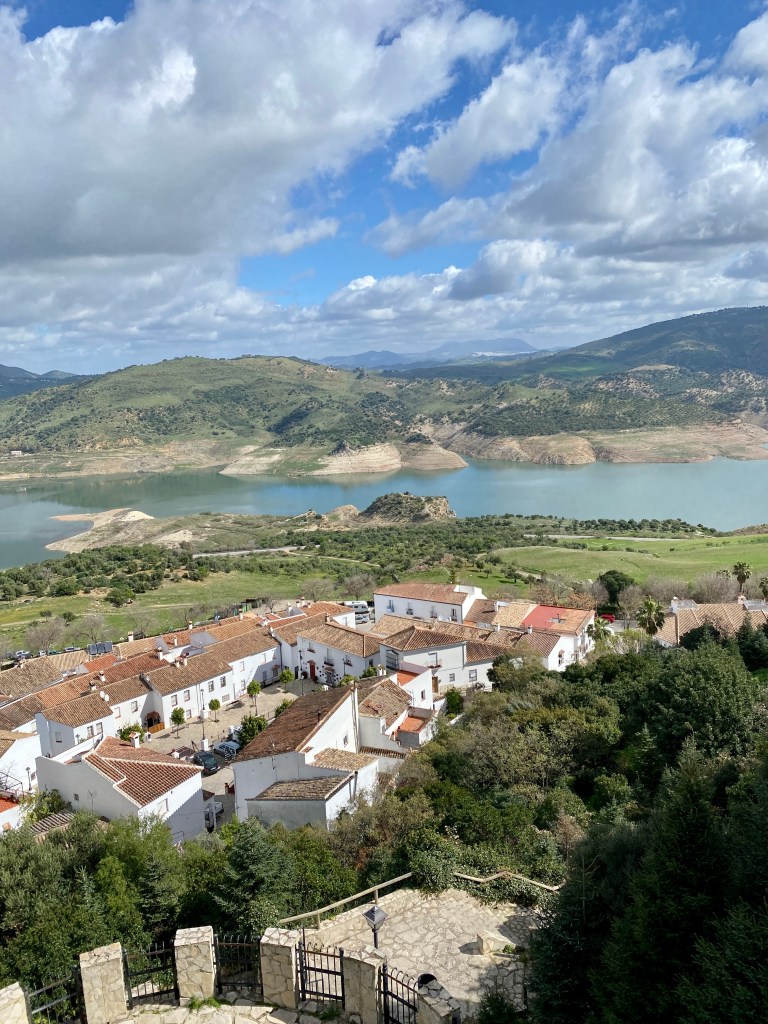
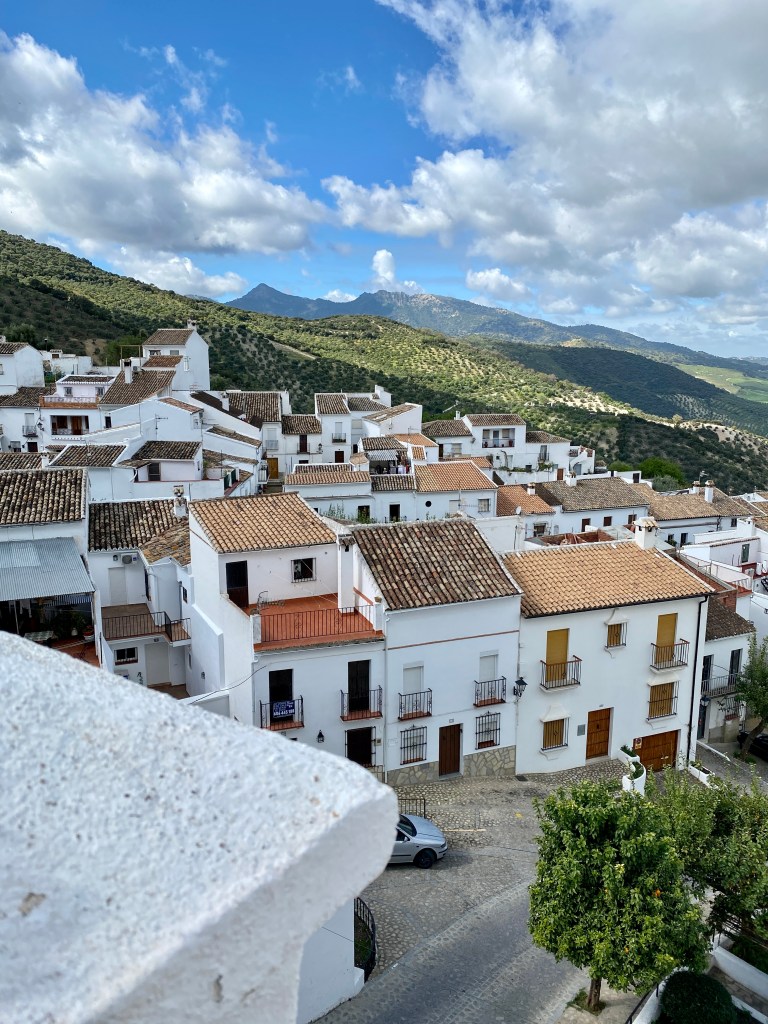
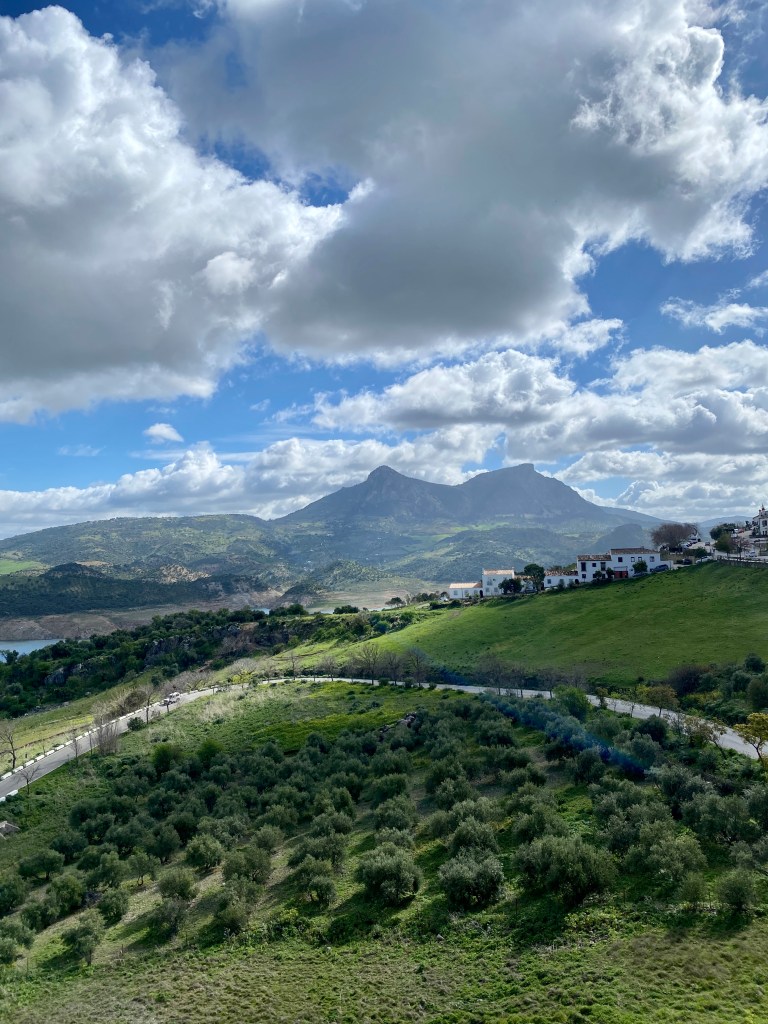
While we had picked two things we wanted to see, we let the expert choose the last destination for us. He chose Zahara de la Sierra, a picture-perfect white town in the hills. In my research, I had seen photos of this town, and it did not disappoint. Perched on a hill with the remains of a fortress above it and a reservoir below it, Zahara is somehow quaint yet impressive. The fortress atop the hill was built in the 13th century by the Moors who held that territory at that time. We discussed hiking up and around it the fort, but decided we wanted to spend more time in our other destinations, so we simply walked the small town, taking photos, and enjoying the beautiful day.

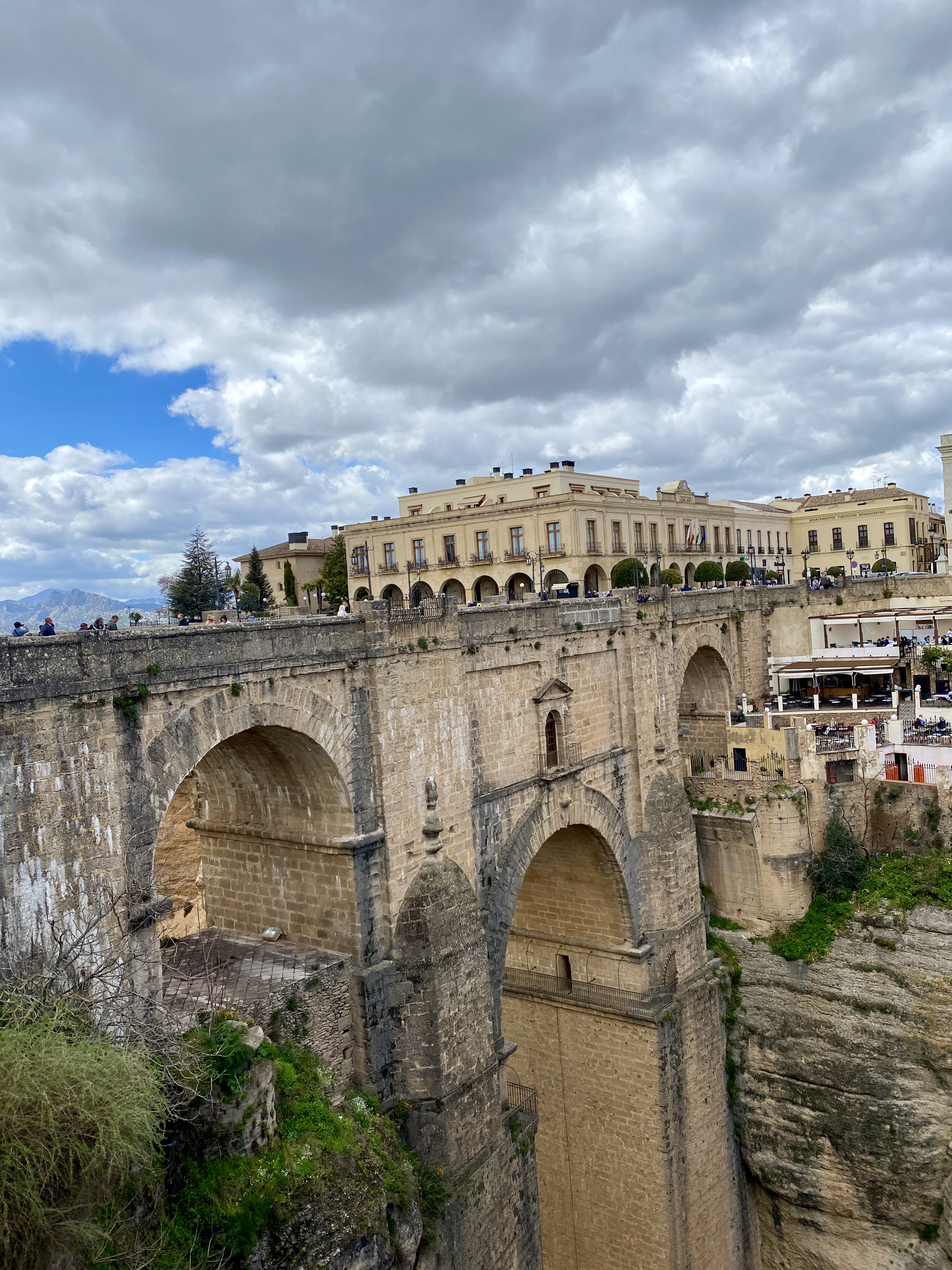
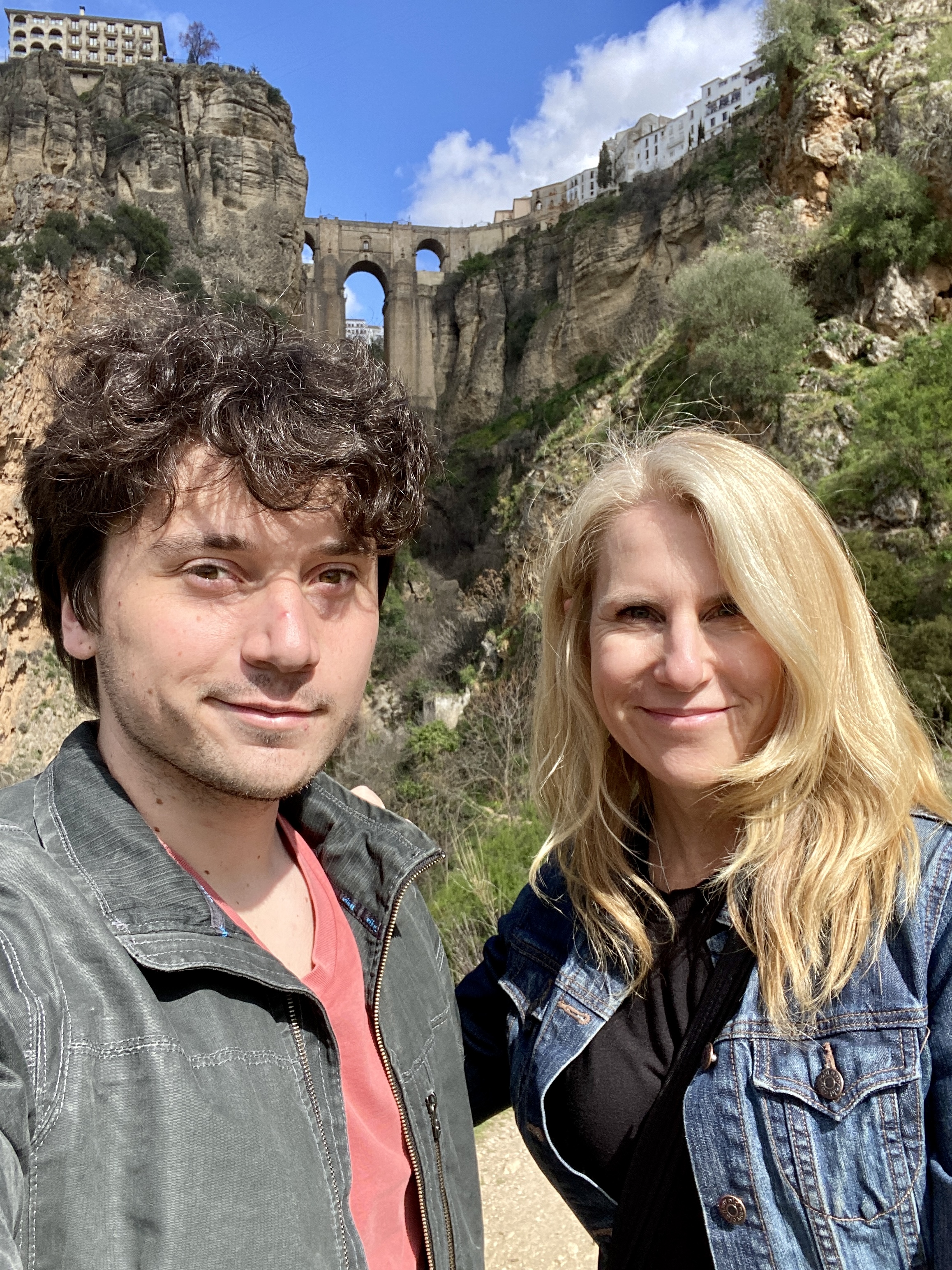
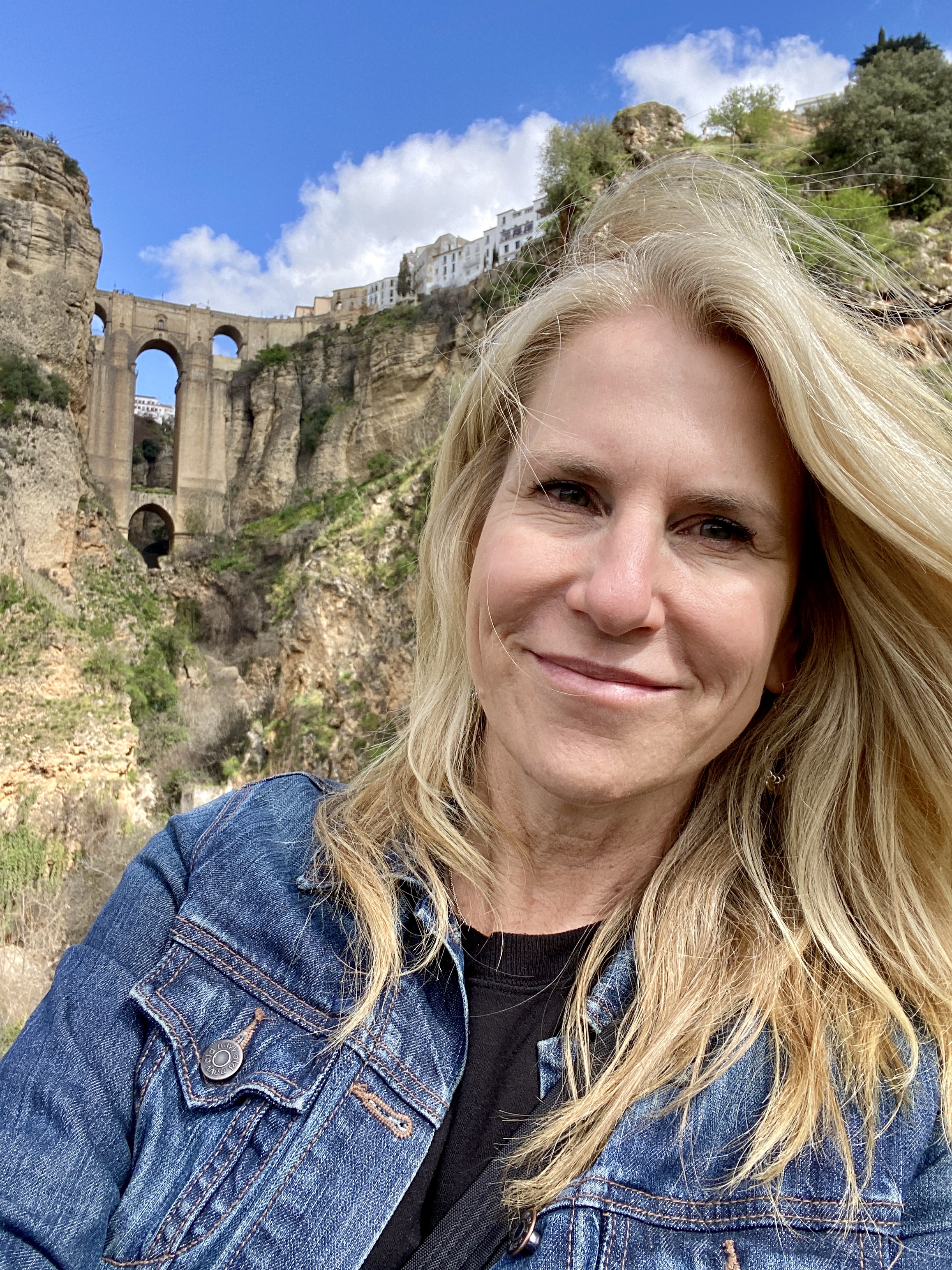
Our next stop was Ronda, which Enrique told us would be busy. He was not wrong. This town (technically a city of 34k people) has surged in popularity since photos of its 18th century bridge, which spans a deep gorge separating the old town from the new town, became widely circulated on the Internet. I often see the bridge pop up in the rotating photos on my Echo Show. There are actually three bridges that span the El Tajo gorge and connect the two sections of the clifftop town. We walked to and over each of the bridges in turn, taking in the scenery before heading into the town. The famous Puente Nuevo (New Bridge) is the most impressive.

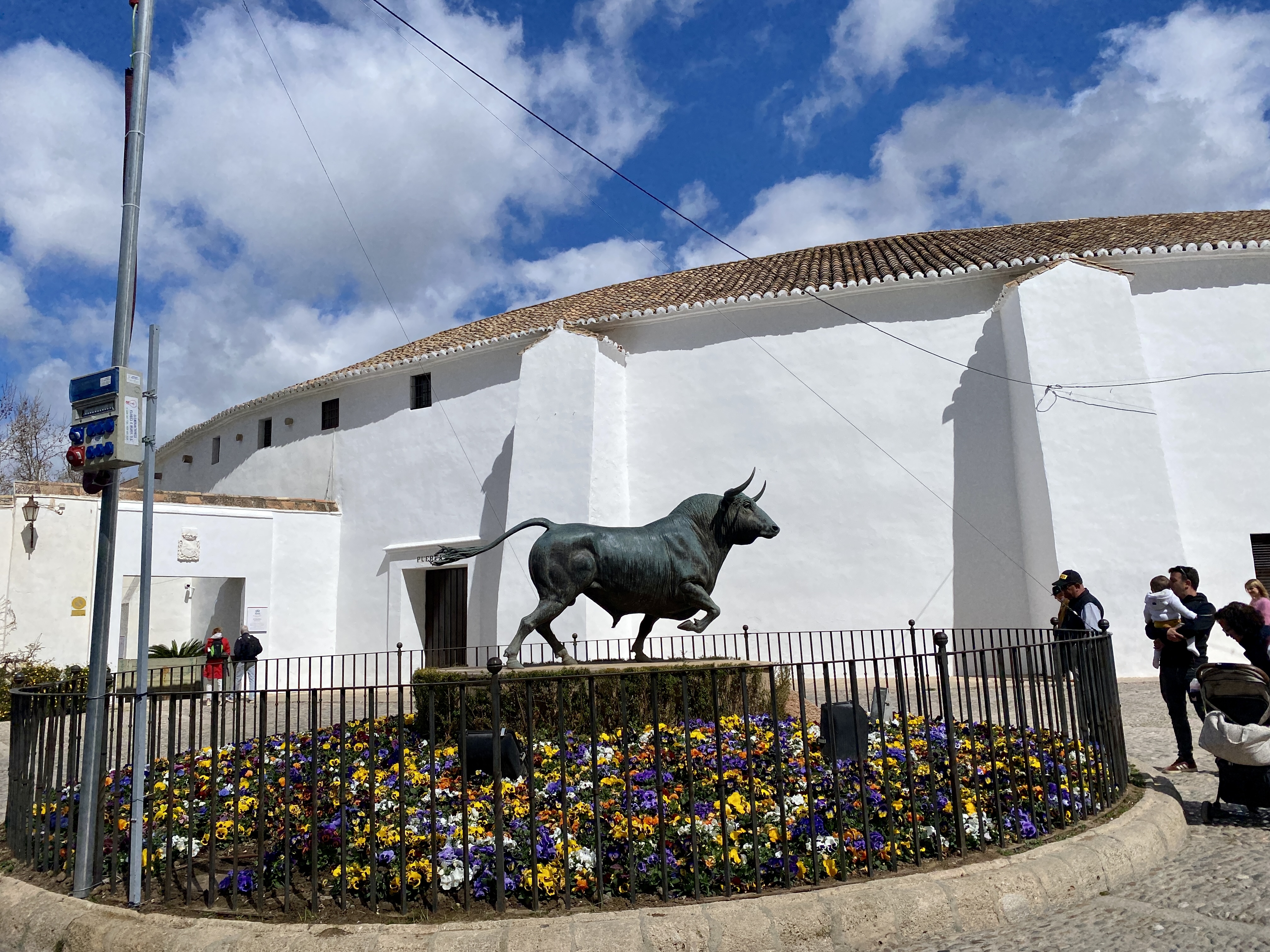
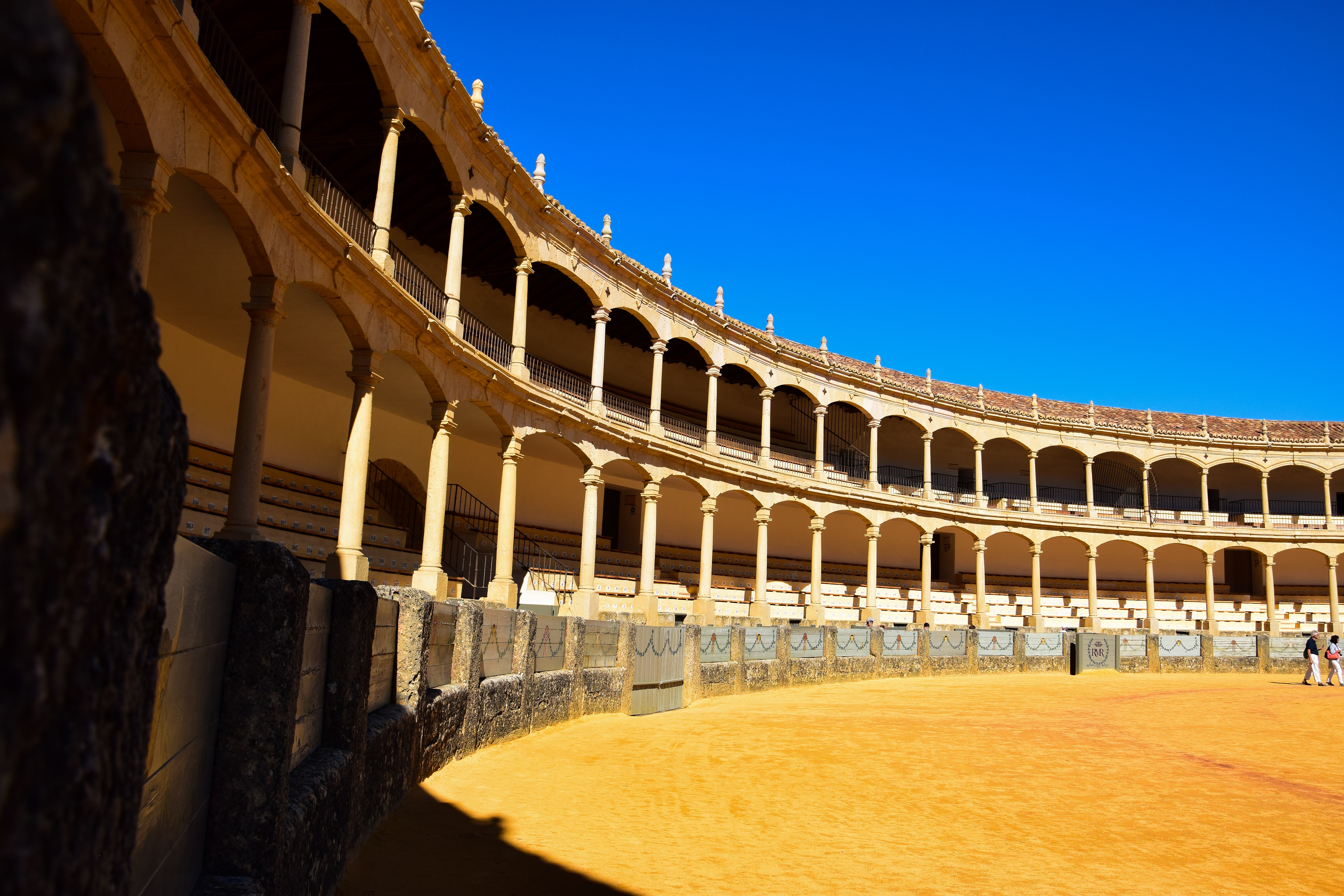
Labeled the Most Romantic Town in Spain, there are cute shops, pedestrian streets, and plenty of restaurants. I can’t attest to how romantic is it, but it is definitely popular and busy. Perhaps the most famous attraction in the town, aside from the bridge, is the bullring. Built between 1779-1785, it is the only bullring in Spain constructed entirely of stone (rather than stone and brick) and it offers covered seating. Enrique told us that bullfighting in Spain is highly controversial. Some consider it cruel and would like it discontinued, while others contend that it is part of Spain’s unique cultural heritage and should be continued as a tradition. I understand the arguments on both sides and, because I am not Spanish, I will refrain from offering my opinion in that debate. I will, however, be interested to see what happens with it.

It was lunchtime, so Enrique guided us to a local restaurant that offered many traditional dishes. Joe had a beer and we shared several tapas, the mushroom croquetas being our favorite. Joe and I also tried the fried anchovies stuffed with ham and piquillo peppers. I wasn’t sure what to expect and I generally only like anchovies in small amounts, but these were pretty interesting.

Afterward, we traveled to the spot where the most iconic photos of the Puente Nuevo are taken so we could add ourselves to the long list of people who have been there. We took the requisite selfies because you gotta. It felt incredible to be standing there finally, years after I discovered its existence and decided I had to see it in person. We didn’t linger long because we were excited to get to our next destination and optimize our time there, but now when that famous bridge pops up on my Echo Show I think, Hey…I’ve been there!

Our final destination was Setenil de las Bodegas. Joe’s girlfriend had sent him photos after she visited there earlier this year and he immediately sent them to me, asking if there was any way we could get there. After seeing the photos, I knew I had to make it happen.

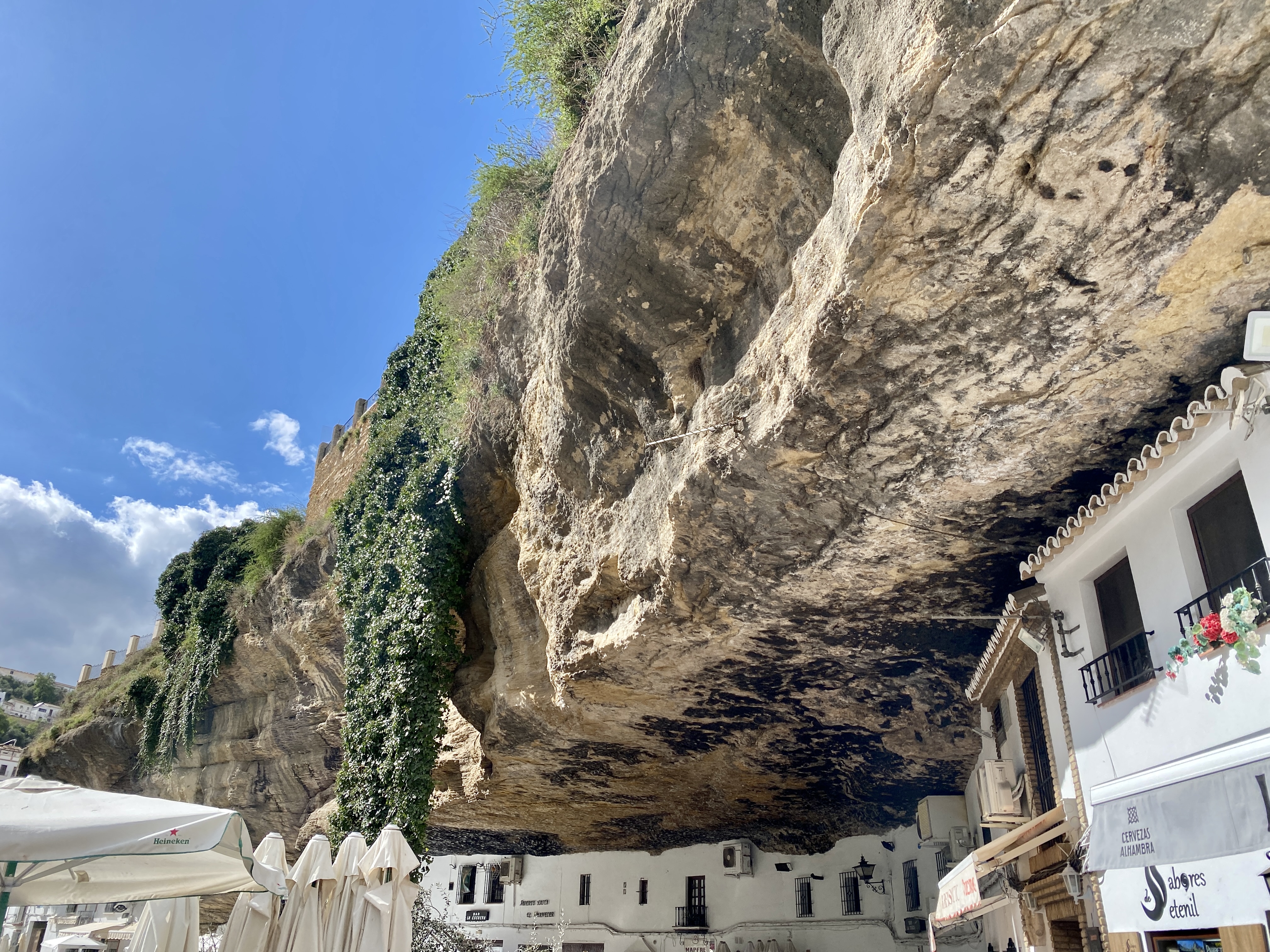
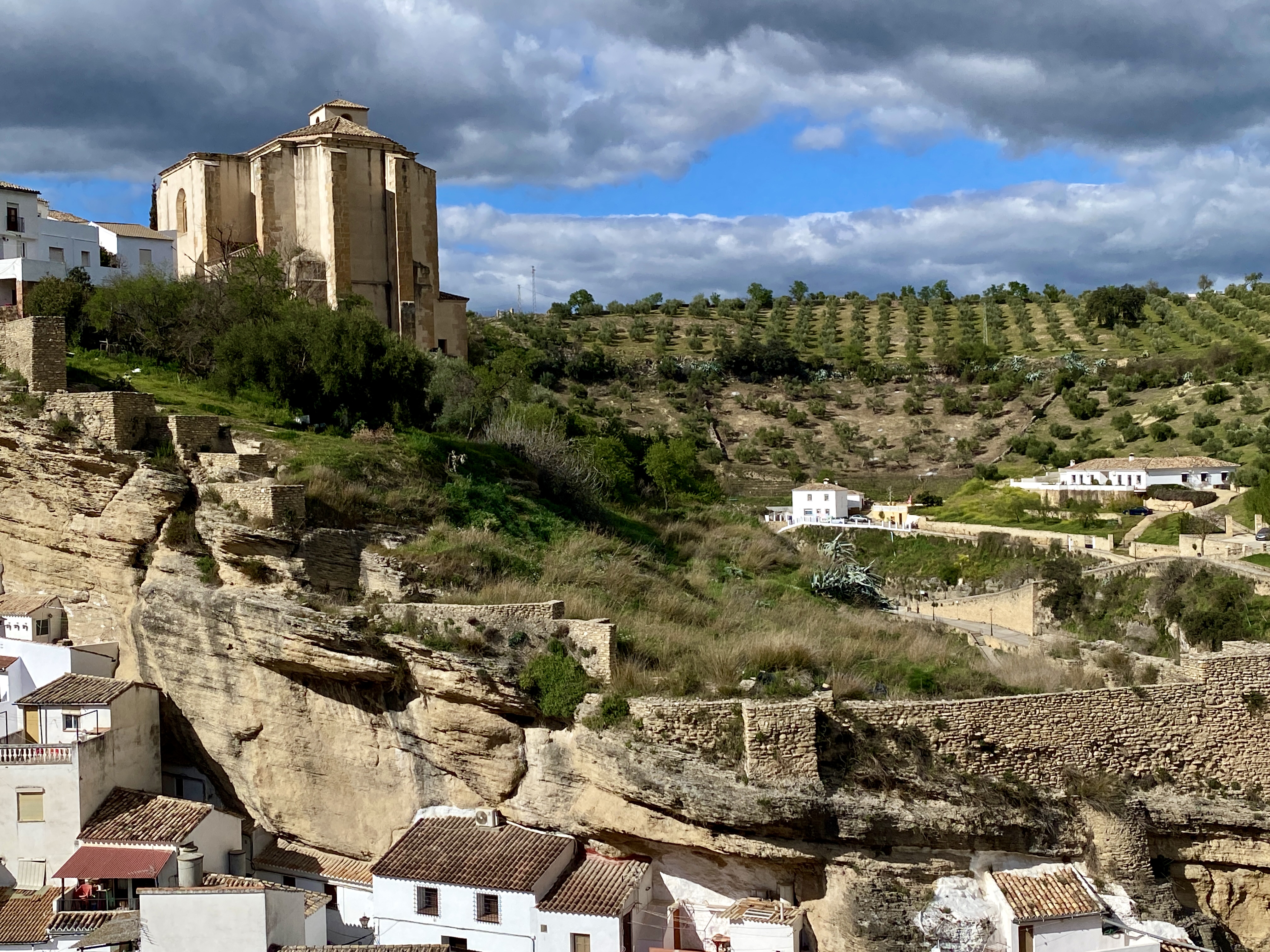
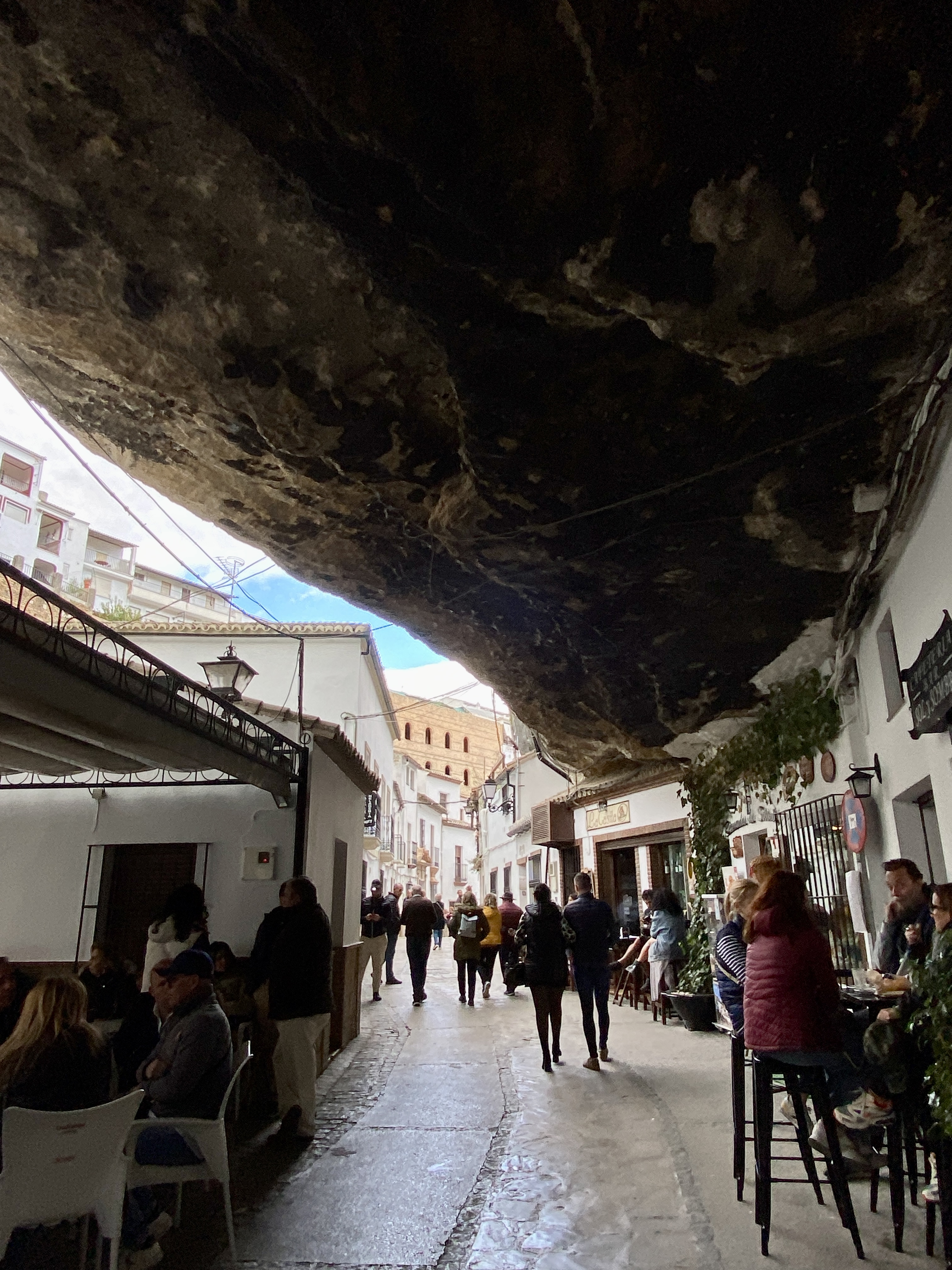
Setenil consists of buildings and cave homes built under and among rocks in a narrow, protected river gorge. The hilltop fortress above the town was built by the Moors. During the Reconquista, the Christians came to take the fortress, which proved to be more difficult than they expected. Due to the settlement’s hidden placement under rocks beneath it, the Moors were able to surprise their attackers from different angles and directions as they approached the fortress. The story goes that the Christians battled for fifteen days to take the town, trying seven times and failing before finally figuring out how they were being defeated and eventually triumphing. The name of the town is believed to be derived from the Latin “Septem Nihil,” which refers to the seven lost battles, “seven times no.” If you find yourself in Andalucía, do not miss this town. It’s something else.

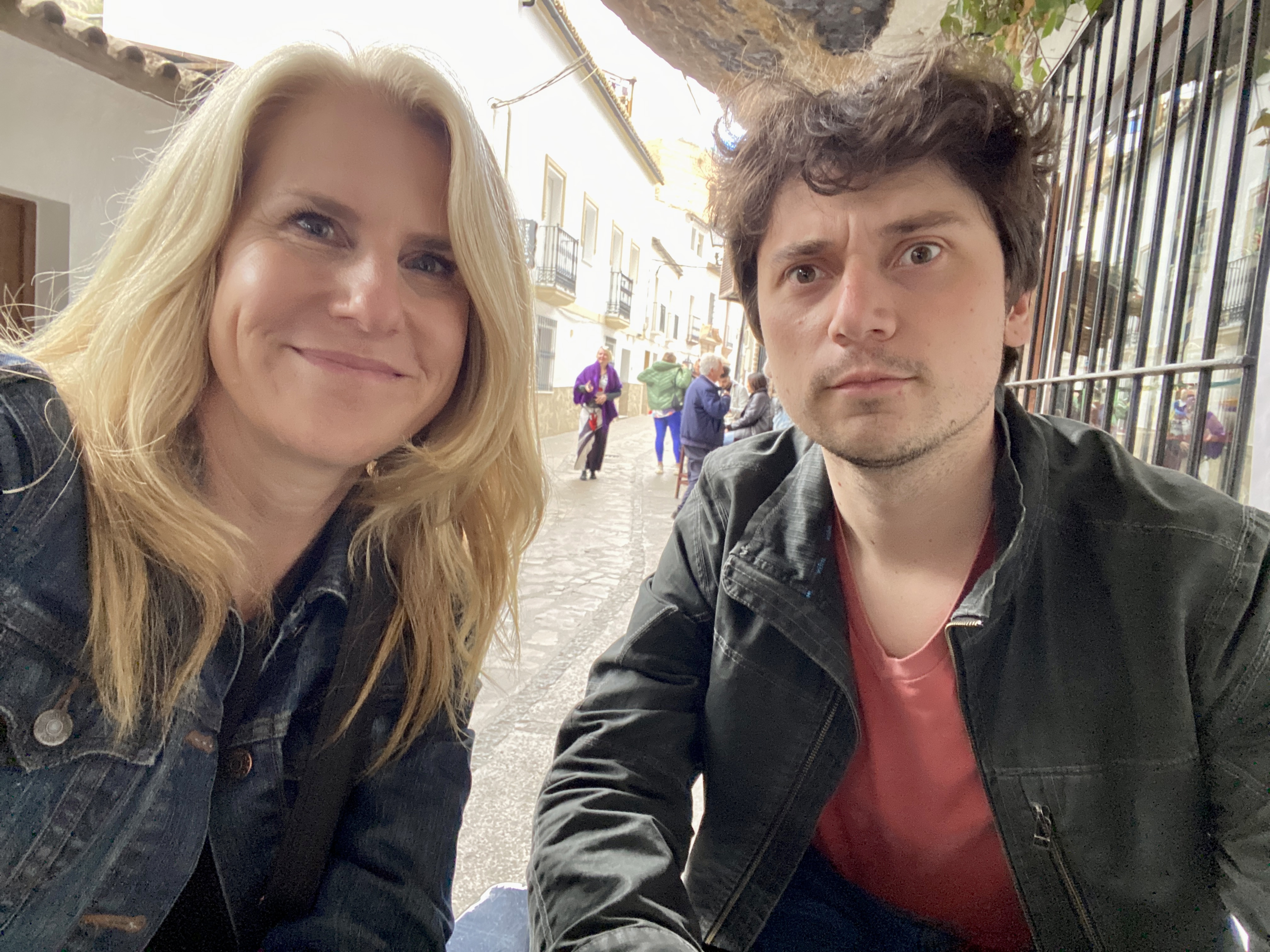
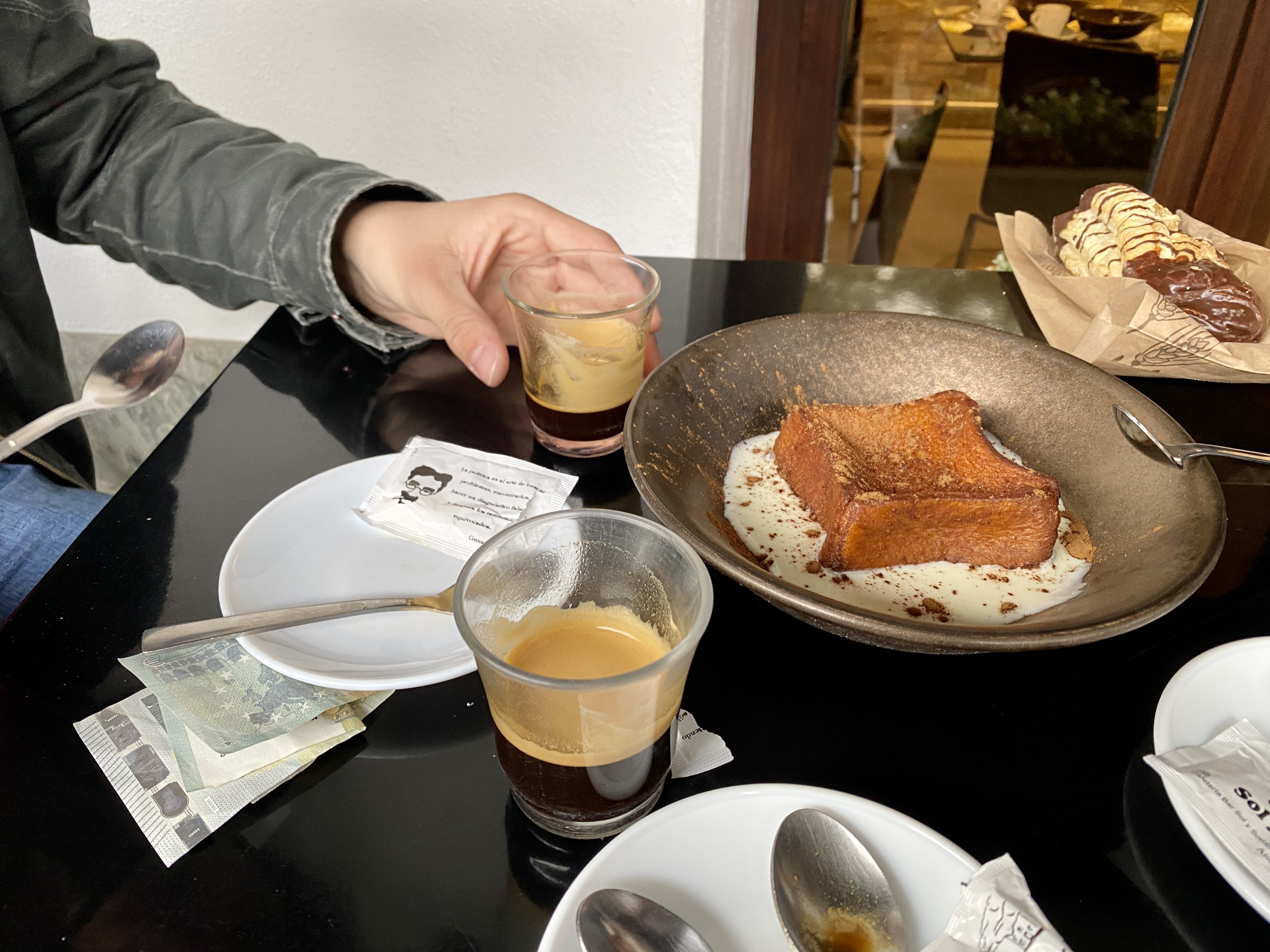
Enrique led us up back roads and seemingly endless stairways to a lookout point from which we could see the fortress, now surrounded by olive trees. It was easy to see how if you approached from one direction you would have no idea what lurked beneath. Joe and I snapped endless photos and, as we walked, I could not stop muttering to no one in particular random phrases like, “Wow. This is crazy. What? Whoa.” We stopped at a small coffee/dessert shop located in a cave under a large section of rock for an afternoon espresso and torrejas (kind of like a Spanish French toast). Our torrejas came served in a white chocolate sauce. Are you kidding me? It was an apt end to our time precious time in Setenil, sitting at a cafe table outdoors, rock overhead, watching people walk by and cars (yes, cars) pass. When we were preparing to head back to Seville, Joe and I snapped a selfie. Joe did what he often does, posing for the photo with a random expression. I adore viewing my photos at the end of a travel day and finding at least one where Joe’s expression makes me laugh. Love that kid.

We arrived back in Seville around 7:30, ten hours after we had begun our journey. We heartily thanked Enrique for the memorable day and headed off to dinner, tired but not yet ready to throw in the towel. We had a couple last things we wanted to do in Seville, so after dinner we walked 20 minutes to find this structure.

Officially named the Metropol Parasol, it is known more casually as Las Setas (the mushrooms). It is one of the largest wooden structures in the world and at night multicolor lights undulate through the grids. It’s such a juxtaposition to the buildings surrounding it, yet somehow it seems to fit in just fine. I’m glad we went to see it lit up at night. I now wish we had gone up to take in the night view from the top (we didn’t realize you could do that), but at least now I have another reason to return.

Exhausted, we walked back to the hotel and collapsed. Fitbit recorded 23,516 steps and 86 floors for me that day. I would do it again tomorrow.

A Day In Seville

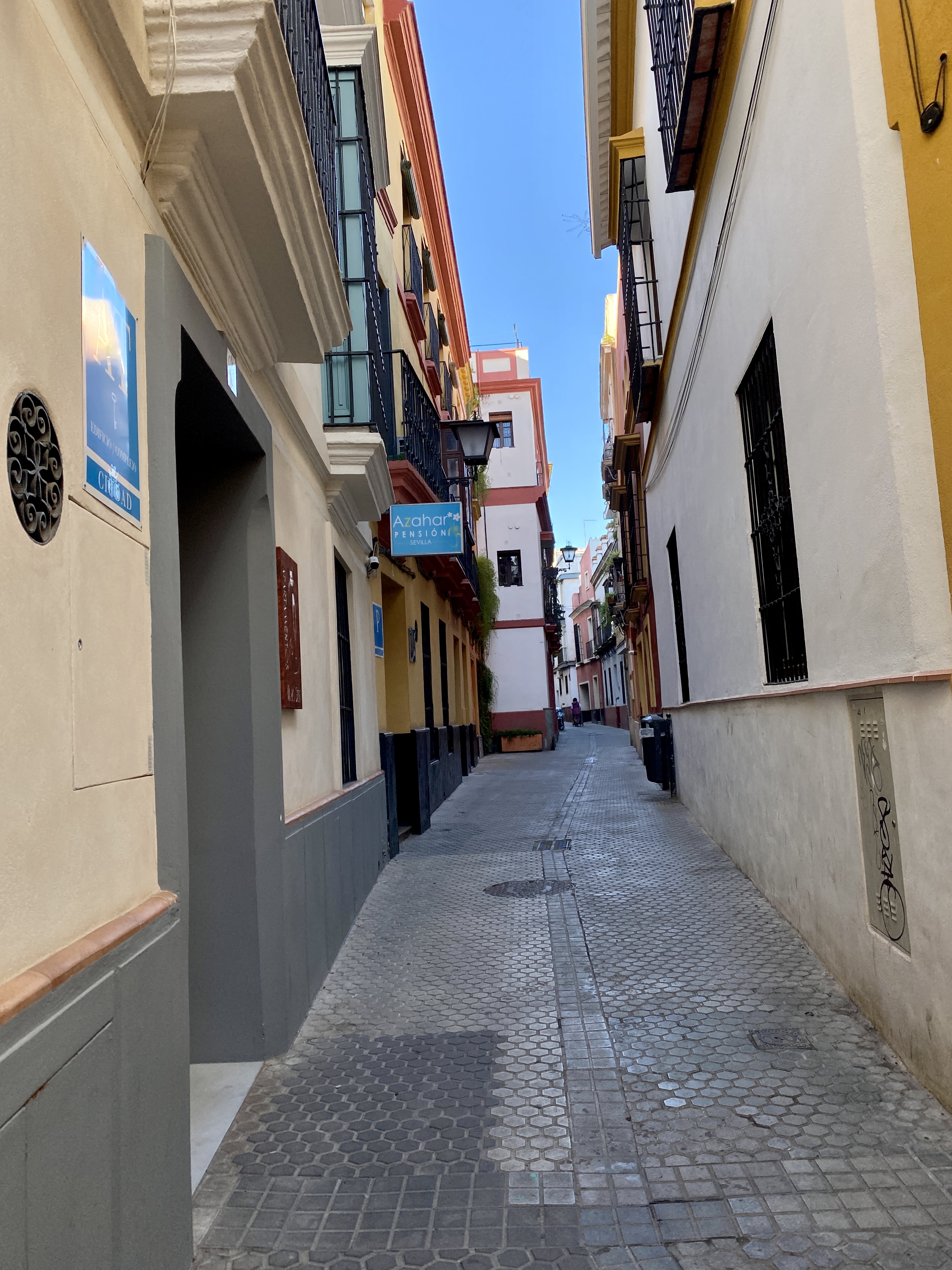
Narrow pedestrian street in Seville

The next stop on our whirlwind Spain trip was Seville. We had limited time there, so I had it planned with little room for error. We hopped on a 6:30 a.m. train from Granada and arrived around 9 a.m. After dropping our bags at our hotel, we hit the Starbucks that was on the way to our tour of the cathedral and the Alcázar.

Although I normally eschew American food chains in other countries, one great thing about them is you usually find foods and beverages you can’t get in the US. And we did. In addition to my compulsory oat milk latte, we ordered bocadillos so we didn’t start our day hungry. Bocadillos had quickly become Joe’s favorite new thing. I mean, how do you go wrong with crusty bread, Jamón Iberico, and manchego cheese? You don’t.

We headed to the meeting spot for our tour and prayed we would find our guide among the throng of tourists. We must have looked lost because someone with a tour group list approached us and got us sorted. The Seville Cathedral (Catedral de Sevilla), a UNESCO World Heritage Site, is the largest Gothic cathedral in the world. Our guide said it is also the third largest cathedral in the world. I thought the Granada Cathedral was impressive, but this was something else. So large and grand, it was impossible to capture it all (or even most of it) in one photo or in one visit. To demonstrate the scale, I had Joe stand next to a pillar.

Feeling small in the big, wide world

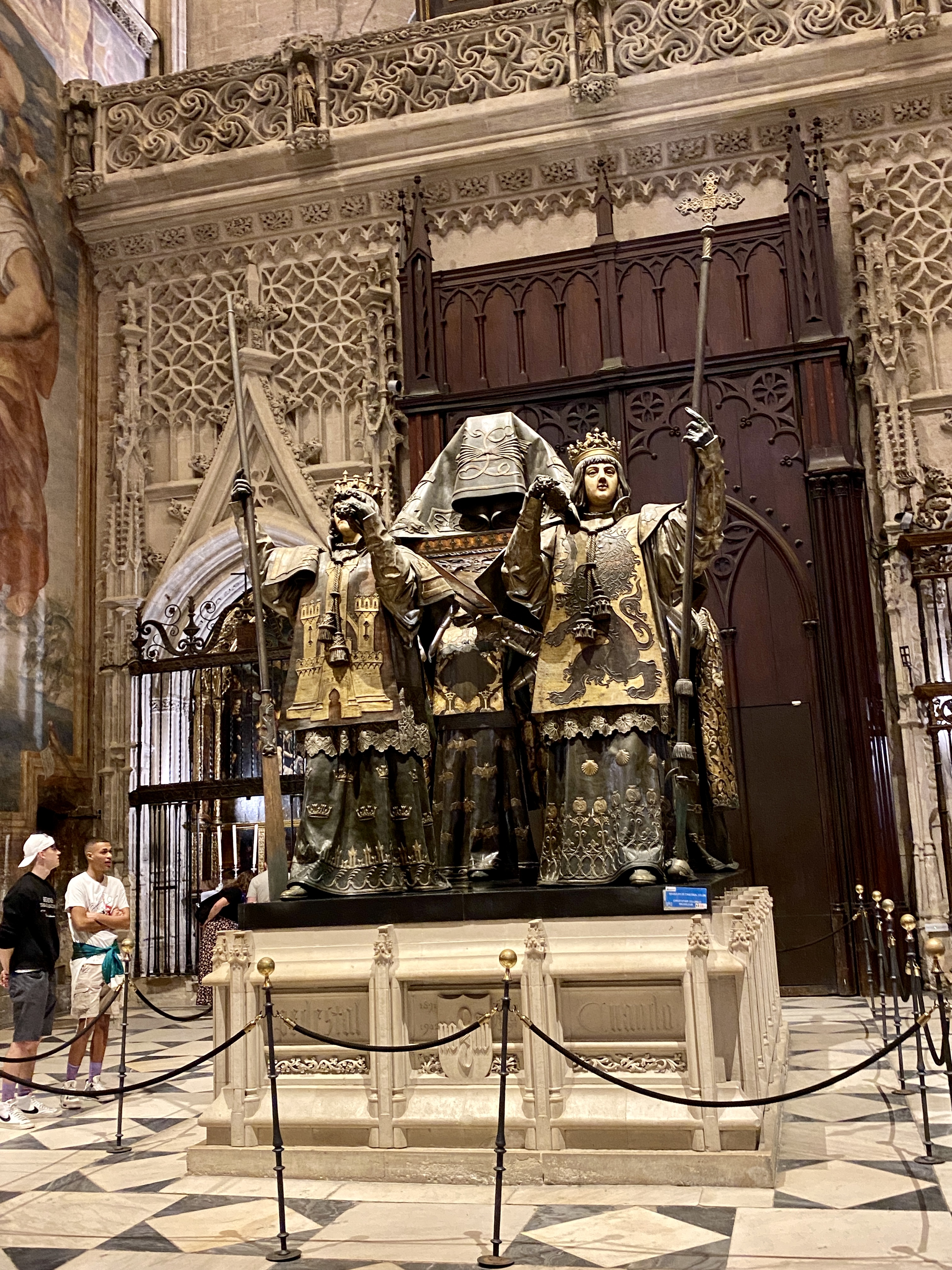
Our guide first showed us an impressively large painting called The Vision of St. Anthony, painted in 1656 by Bartolomé Esteban Murillo. In 1874, some knuckle-headed thieves cut St. Anthony out of the painting and made off with him. They then attempted to sell the canvas to an art gallery in New York. Fortunately, the owner of the gallery recognized it as the missing piece, bought it for $250, and returned it to the Spanish Consulate. If you look at the section of the painting above St. Anthony’s head you can see a line that shows where the cut was made. Funny to think St. Anthony, patron saint of missing items and lost causes, managed to get himself returned. He does good work. Another item of note in the cathedral are the remains of Christopher Columbus. Yes. THE Christopher Columbus. Or, as our guide explained, about 300 grams of him. No one is entirely certain where the rest of the remains are. But at this time, in the Seville Cathedral there are verified remains of Christopher Columbus, a man who traveled more after his death than during his life. There is also an impressive altar, Altar Mayor. The altar features wood-carved depictions of the lives of Jesus and Mary and took 80 years to complete. Hard to tell from the photograph because of the gates protecting the private chapel, but the altar is 66 feet high and 60 feet wide.

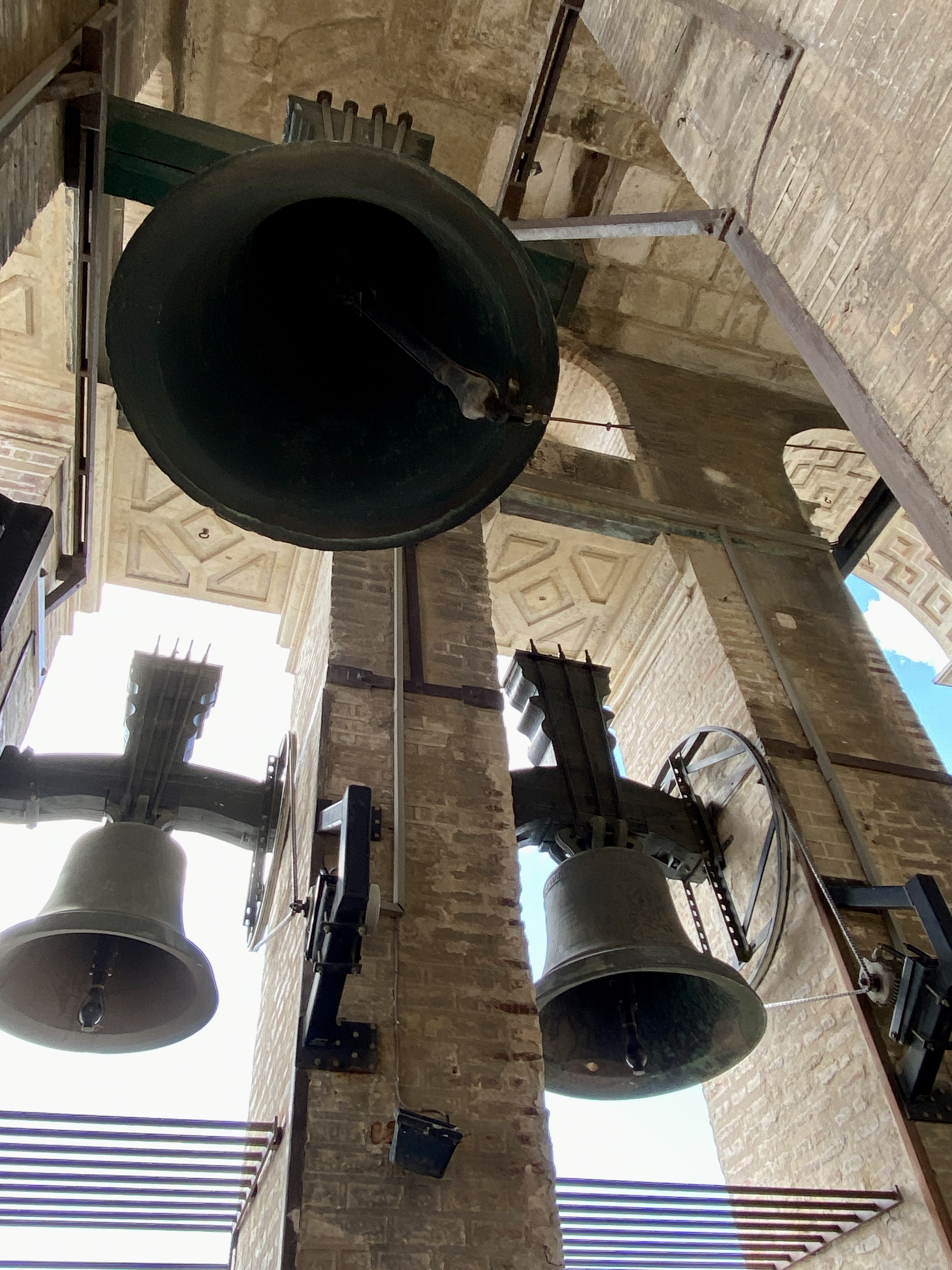
After the cathedral tour, we had the opportunity to climb the Giralda Tower. Thirty-five ramps and 16 stairs transport you the top where Seville spills out in front of you. It was definitely worth the trek up. The tower itself was initially built by the Moors as a minaret, but after the Catholics took over they added a Renaissance-style belfry to complete the tower we see today.

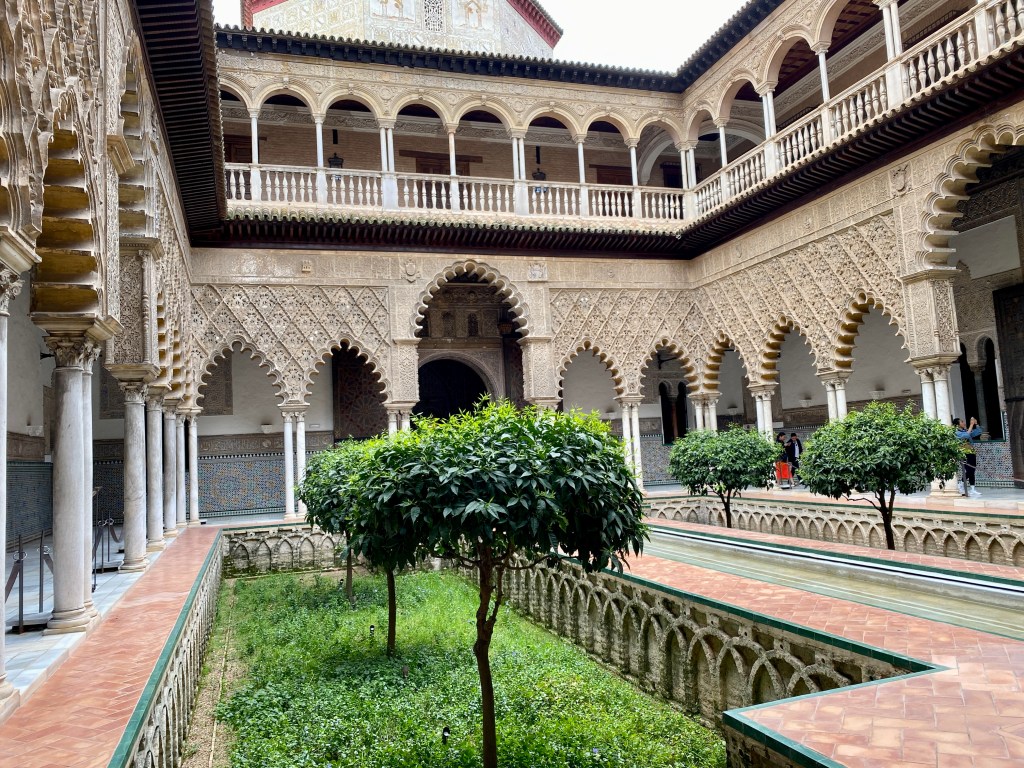
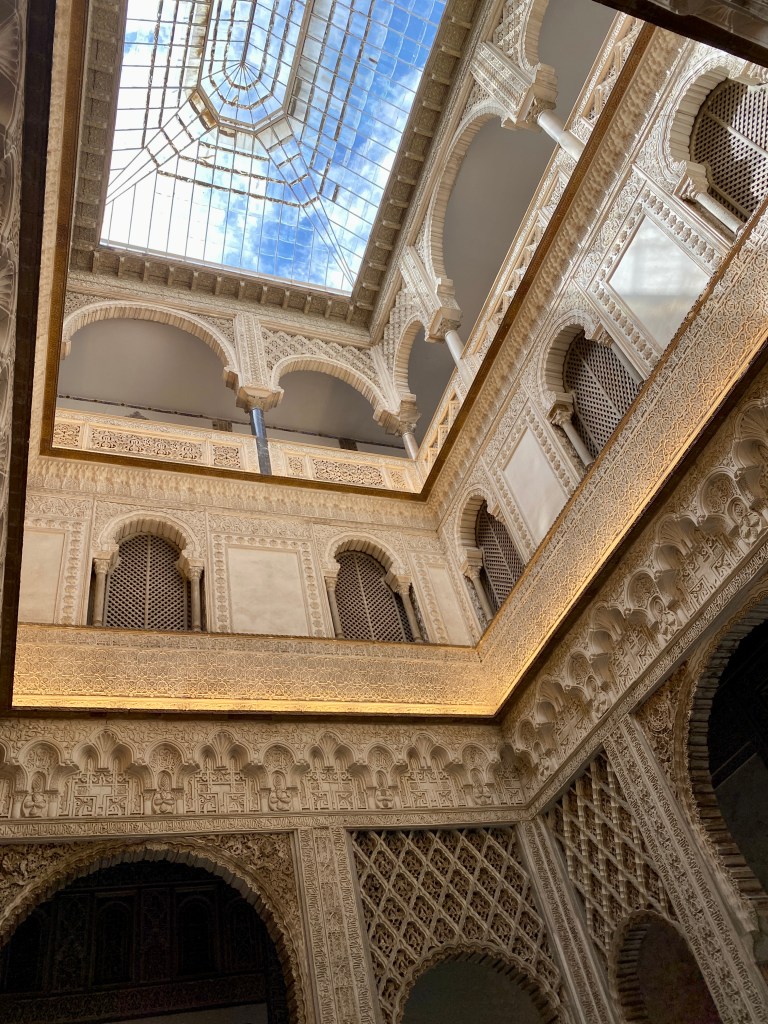
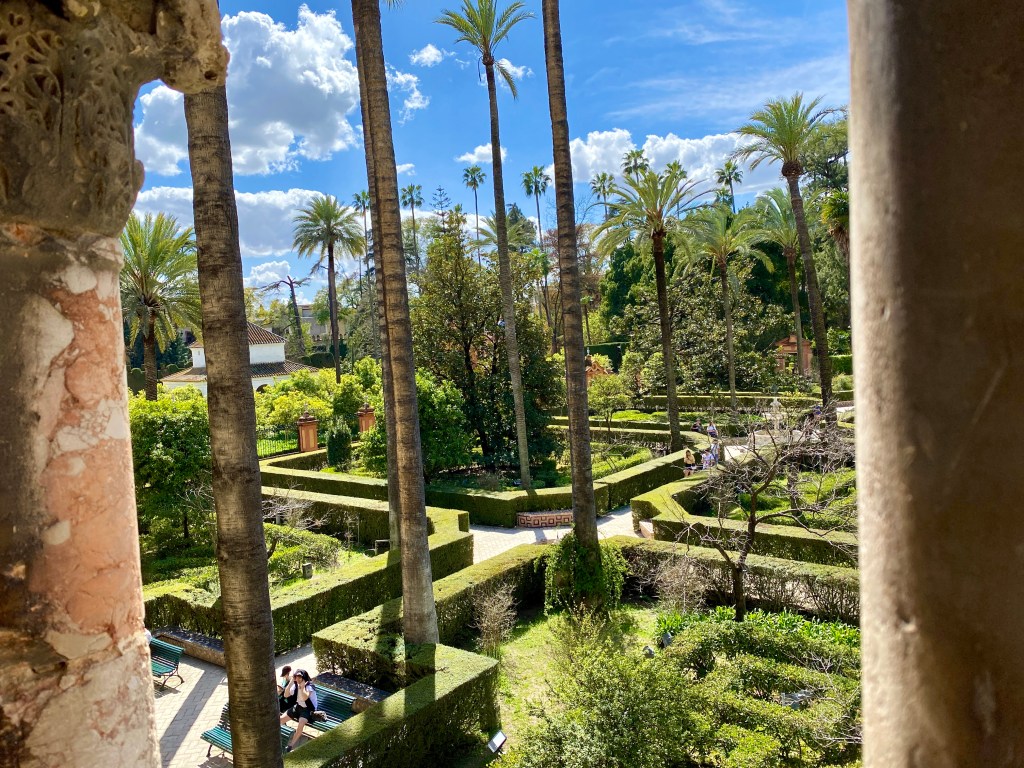
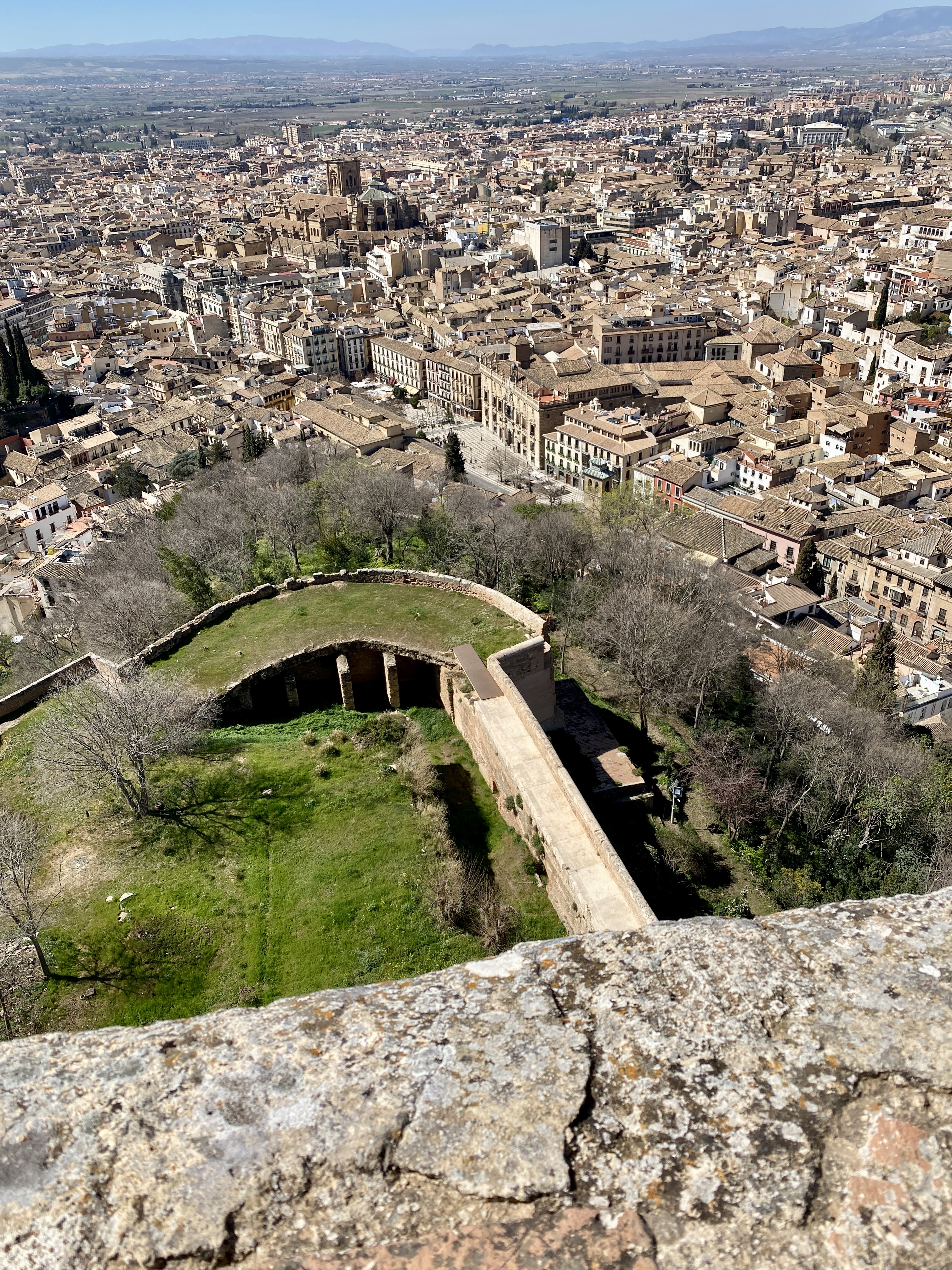
Next stop was the Alcázar of Seville, another UNESCO World Heritage Site and the oldest royal palace still in use in Europe. Its name means “fortification” and, indeed, you pass through a fortified stone wall to enter the courtyard where the palace sits. The Alcázar appears Moorish, however it was designed and built by Muslim workers but commissioned by a Christian king more than 100 years post Reconquista. In addition to the ornate palace, there are nearly 25,000 acres of gardens to visit. I wish I could say we had time for all that but, alas, we did not. Still, here are some photos.

Trying to fit in as much of Spanish culture and time with actual citizens as possible on this trip, I had booked a guide for a food tour and a flamenco show. Elena is a Seville native with a foodie instinct. A teacher by day, she does these tours in the evening to fund her love of travel. First, she took us to try an aperitif of Spanish vermouth, white wine fortified with spices, herbs, and botanicals and then aged in barrels. So delicious. Joe and I were surprised how much we liked it. After all, it is called vermouth.

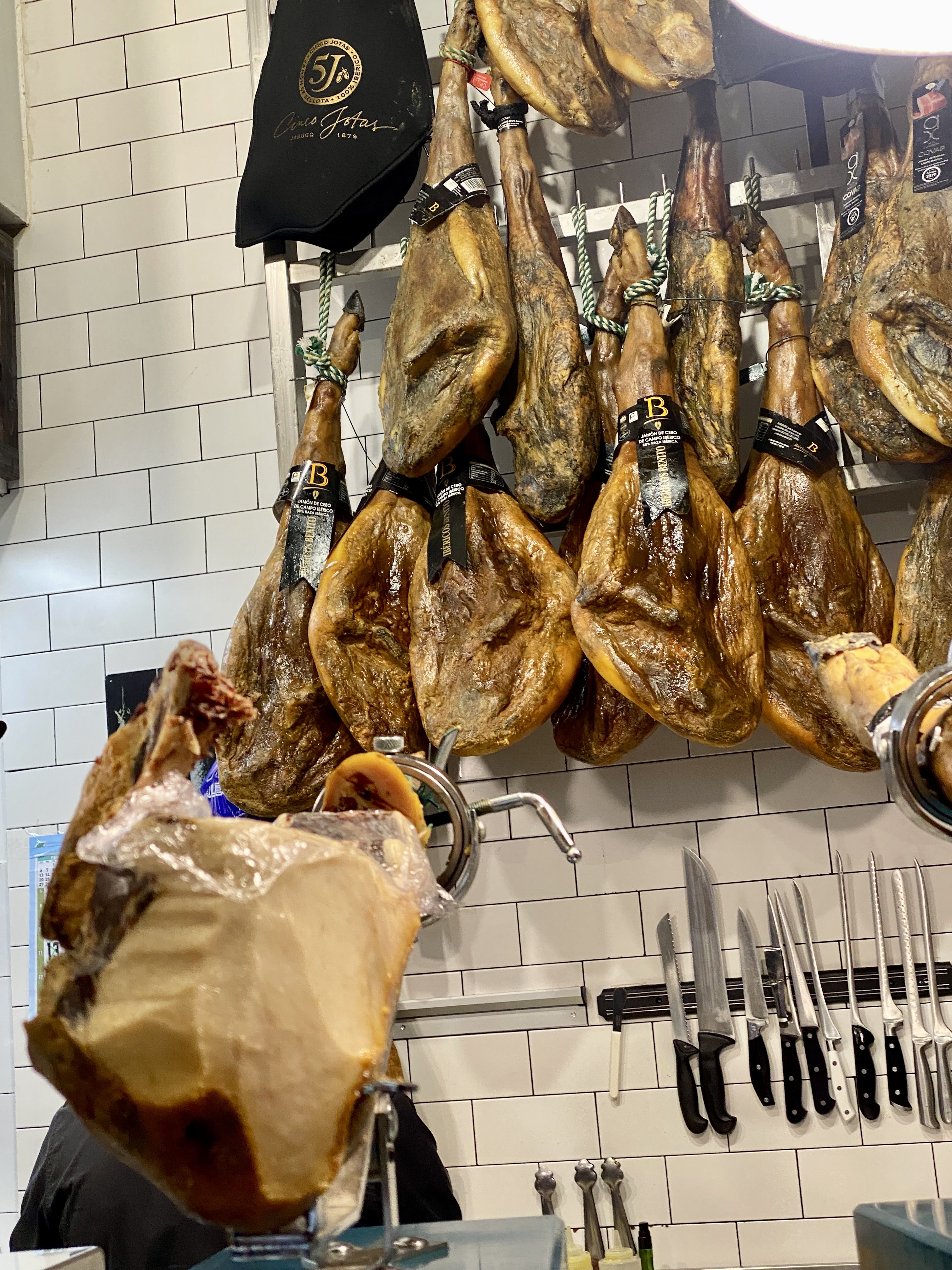
After our aperitif, we went straight into the pork. The Spanish love pork. The black-hoofed hogs that graze on acorns in the Spanish countryside are the reason. The acorns are filled with lovely fats that make their meat like nothing else, melt in your mouth gold, similar to Italian prosciutto but with a more intense flavor. Elena made a point of telling us that these pigs are free range and live great lives, until they become dinner, of course. After eating Jamón Iberico, I began to understand how one would arrive at that justification to ease your ham-eating guilt.

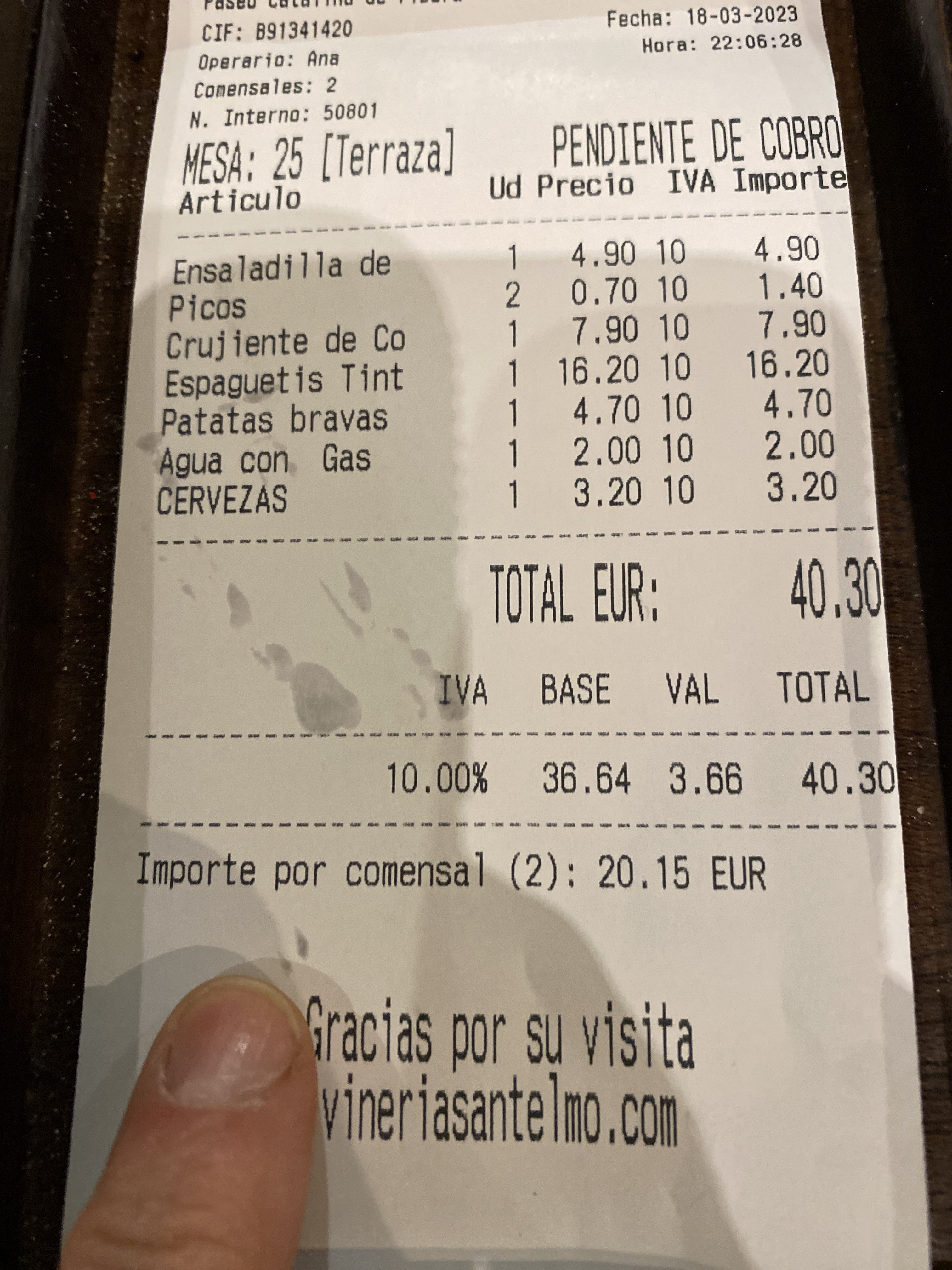
So many different ways to have it prepared, using as much of the animal as possible. All of them are amazing. After our snacks, we headed to a restaurant that prepares serves up Spanish dishes with little modern touches. The food was wonderful and the prices were quite reasonable, so we returned the next night for ensaladilla de Rusa (potato salad with tuna), patatas bravas (potatoes with a red sauce the Spanish call “spicy”), and squid ink spaghetti with scalllops, prawns, and seafood. While we were eating, Elena talked to us about the history of flamenco, the costumes, and the how the performances work. Her father was a student of the different flamenco styles, and he passed his love of the art onto a younger Elena who learned to dance “for the dresses.”

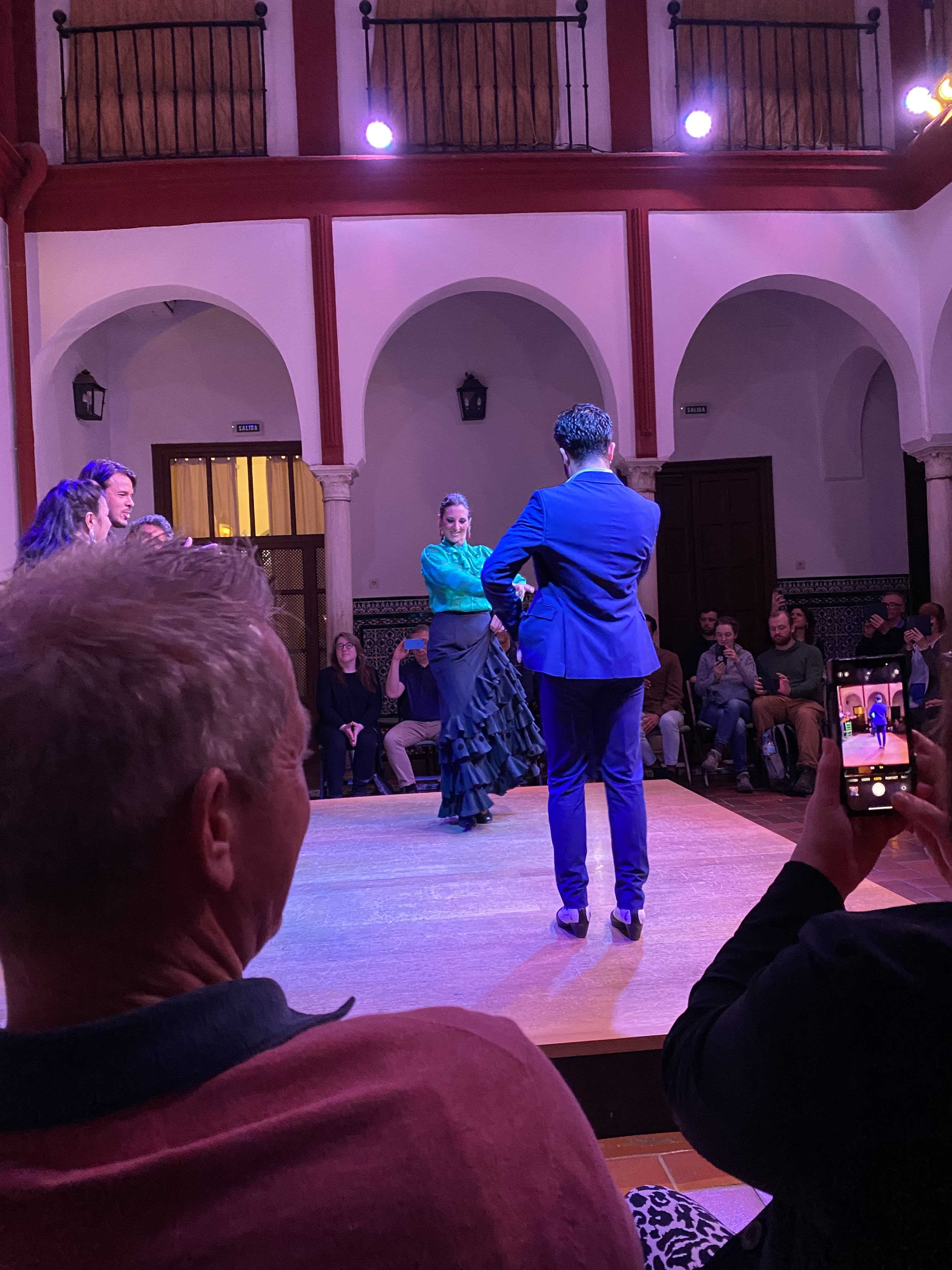
After we were stuffed, we walked to the show. What made it so much more impressive than I expected is that Elena explained that the shows are not choreographed. The music, the vocals, and the dance are all improvised. Clapping by the performers creates a percussive beat. We observed each performer watching the other performers for cues and changes so they could work together to create a cohesive performance. The singers, dancers, and guitarists combine their unique styles of flamenco and somehow manage to finish the performance in sync, despite not being choreographed. At the venue we were at, the performers are changed daily. So it is likely that the five persons on stage have not all performed with each other in that exact combination before, which demonstrates just how improvisational flamenco is. Photos and videos were forbidden during the show, but they did one last short song so we could get the obligatory photo.

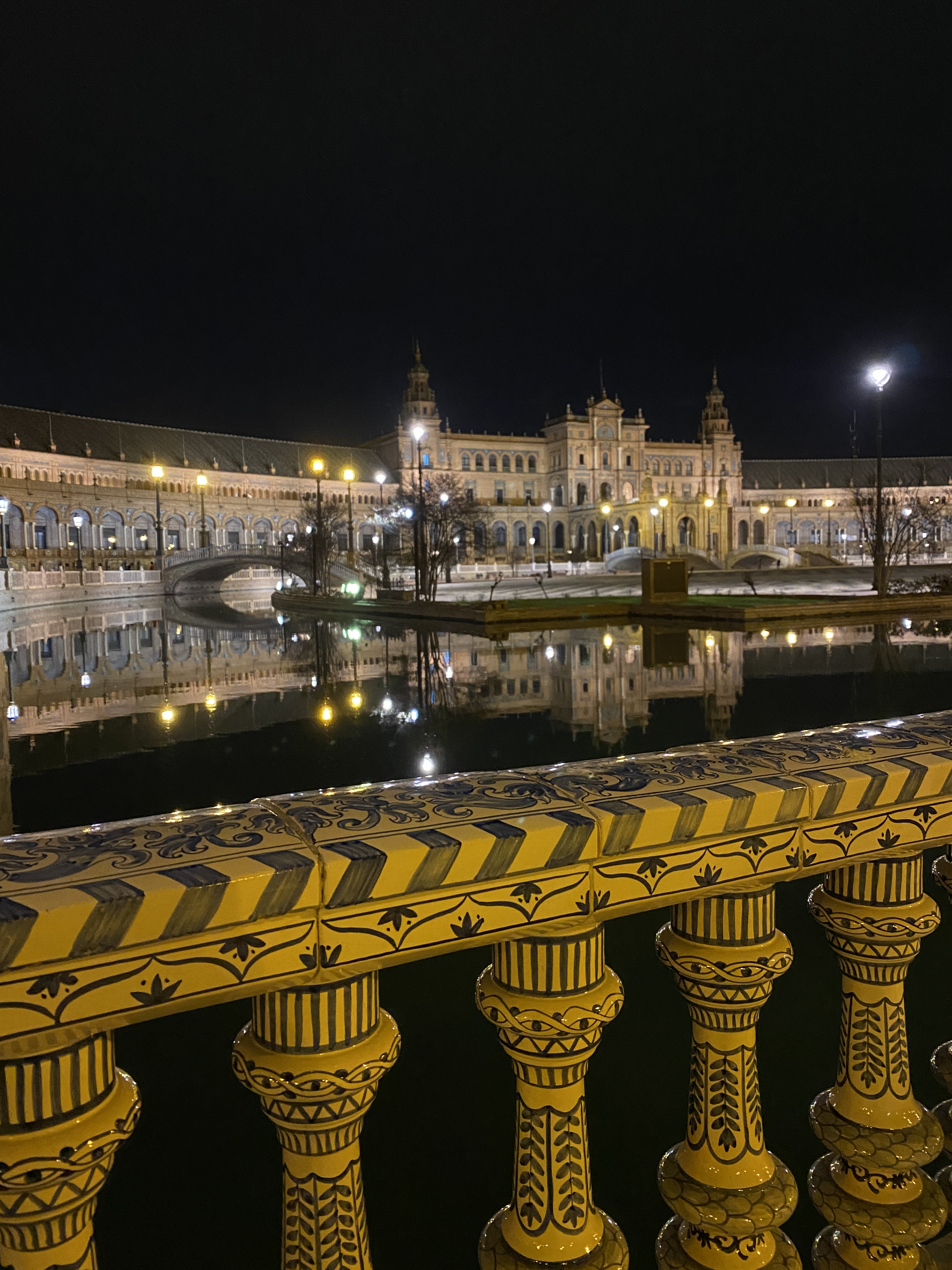
The show finished around 9:30 p.m. and, although we had already garnered over 20k steps, we decided to go to the Plaza de España in case we ran out of time for it the following day. Built for the Ibero-American Exposition of 1929 in Maria Luisa Park, the buildings in the plaza form a huge semi-circle and the buildings are accessed by crossing bridges over a moat. It is now is used as a government office building, but you have to see the architecture because it is iconic. We were walking around the plaza and being silly, pretending to fall into the moat and fountains, when we were spied by security personnel. Apparently, we were there past hours. In our defense, the gates were open and nothing suggested we shouldn’t be there until a guard showed up in an electric vehicle and started yelling “Cerrado” at us. Oops. So, I guess the area closes at 10 p.m.

We beat a hasty retreat and returned to explore the hotel. The hotel is music themed with rooms named after famous composers, and it has small salons where musicians can practice. We stopped in at the rooftop patio, which featured a hot tub, a small pool, and a bar. From the roof, we took a pause and our final photos of the day.

The Seville Cathedral lit for the night

Next up, Ronda and the white towns of AndalucÍa.

You Oughta Go To Granada

In mid-January, I seized upon an opportunity to plan a quick spring break trip to Spain with my son. With two months to prepare, I cashed in my United reward miles and booked hotels, train trips, and tours. Then I began the arduous task of determining how to fit 9-days worth of clothing into a backpack, and I learned packing for a trip is the quickest way to figure out you hate all your clothes. Still, I made it work. The bag was not light and I am not the fittest, but I was going to Spain and I could suffer for 9 days. As it turns out, I didn’t suffer much.

Granada

Our first stop was Granada, a city of about 115k people in the Andalucía region of Spain, where Joe planned to spend as much time as possible with his girlfriend who is studying there this semester. I planned to take some tours and relax. The one thing Joe and I had scheduled to do together in Granada was tour the Alhambra, the most visited site in Spain and a masterpiece of Muslim art in Europe. This is where things went awry on our very first day. Not a good sign. I had a tour booked for us, but when we got to the meeting place there were so many other groups of tourists we could not find our specific group. There were no signs to aid us in our search, so Joe wandered from group to group asking if we belonged there. But the guides kept pointing us in different directions toward other groups. In the end, by the time the tours had begun, no one had claimed us. That was strike one. Undeterred, I went to the ticket window figuring at least we could do our own viewing, and I purchased two tickets. Sadly, they were not the right tickets, as tickets to the palaces we most wanted to see were sold out. I didn’t catch that with my measly Spanish. That was strike two. Joe was devastated. He tried not to be too upset and to play positive because he knew how miserable I felt for twice messing up the the ONE thing he wanted to do. Still, he was visibly disappointed, and I was disconsolate for failing my son. We did the sightseeing we could at the Generalife (the gardens and vacation home for the inhabitants of the palace) and the Alcazaba (the fortress that is the symbol of the Alhambra complex) and went our separate ways for the evening.

I lost it as soon as I got to the rental flat and cried for a while. Then I did what I always do. I got determined to find a way to make it happen. Searching online for at least an hour, I discovered there were zero tickets available for the Nasrid palaces for the next few days, either from the site itself or as part of any regular tour with any tour company I could find. Then, finally, some light crept in. Around 9 pm, I discovered there might be a possible opportunity via a private tour. It was not inexpensive, and after my two previous ticket foibles I had already exhausted too much money in this quest. But it made zero sense to have traveled all the way to Spain not to see the one site Joe, a religion and middle east studies major, most wanted to see. So, I booked it.

Turns out it was the best money I have spent in a long time. Our tour guide, Isa, was a delight. She’s an architect who literally grew up at the Alhambra because her mother, also an architect, had worked on restoring the site when Isa was a young girl. We couldn’t have lucked into a better situation. While we toured, Isa told us the history of the location, pointed out small details she knew about that others might not, and spoke Spanish with Joe’s girlfriend who wanted the practice. We spent three hours touring with Isa, talking with her about the site and about Granada, and we learned so much more than we ever would have learned in a 25-person tour. But my biggest takeaway from the series of events in those 24 hours is that sometimes when the lights fade on your vision in one way, they illuminate elsewhere and lead you to much better opportunities you might never have encountered otherwise. And yes, the third time’s a charm.

The Nasrid Palaces, built between 1238 and 1492, are awe inspiring. Although my photos miss much of what you see in person, let me use them demonstrate the beauty of the architecture and design.

Most of the color on the walls has faded with time, but if you look carefully you can see remnants of what once was there. Can you imagine how beautiful the interiors here were seven hundred years ago? You were meant to feel small here, humbled by the wealth and power of the Nasrid dynasty. I wish I could have spent days wandering and taking it all in but, alas, all good tours must come to an end. And so we said goodbye to Isa, and I went back to the flat feeling so much better than I had the night before.

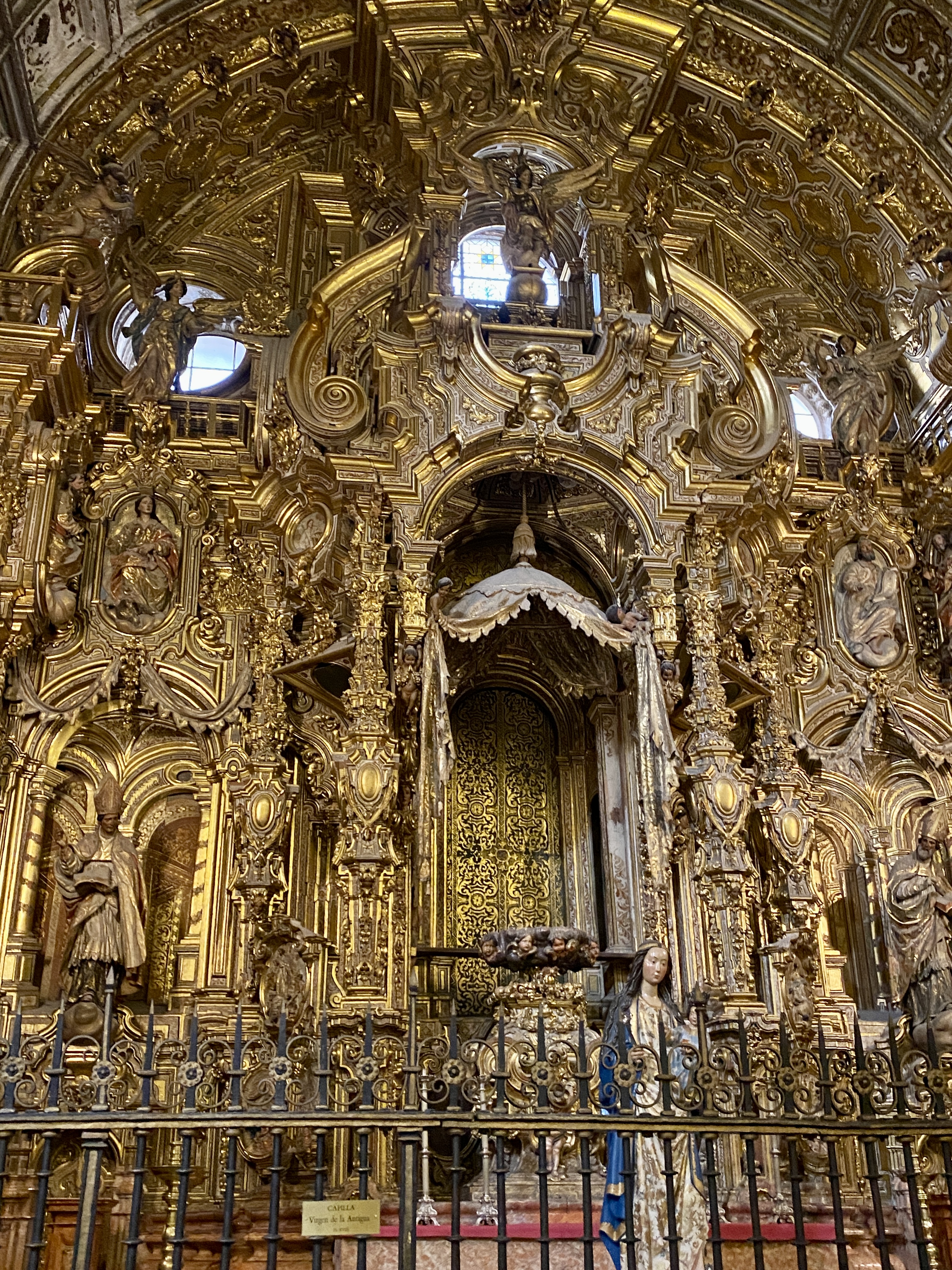
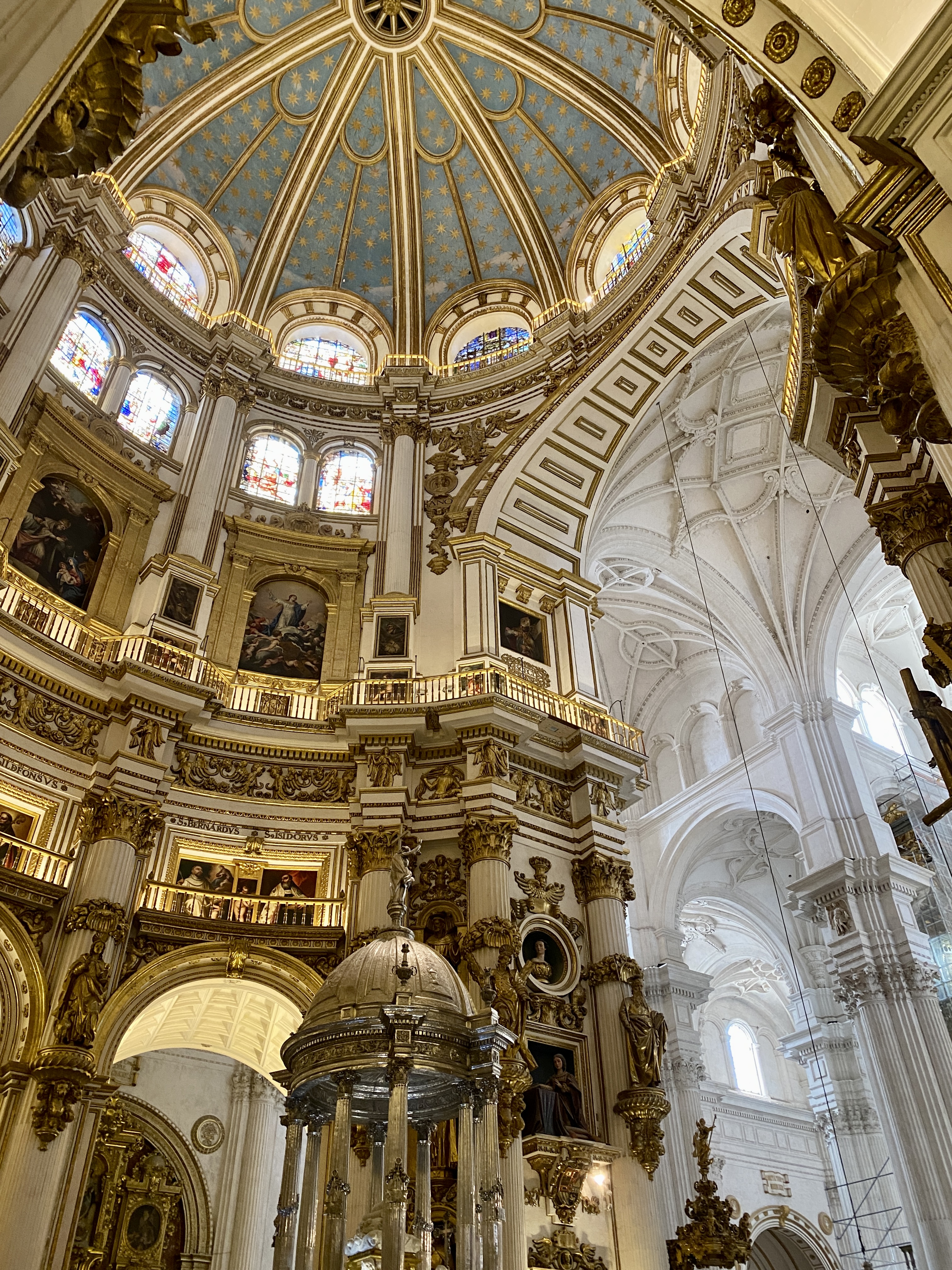
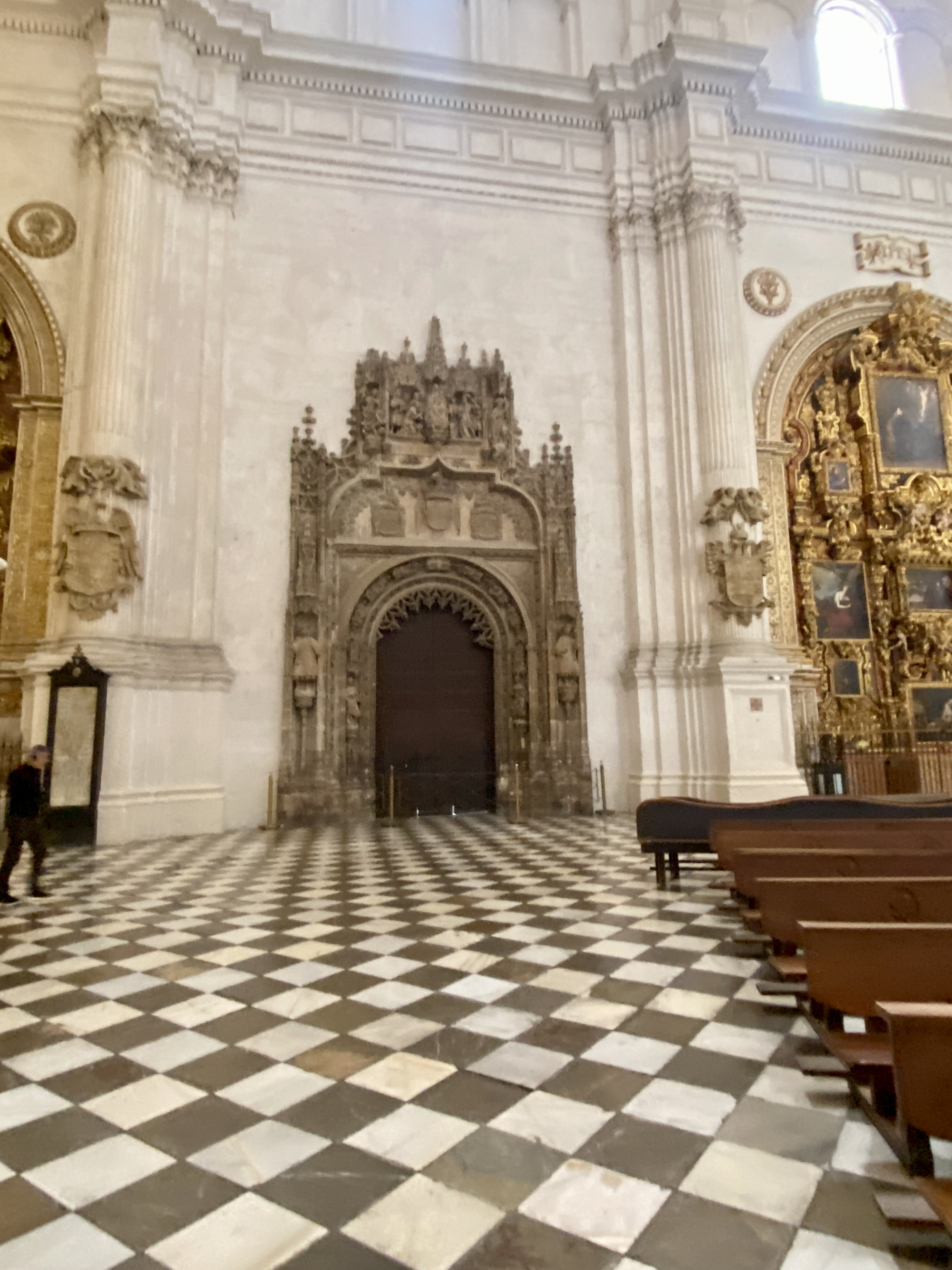
Once solo, I toured the Granada Cathedral. I love visiting cathedrals. Some are so ornate and overwhelming they border on gaudy, but the Granada Cathedral is gorgeous. The first part of the church, built by Queen Isabella after the Reconquista in 1492, was completed in Gothic style and is now the Royal Chapel. This is where King Ferdinand and Queen Isabel are interred. We viewed their simple caskets on display underneath the chapel floor. The cathedral was built later in Spanish Renaissance style. If you want to feel small and insignificant, step inside a building meant to portray the greatness of God.

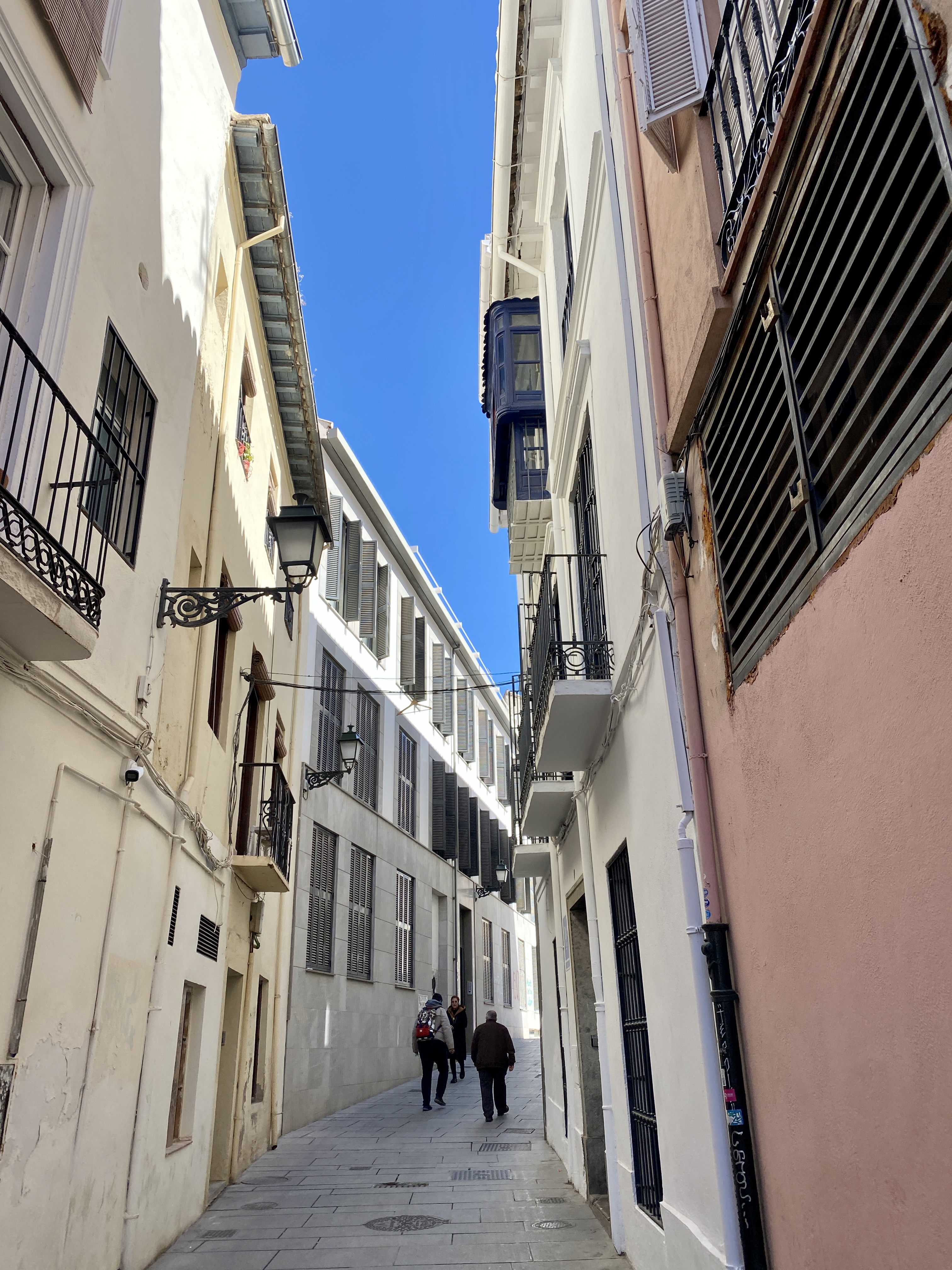
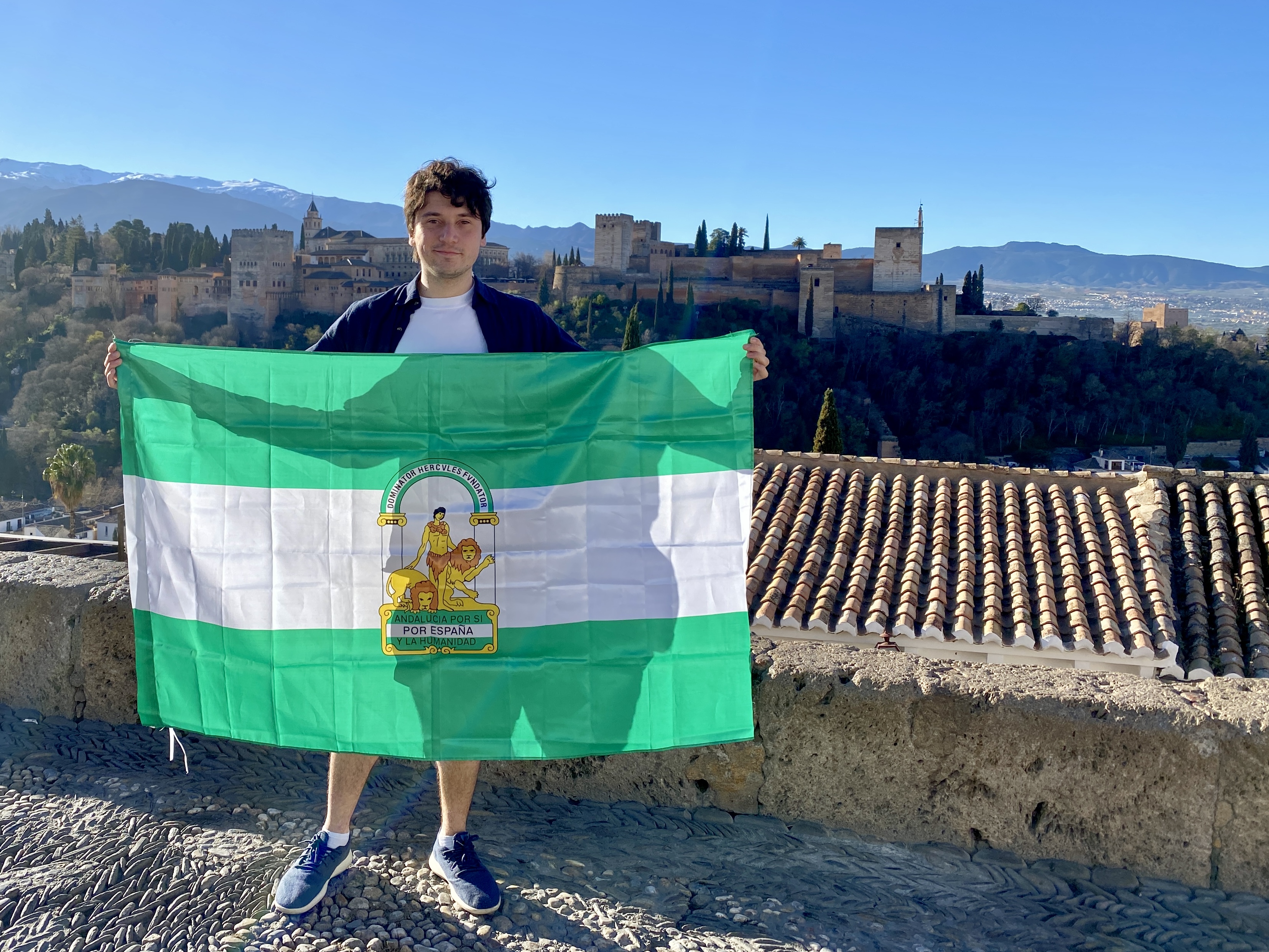
I also toured the Albaicín and Sacromonte areas of the city. These sections are located across the Darro River on the hillside opposite of the Alhambra. The Albaicín settlement is where the original palace workers lived back in the day after they were forced into conversion by Ferdinand and Isabella. In the Sacromonte neighborhood, Roma people (called gypsies) settled into cave houses built into the hills. You could spend days wandering the narrow, often car free, streets here. Joe and I visited the courtyard of the St. Nicolas church, located on a hill directly opposite the Alhambra, multiple times at differing hours of the day to take photos. One morning, Joe pulled out a flag he had brought from home, the Andalucían one his brother bought for him in Granada four years ago, and asked to be photographed with it. He usually only buys flags from places he has been, and prior to our trip he said he felt like a fraud for having this flag. At last, he could legitimately claim ownership for it.

Segways lined up for our group

I like to try new things. On this trip, I determined that would be taking a Segway for a spin. There was a tour of the Albaicín and Sacromonte offered via Segway. Joe did not want to participate, so I went with seven people I just met at the tour office. Operating a Segway is fairly straight forward with some practice. I had about 1 minute to practice before we took off. I didn’t feel fully confident, but everyone else in the tour had already ridden one and I was holding up the group.

Acting confident

As I previously mentioned several times, this area of Granada is hilly. Some of these hills are rather steep. With my uninformed mind, I imagined this would make the Segway an ideal mode to get around. At least I would not struggle. That was a miscalculation for a first-time rider. When I booked the trip, I didn’t understand just how narrow, windy, and treacherous these hills were in places. At our first steep incline, the tour leader dismounted and said he personally would coach each one of us up and over the first curve in the hill. Yikes. I could go into gory details about how the rest of this tour went for me but, suffice it to say, the next time I book Segway tour, I will make sure it is in a flat area so I don’t endanger anyone else. I enjoyed the experience, but I’m not so sure the tour leaders and the woman from England who fell off her ride when she ran into cautious me on my slow-going machine felt the same about their trip .

Of the places we toured on our brief sojourn in Spain, Granada was at the top of our list. It’s small, easily walkable, and beautiful with its position at the foot of the Sierra Nevadas. I will definitely return. Next time, I will bring my husband. And I will know the correct way to visit the Alhambra so we only have to pay for our visit one time.