Eat The Rich

Yesterday morning, I happened upon a story about Mark Zuckerberg. I am not a fan of Zuckerberg on the best of days. I use Facebook only to share my Wordle score with a friend group and to relay my blog posts to my friends who use the site. I go back and forth on whether the platform has any redeeming value, most of the time erring on the side that says we’d probably be happier humans if it had never come into existence. At any rate, the story I saw reported that Mark Zuckerberg had a 7-foot-tall statue of his wife created. It linked to the Instagram post where Mark revealed his exorbitant gesture of love.

It’s difficult to encapsulate the ways this post bothered me, but I am going to try. First, there’s the casual fashion in which Zuckerberg attempts to make commissioning a statue of his wife into some relatable gesture by posting it to Instagram. Because, of course, the average Insta user is going to see the post and think, “Wow. What a thoughtful, loving husband.” (Insert vigorous eye roll here.) Second, Zuckerberg has zero concept that invoking a tradition associated with the elite Roman class might be ill advised at a time when many feel our own democracy is falling like Rome itself fell. And how tone deaf is it to brag cavalierly about a statue you’ve had created in honor of your wife at a time when people are struggling to afford gas, groceries, and housing? Not certain we needed the cogent reminder of wealth disparity in our country. I think the majority of us are well aware of it, thank you very much.

As an upper middle class, white woman in suburbia, I have my fair share of privilege. For our anniversary this year, my husband sent me a floral arrangement with 29 long-stemmed red roses, and I posted about it on Instagram because, while he regularly brings me flowers, he has rarely sent them to me. He did it this year only because we were apart on our anniversary for only the second time in nearly three decades. I do know the funds it took to purchase the roses could have provided a week’s worth of groceries to a small family. I get it. I’m no monument to justice, and I can understand how someone might feel the same way about those roses that I felt when I saw that statue. But if 29 long-stemmed roses could provide a week’s worth of groceries for a struggling family, how many families could the money used for that statue of Priscilla provide? Some will argue he earned his wealth and should be able to do with it as he sees fit. And, honestly, I don’t begrudge him the luxury of being able to fund such a grand gesture as much as I find it unhinged to assume posting about it on social media would make him look like a good guy. What could he have been thinking? With so many barely scraping by right now, it felt a little, well, “Let them eat cake”-ish.

Though the whole display left a sour taste in my mouth, I’m empathetic enough to understand Mark has perhaps lost some grasp on reality with the attainment of his prodigious wealth. There are roughly 800 billionaires in the United States, and approximately 85% of them are white men. Imagine the mental disconnect that must accompany being one of 800 people who collectively hold nearly 4% of US wealth while the bottom half of Americans, approximately 167 million, hold only 2.5% of the nation’s wealth. Possessing the financial resources to buy 1,400 acres of ancestral land on Kauai for the purpose of establishing a family compound complete multiple houses, treehouses, and a 5,000 square foot underground bunker might make one more than a bit removed from reality. This is the American dream, though, isn’t it? The notion that hard work can lead to a life of ease and luxury? This is precisely what capitalism promotes.

I have to wonder, though, at what point the other 332,999,200 of us will decide we’ve had enough of this shit. Are we even capable of becoming appalled rather than fascinated by this nation’s billionaires? Where do we draw the line with wealth and decide too few possess too much? Or is it simply part of the destiny of a free, capitalist society to escort us to where we are? Will the gross display of billionaire excess ever tip us towards a revolution away from capitalism? Will we prove the musings of Jean Jacques Rousseau correct, that “when the people run out of adequate sustenance, they will eat the rich”? If we do get to that point, I’m gonna guess the native Hawaiians might be the first to climb the six foot wall around Zuckerberg’s compound and approach him with a fork.

(Editor’s note: I am, in no way, promoting cannibalism. I just found Rousseau’s statement to be food for thought.)
Shit Is About To Get Real — Can We Handle It?

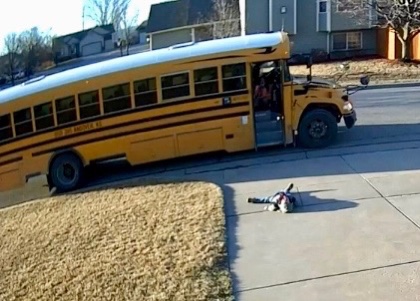
This kid literally cannot

To protect my mental health these days, I keep most of my news consumption to online articles because when I watch television news and see the strength and resolve of the Ukrainian people as they undertake what may well be an in-vain attempt to salvage their nation, I often have to leave the room to cry. I just can’t. It’s too much. Coming off two years of a global health crisis that kept us indoors and away from the greater community that binds us, my coping strategies have reached their limit like an old, elastic band that has been sitting in a drawer for ages and now will break when stretched. Just when the light at the end of the tunnel came into view, an aging white autocrat in Russia decided to push his limits.

I saw a video today of a four year old who approached his waiting school bus, got within fifteen feet of its steps, bent over to put his mask on, and then fell backwards with dramatic flourish onto the concrete, as if the prospect of the school week was more than he was capable of handling at that moment. We are all that kid right now as we wonder how much more insanity, unrest, upheaval, heartbreak, hardship, and stress we can take both at home and around the world.

For almost 77 years, the world has known peace in Europe. That peace has existed my entire life and all but three years of my parents’ lives. While my parents had a solid concept of the horrors of war through their parents, I had only what I saw in films. Aside from the 1980s era nuclear holocaust fears I had courtesy of our Cold War with the Soviets and “The Day After” television movie that haunts me 38 years later, I have felt mostly safe in our geographically isolated American bubble. That ended the other day when Putin’s army invaded a sovereign Ukraine, and then shit got real when he dangled the threat of a nuclear attack.

In an opinion piece on the CNN site this morning, six global voices weighed in on Putin’s invasion. Marci Shore, an associate professor of modern European intellectual history at Yale, had this to say about Putin: “This no longer felt like a man playing a high-stakes chess game, now it felt like a scene from Macbeth. My intuition was that an aging man facing his own death had decided to destroy the world. Ukraine is very possibly fighting for all of us.” This does indeed feel like the situation. While texting with my geopolitically savvy son last night, we discussed what can be done about the war as Putin begins to feel the squeeze of the joined hands of the free world around his neck. Joe told me, “The goal of the west should be to sanction as much as possible and create a counter propaganda machine to turn the oligarchs and Russian people against Putin.” And while I realize he is 100% correct, it means this war in Europe does not stay in Europe. We are a global economy. People around the planet will feel the sting of Putin’s actions in higher fuel costs, and those higher fuel costs will trickle into the costs of goods manufactured and sold around the world. The sanctions imposed on Russia will touch us all one way or another.

These financial hardships will be our contribution to squashing tyranny and, hopefully, restoring stability to Europe. Are we up to this task? I’m not sure. For the past two years, we’ve witnessed a steady cavalcade of tantrums over wearing a mask. If we weren’t all on board with covering our noses and mouths to suppress a transmissible, deadly virus, how willing will we be to suffer financial hardships for the sake of protecting democracy on a continent across the Atlantic? Are we smart enough to recognize that our peace and freedom are tied to the peace and freedom of citizens on the European continent? Will we be able to channel the ghosts of our American predecessors and adopt the WWII war-effort mindset of “Use it up – Wear it out – Make it do – or Do without”? Will we withstand financial hardship inside our own households and country, however long it takes, to protect the freedom and peace we have taken as a given for three quarters of a century? Man, I hope so. I would like to think we still have better days ahead.

We are a global people now. We need to act in the best interests of others to maintain our own best interests. As long as the majority of us in free nations are able to comprehend and live with that fact, we might be able to vanquish Putin, return Europe to peaceful homeostasis, and avoid nuclear fallout. The question remains, though, do we have it in us to continue living in an uncomfortable and perhaps increasingly painful holding pattern until better days arrive or are we just too soft now?

On Simon, Anna, and Trust Falls

Photo by Brett Jordan on Unsplash

A few nights ago, my husband and I watched “The Tinder Swindler” on Netflix. I followed that up (while I was ironing, of course) with “Inventing Anna,” another Netflix show. I mean, who doesn’t love a good, juicy story about a conman/conwoman? When someone has the audacity (or mental illness) to buck society’s norms and use their friends, lovers, and coworkers as pawns in their own personal chess game, without any regard for what will happen to these people, we get curious. Curious about what makes them tick. Curious about how they planned and executed their cons. Curious about how their victims didn’t see it all as plain as the brown on a paper bag. Humans love a sensational story. If we didn’t, TMZ wouldn’t exist.

Much has been said about the naiveté of the victims of these hustlers. In the case of the Tinder Swindler, people have called his female marks slurs like gold diggers, idiots, and sluts. When we were watching the documentary, I admit I sat there agog that these women would send a man they had only known a matter of weeks photos of their passports. What on earth could they have been thinking? I remarked to my husband that in a million years I never would have done something like that when I was dating. I grew up feeling anxious and unsafe in my home environment, and there I learned I could trust no one but myself. As a young woman in the dating world, I was cautious and independent, so the idea of meeting a guy for coffee and then agreeing to hop aboard his private jet bound for another country seems insane to me. While these young women were thinking, “Oh…this is like a fairy tale movie,” I would have been thinking, “This is like a serial killer movie. He’s going to lure me to another country with his private jet and then murder me and dump my corpse there.” I mean, really. Fairy tale? Come on. And call me crazy, but a young, handsome heir to a diamond fortune doesn’t need to find women on Tinder.

Once I got over the preposterousness of it, though, I felt for his victims. They wanted to believe the best. They wanted to trust that this man was what he said he was, what he was actively working to present himself as. They were being flown all over Europe in private jets, wine and dined, presented with lavish gifts and attention. All of these things seemed legit. In the absence of skepticism and a stunted, cynical heart like mine, you are primed as a human for this trickery. So these women lost tens of thousands of dollars to him, and they are still paying off their losses.

Trust is necessary for people to coexist. For societies to work, we have to trust each other. We have to assume when we drive that other drivers will also pilot their vehicles according to the rules of the road and act to keep themselves, as well as others, safe. When we go to the hospital, we trust that the doctors and nurses will do everything in their power to help us. We trust our teachers to be kind and helpful. We trust our neighbors will be decent and responsible. When you don’t trust others, you limit your ability to participate in the world around you. Ask Vladimir Putin.

So as you watch The Tinder Swindler or Inventing Anna and find yourself being deeply critical of those who fell for the ruse, just remember the victims of these cons are not pathetic, gullible losers, but human beings doing what human beings do: trusting others and believing that good still exists in the world. Conmen have for millennia taken advantage of the human need to trust others. We use the term “snake oil salesman” as a cautionary tale for a reason. But we need to believe in the inherent good of others. Trust in others is part of what makes our survival as a species possible. It’s a shame there are those bad apples out there who insist on reminding us there is evil and unmitigated gall for our species to survive too. And it only makes for entertaining television when you aren’t the one who got dropped in their trust fall.

No Such Thing As Small Change

Years' worth of small change can really add up!
Years’ worth of small change can really add up!

I hate carrying change around in my wallet. My purse is heavy enough without my having to lug coins everywhere with me. So, for years, I’ve removed the change from my wallet and deposited it into glass containers we’ve kept in our bedroom. Every bit of change that hubby left lying around or that I found in the washer or dryer was collected and dropped into the jars as well. We’ve made a game out of it. After paying for the church we rented for our wedding with over $150 in spare change that we had saved, we understand that saving those seemingly worthless coins actually pays off. So, for several years now we’ve been telling ourselves that we will take it to the bank to exchange for cash when we have something memorable to spend it on, something we know we want to do but might not be able to afford to do otherwise.

Well, with our sights set on kayaking the Wailua River in Kauai with the boys in a couple months, we hauled all our change to Wells Fargo yesterday to cash it in. When we came in carrying our heavy jars, I expected the tellers to close their windows. I worked at a credit union when I was far younger than I am now, and I remember how much I dreaded the customers who took me away from my window to feed the change converter. But, they were very accommodating and, in just 10 minutes, they had our grand total. Steve’s estimate was $392. Mine was $429. We were both wrong. After socking away spare change for a few years, we’d saved a grand total of $468.20. Sometimes it pays to be patient. We will now be able to afford our river paddle excursion and a two-hour whale watching expedition. And, we will feel great knowing that our little effort yielded a big, memorable result.

Worth the wait
Worth the wait

I’ve been thinking about how often I am unwilling to acknowledge that it’s the little things that add up to create the big things. I, like most people, forget the value of patience and perseverance because I want it now. But, the best things in life aren’t the ones that come quickly. They’re the ones that we work on day-by-day, and they don’t seem like much as we’re doing it. Consider Michelangelo’s statue of David. At one point, that 17-foot tall statue was nothing but a large block of untouched marble. Only with steady patience and dedicated effort over a period of three years was Michelangelo able to create the glorious sculpture people still marvel at over 500 years later. It takes vision to acknowledge that effort rendered in seemingly miniscule amounts will inevitably enumerate over time, and only when we’re willing to settle in and commit ourselves with patience will we realize real accomplishment and self-satisfaction. You can’t cash in your change jar after just one day, one week, or one month’s worth of efforts. You have to hang in there because some day it will add up and you will understand that some change is definitely worth working for.