Our Lady of Perpetual Slow Learners

Lovely couple of kids

If there’s one thing I’ve learned through my journey as a parent, it’s that expectations can be your undoing. In terms of expectations, mothers are doomed from the start. From the day we pee on a stick and see pink lines, we are an expectant mother. Our pregnancy bible is entitled What To Expect When You’re Expecting, and we devour the information between its covers because pregnancy is so new and different and impending parenthood is equal parts exhilaration and terror. We want to be prepared…as much as anyone can be prepared for the arrival of something so much a part of oneself and yet totally unlike anything anywhere else. While our children begin their lives unencumbered by the existence of expectations, we embark on our parental career ready to measure them against the rubric of the typical. And that’s the point when we make our first big mistake.

I knew fairly early on that our sons were not typical. They did not follow growth and development charts. They were on their own schedules. Things their peers were readily learning, our sons could not. They skipped letters in the alphabet  and struggled to write their own names. They were uncoordinated with sports and were unable catch a ball or skip or follow rhythm. Physicians noted their shortfalls while reassuring us that they were fine. In school, they displayed obvious intellect while retelling stories or playing creatively, but rote memorization of math facts escaped them. They began to get poor marks on tests science and social studies tests despite knowing the answers when asked orally. We were frustrated. We knew they were intelligent, but their grades didn’t reflect it. Teachers told me they weren’t trying, but I knew how hard they worked. I could see their constant struggle to keep up and fit in with expectations they now innately understood by watching their classmates and receiving their report cards. When we finally realized that they had learning disabilities, the damage had been done. Our sons no longer believed they could be successful. Expectations were crushing them.

This year we pulled them out of traditional school and did what we swore we would not. We put them into a special school, a school for children who think differently, a school for the atypical. We’d been hesitant to take this route, fearful of pointing out to them and to others that they weren’t measuring up in regular schools. But the time for denial being a river in Egypt was over. They needed help…no matter what that help looked like. Their new school was a big adjustment for me. You see, there are no grades there. None. Kids aren’t in 4th grade and they don’t earn letter grades. They’re not evaluated that way, and teachers and students don’t discuss grades. They discuss progress. They discuss solutions to struggles. While the kids are evaluated regularly, they are assessed solely on improvement. If they’re improving, they’re on the right track. If they’re not improving, it’s time to re-evaluate how they might learn better and pursue a different route. It’s so simple it’s scary.

And, honestly, this new system of analysis did scare me. I was so tied to our traditional conventions that the variation seemed dubious. As a culture, we subsist on numbers and quantitative results. Our conversations with other parents about our children often revolve around concrete standards. Bobby came in First at State. Jimmy has a 4.0. Sue got a 1300 on her SATs. Hey. I get it. It’s an accomplishment and a feather in our caps when our child is successful in a way that we can readily point out. I know from personal experience, though, the other side of that equation. When our sons were earning C and D grades, I perpetually feared having someone ask me about their report cards. I knew that based on their grades our boys would be marked as subpar by others, and that was frightening. And now when they’re getting no grades, well that’s even scarier. When you tell someone your son is “around the 4th grade level and is a consistently improving student,” they look at you as if you’re sporting three heads. No one is up for flexible standards of personal success although that is the only type of personal success there is…the personal kind.

If we’re going to live by expectations (which we seem bound by human nature to do), perhaps we could be a bit more flexible with our assessment of others? We could accept steady improvement as our rubric. We could value overall forward progress over typical milestones because the truth is that not everyone is typical in every way. Our sons are slow learners because their brains process information differently than the majority. So what? It’s taken me almost 46 years to believe that a piece of paper doesn’t prove wisdom and all the outward success in the world doesn’t make you a better person than the next guy, and that makes me a pretty slow learner too. I’m learning to let go of expectations and becoming more patient with myself and with others. It might be two steps forward and one step back, but I’m making progress just like my sons. By the end of my life, I like to think I will have evolved not just to standards but beyond them in ways that are immeasurable.

I threw away the books that told me how my children should be. I now appreciate them for how they are.

Crushing The Hulk

Mental peace = sunrise on Kauai

I’ve been spending a lot of time lately engaged in what has become a regular pastime of mine…pondering the unanswerable questions of life. Rather than being consumed by the everyday worries provided 24/7 via the cable news networks, I exercise my brain by contemplating topics like the potential for achieving emotional peace whilst circumnavigating the vast ocean of fluid interpersonal relationships. Is there a meaning of life? Is there a Hell? Are humans doomed to repeat their mistakes? Will there ever be another television program as brilliant as Breaking Bad? (Okay. Maybe not that last one, but it does deserve an answer.) While some friends find my need for intellectual exercise exhausting, as an introvert I rather enjoy my armchair philosophy. There’s something comforting in asking questions that cannot be answered. At least you’re certain your suppositions can’t be proven wrong.

Yesterday while my mind was entrenched in the question of whether a person can have true compassion for a friend without taking on any emotional burden of said friend, Joe came racing in from the cold to interrupt my mental machinations. He’d been outside sledding and wanted to share something with his brother who had been resigned to inside play after I’d discovered that his second-hand snow boots were falling apart (literally, the heel of the boot was flapping when he walked and he’d failed to mention this little tidbit to me for a week).

“Luke, you’ve got to come outside and sled!” he implored.

“I can’t, Joe,” came the disappointed reply. “My boots are broken and the insides are all wet. It’s too cold.”

“Okay. But we’re out there running over the Hulk with our sleds. We’re trying to destroy him,” Joe explained before beating a hasty retreat back to the sledding hill lest he miss any additional opportunities for destruction. Poor, plastic Hulk. He didn’t stand a chance against four preteen boys hell-bent on mowing him down in freezing temps.

Luke sat quietly for a minute or two and then he ran upstairs. He reappeared shortly wearing long underwear, fresh wool socks, and a hat with ear flaps. He ran to grab his snow pants. When he came back in, he began his verbal campaign as he continued dressing.

“I have to go back out, Mom. I don’t care if my feet get cold. They’re sledding…over the Hulk. How often do you even get that opportunity? It’s epic!”

I didn’t see how I could argue with this logic. He was right. You don’t get many opportunities to team up to destroy the Hulk, even if he is just a small, plastic shell of the big, green guy. Philosopher though I am, I understand the occasional sense of urgency to let go of the mantle of deep thought, logic, and rational behavior to seize an epic opportunity, warm feet be damned. Yes. My mind may be old and grown up, perpetually stymied by life’s deeper questions, but I’m still young enough to appreciate that sometimes you have to throw caution to the wind and crush the Hulk.

No matter what the bigger answers are, every day my children remind me what it truly means to live.

Kids Only Lose Sleep For Something Truly Important

Luke and Motty-O feign sleep

Our oldest son has never been a good sleeper. I used to laugh when people told me that I should “nap when the baby naps.” That would have been a perfect solution to my exhaustion if I hadn’t had to drive him around just to get him to go down for a nap and keep him asleep for that hour. Luckily, our youngest is a better sleeper than his brother. Last night, however, he was restless. By 10 Joe was asleep, but still Luke was not. Hubby asked me if I would go in and say goodnight to him again because that might be just what he needed. So, I did.

I walked into the boys bunk room and, sure enough, Luke was in bed but wide awake. I told him I knew exactly what he needed and traipsed off to their play room to retrieve Luke’s most favorite stuffed animal, a grey Webkinz horse named Motty-O. (Don’t ask me. He was 4 when he named it.) Our creative Luke has a series of stories about this horse, whom he has informed us is from Kentucky and sleeps standing up. We know this horse’s entire back story, a fact I’ve perpetually found charming. When I handed Motty-O to Luke, Luke smiled and hugged him. He stroked his tail thoughtfully and suddenly looked quite sad.

“What’s the matter, Luke?” I asked, worried by the face that usually proceeds his tears.

“Nothing,” he said, still stroking the horse’s tail.

“Are you worried about his tail, sweetie?” I inquired “You know, the more you love on an animal, the more threadbare they begin to look. That’s not a bad thing at all. It’s a sign that you love him the most.”

“I know,” he said with tears welling up in his eyes.

I’m not the only one who has had a long and rough week. Although he’s been taking it like a trooper, Luke was the one who received the dyslexia diagnosis and began tutoring for his disability. He’s the one who has to think about switching schools and feeling different. I started to wonder if his tears had less to do with his horse than with other things he must certainly be grappling with at this time.

“You know, Luke, sometimes if you’ve got something on your mind it’s better to talk about it. Maybe if you tell me what’s making you sad you’ll be able to fall asleep better?”

“Nope. I’m fine,” he replied even as he opened his eyes wider and looked up at the bottom of his brother’s top bunk to keep the tears from falling down. Just like his mother, Luke likes to believe he can handle anything without any additional help.

I sat on the bed with him and stroked his hair, hoping he would open up but he didn’t. Finally, he asked me to leave. It was around 11:30 when he at last surrendered to sleep.

Tonight, I finally pried from him the reason why he was so sad last night. It wasn’t that he was worried about the dyslexia or the tutoring or the idea of switching schools or even the idea of possibly having to move. It was something I never saw coming.

“I was sad about Motty-O,” he reluctantly admitted.

“Sad about his tail falling out a bit?” I guessed.

“No. It’s something else.”

Having been something of a stuffed animal freak myself, I dug deeper into the stuffed-animal-lover psyche to try to extract the thing that might make him sad. Then it came to me.

“Are you sad because you won’t always have him with you?” I asked.

“Uh huh,” he said, tears once again pooling beneath his sweet, green-hazel eyes.

“You will always have Motty-O, Luke. I still have my most precious stuffed animals,” I said. “You know my orange dog, Drooper? I’ve had him since I was 9 years old. I’ve had him with me for 35 years. He went to college with me. He’s traveled with me. I will have him forever. And, you will have Motty-O for your whole life too.”

At this point, a couple tears leaked down his cheek.

“I won’t have him when I die,” he said as more tears fell.

“Oh, Luke,” I said, hugging him, “I believe you will have Motty-O in Heaven. I believe Heaven is filled with all the wonderful things you love and cherish in your life. Motty-O is part of our family. He will be in Heaven with us. I just know it.”

“My other animals too?” he asked.

“Most definitely,” I replied, relieved to know that he wasn’t suffering any ill effects from his diagnosis.

I can’t help but laugh now at how it all played out. Last night, Luke couldn’t sleep. I thought it was because of the same things that have been troubling my mind this week, so I gave him the one thing I thought would be the greatest comfort to him. Instead, that was the one thing that made it more difficult for him to fall asleep. I’ve got to learn not to project my concerns onto my little guy. Of course he’s not got insomnia about his reading issues. Why would he worry about something he’s always known? It’s the mysteries of the universe that keep children awake, mysteries like what happens to our stuffed animals when we die. That’s the only kind of mystery that is worth losing sleep over.

Nobody Puts Joe In A Corner

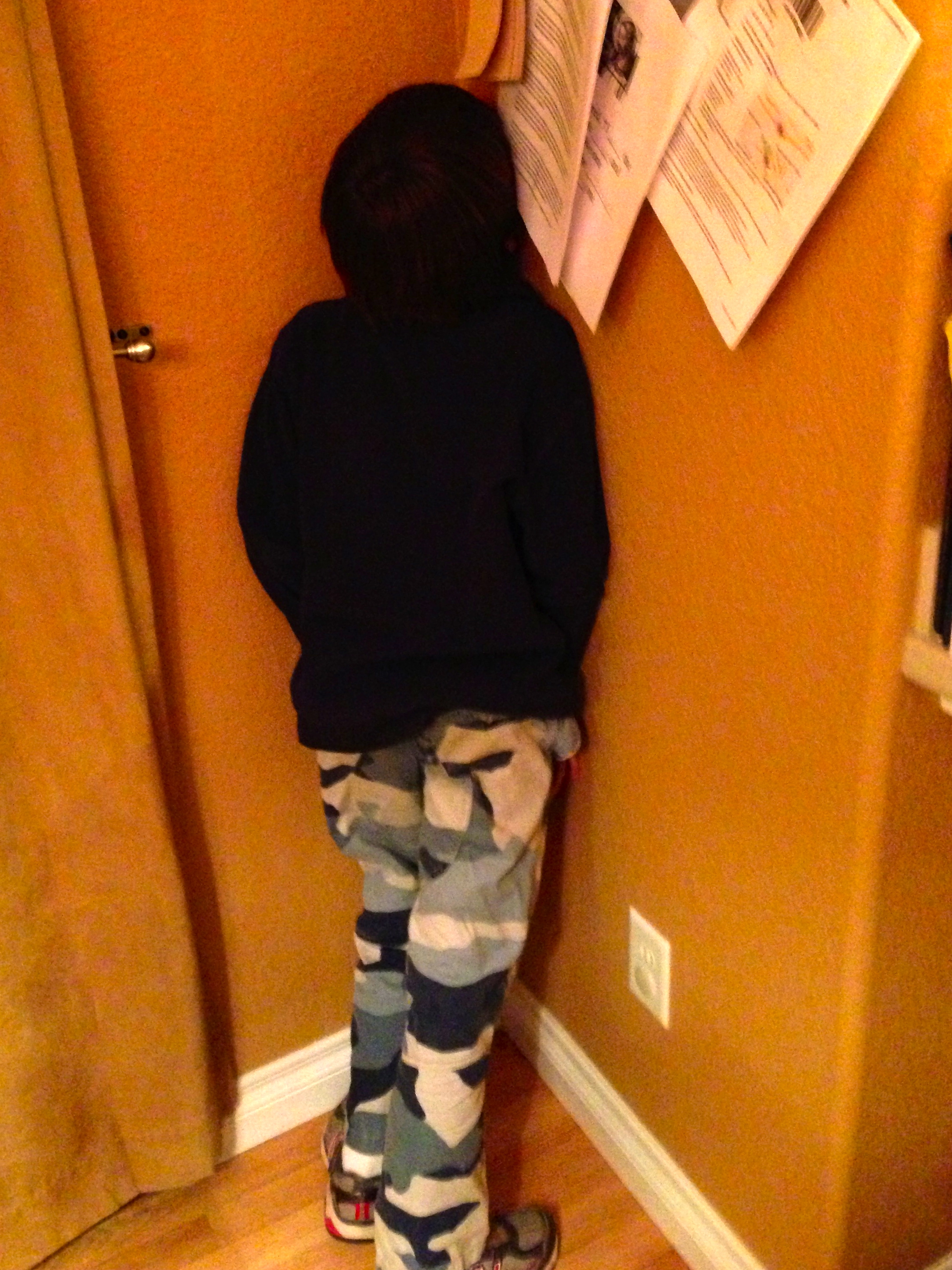
Who stands in a corner voluntarily? Joe does.

I swear, I’d really like to believe my boys are exceptionally bright but sometimes they make me think I should set my expectations a wee bit lower. This evening I was sitting on the sofa helping Joe practice his words for his spelling test tomorrow. Spelling has never been an easy subject for Joe, but even as the words have increased in difficulty during his fifth grade year, he has been doing a bit better with spelling this year than he did last year. (Yes. I was, in fact, simultaneously knocking on wood and typing just then.) I’ve begun to see a light at the end of the tunnel, as if his hard work is paying off and things are finally starting to take root in his brain. He didn’t struggle at all with hemisphere and he breezed right through isthmus. He was even able to give me the correct spelling and a word-for-word definition for archipelago. Then, just when I was starting to get a bit cocky thinking that all the time and effort I’ve put into being a stay-at-home caregiver was at long last yielding measurable results, he said something that really confused me.

“Okay, Joe. Spell tributary.”

“Mom…wait. Wait. I have to tell you something first,” he pleaded.

All too familiar with his stall tactics, I pressed on.

“Spell tributary and then you can tell me,” I replied.

T-r-i-b-u-t-a-r-y,” he spit out. Then, as quick as lightning without a pause for breath in between his words he spewed forth, “Mom-today-I-stuck-my-nose-in-the-corner-of-the-dining-room-by-the-magnetic-board.”

He said it so quickly that I didn’t have a chance to catch half the words. Still, he was looking at me expectantly as if he’d just divulged the magic fix-it solution for the holes in the ozone layer.

“What?” was all I could muster. Well…that and a quizzical scrunching of my eyebrows.

“I-stuck-my-nose-in-the-corner-of-the-dining-room-by-the-magnetic-board,” he said again, slightly more slowly but still in a barely intelligible way.

“Okay,” I said with brows still furrowed, “that time I got corner and magnetic board. What corner?”

“UGH!” he was getting frustrated with my slow-uptake skills. “The corner in the dining room by the magnetic board.”

“Yeah? What about it?” I asked.

“Today, I stuck my nose in the corner of the dining room over by the magnetic board,” he repeated, trying very hard to be kind to his old and clearly mentally impaired mother.

“What? When did you do this?”

“When I was working on my math homework,” he replied.

Okay. This was starting to make some sense. It’s not unusual for any child to seek a break from his math homework. It’s even less surprising when your ADHD child becomes distracted from the process of long division.

“The next question, I guess, is WHY?” I asked, drawing out the end of that interrogative word hoping it would help him to understand how truly bizarre what he had just disclosed was.

“Because I’ve never done that before. I’ve never seen the house from that angle,” he replied with a tone that told me he was making perfect sense and I was an idiot not to understand it without explanation.

“Wow, Joe,” I said, trying my best not to look concerned about his mental faculties. “That’s an interesting reason to subject yourself to voluntary time in the corner.”

“I was curious,” he said, shrugging his shoulders. Then, as quickly as the conversation started it was over. “What’s the next word?” he asked.

Later, I was retelling the story to hubby who had been out with his parents this evening. After laughing about it for a bit, we started thinking about how differently Joe views the world. We’ve never been able to enter into how his ADHD mind works. We continue to try, but without firsthand knowledge and experience, we’re befuddled. We began to wonder if perhaps Joe knows something we don’t about the world. Maybe there’s something we’re missing? Simultaneously, we went and stood in separate corners in the dining room to see for a moment the world through Joe’s filter.

“I’ve never done this before,” Steve said.

“Me either. Ten years in this house and I’ve never once had my nose in a corner,” I replied.

“Does your nose touch the actual corner of the wall?” Steve inquired from the other corner of the dining room.

“Well, the magnetic board is blocking me at my height, but if I scrunch down a bit let’s see. Yep. Yes it does. It fits right into the corner,” I told him.

“Huh,” he said.

“Why? Does yours?”

“Yeah,” he replied.

“Who knew?”

Now, you could think we’re a little nutty for sticking our noses into the corner the way our son did, but after 11 years of grasping at straws trying to find a passage into Joe’s ADHD brain we will try anything. We desperately want to understand him better. Any hints at all would be welcome. The funny thing is that I started out thinking my son was crazy for choosing to stick his nose into the corner of the dining room, but the more I thought about it the better I felt about it. While most people take things for granted, Joe investigates. He theorizes. He experiments. He doesn’t accept things at face value. He is deeply curious, and there are far worse things you can be in this world. So, I take it back. I am totally okay if my son, by conventional standards, doesn’t appear to be exceptionally bright. If some people choose to think he’s exceptionally weird, that’s okay by me too. The bottom line is that he’s exceptional, and that’s pretty freaking fantastic.


We Need To Go Old School Again

“Play is often talked about as if it were a relief from serious learning. But for children play is serious learning. Play is really the work of childhood.” ~Fred (aka Mister) Rogers

My boys engaged in free time play

Lisa, my dear friend who happens to be a high school English teacher, shared a link to an intriguing Psychology Today article the other day. The article discusses the steep and steady decline in the creativity of our nation’s children over the past twenty to thirty years. Studies have shown that as we’ve become a society more focused on test scores, our children have lost their ability to think creatively. The more we’ve restricted free time and free play (through both increased school work and increased extracurricular activity), the more heavily these creative losses are felt. While I wasn’t the slightest bit surprised by the article’s revelation, I was a little shocked by the statistics behind the assertion:

“According to Kim’s research, all aspects of creativity have declined, but the biggest decline is in the measure called Creative Elaboration, which assesses the ability to take a particular idea and expand on it in an interesting and novel way. Between 1984 and 2008, the average Elaboration score on the TTCT, for every age group from kindergarten through 12th grade, fell by more than 1 standard deviation. Stated differently, this means that more than 85% of children in 2008 scored lower on this measure than did the average child in 1984.  Yikes.”

When I was a child, my mother would hand us a piece of paper on which she had drawn random squiggles, lines, or shapes. Our job was to create a picture incorporating the designs she had already placed onto the paper. While my mother’s impetus for giving us this little exercise was most likely to acquire some uninterrupted free time for herself, what she was actually doing was helping us develop our creativity. As it turns out, this simple exercise my mother used to engage my sisters and I when we were children is the exact test that researchers use to measure the Creative Elaboration mentioned in the above paragraph. The goal is to have the child take what exists on the paper and expound on it in an original, meaningful, and possibly humorous way.

As I reflect on the amount of homework my boys do, on the assignments they have in school, and on the advanced level to which they are asked to work in their educational environment, it’s really no wonder that my eldest will sometimes come home in tears, lamenting the knowledge that he won’t have much free time to play after school. It’s heartbreaking, really. I did homework when I was in grade school. I know I did. But, I didn’t have much of it, maybe 30 minutes in fifth grade. Maybe. I did most of my work in class, including studying for exams, and the work I did at home was largely reading and practicing some spelling words. Joe has thirty spelling words in fifth grade, including ten vocabulary words for which he must memorize definitions. This week, on Joe’s list, appear the words hypotheses, phenomena, and memorabilia. I know adults who can’t spell those words. Joe also does 28-30 analytical, multi-step math problems a night, none of which he has time to do in class. It’s no wonder he’s stressed out.

In grade school, a million years ago when I was a child, we did fun, creative things. I remember one lesson we did for Social Studies. Both sixth grade classes were assigned an imaginary culture. We were told what the people in our make-believe country prized and how they lived their lives. We practiced acting within the boundaries of our assigned culture. Then, the teachers opened the doors between the two classes and we were prompted to interact with the other culture. One culture was entirely money-based while the other was entirely love- and affection-based. It was a hand-on lesson in culture shock. In sixth grade at my elementary school, we also studied a unit on the ancient Egyptians. With the research we had done in the library, we constructed “artifacts.” From cardboard we fashioned headpieces, Anubis likenesses, and even a sarcophagus. And…get this. We did all this work in the classroom. None of it was homework. Then, believe it or not, we dressed like the Egyptians and took the children from the other grades on a tour of our ancient Egyptian tomb, which was conducted in the school’s basement crawl space. I’m not kidding. Can you imagine the potential lawsuits from that type of activity today? Kids ducking their heads and walking around in a darkened, dusty, uneven, underground space in the school guided only by sixth graders? But, I will never forget that experience because we had to be creative to carry out our project. Our teachers, given the necessary freedom, taught us to be enthusiastic scholars. Today, my son got in my car in tears over tonight’s homework load.

I’m not a policymaker in Washington. I don’t hold a PhD in education. I’m just a mom who is home with her children. But, it seems clear to me that what our schools need more of is freedom to make learning a creative exercise and fewer standardized tests for which our children spend the entire year preparing. If we want to be the country that others imagine us to be, full of that American ingenuity we are constantly praised for, then we need to rethink our educational system. Let’s use some of the creativity we developed through the free time and play that we were allowed back when we were children to reinvent a landscape where our children are rewarded for thinking outside the box and solving problems ingeniously. Not only would it make the future of this nation brighter, but it would make our present time with our children more enjoyable and less tearful as well.