I Don’t Miss Sleep Anymore

Safe haven
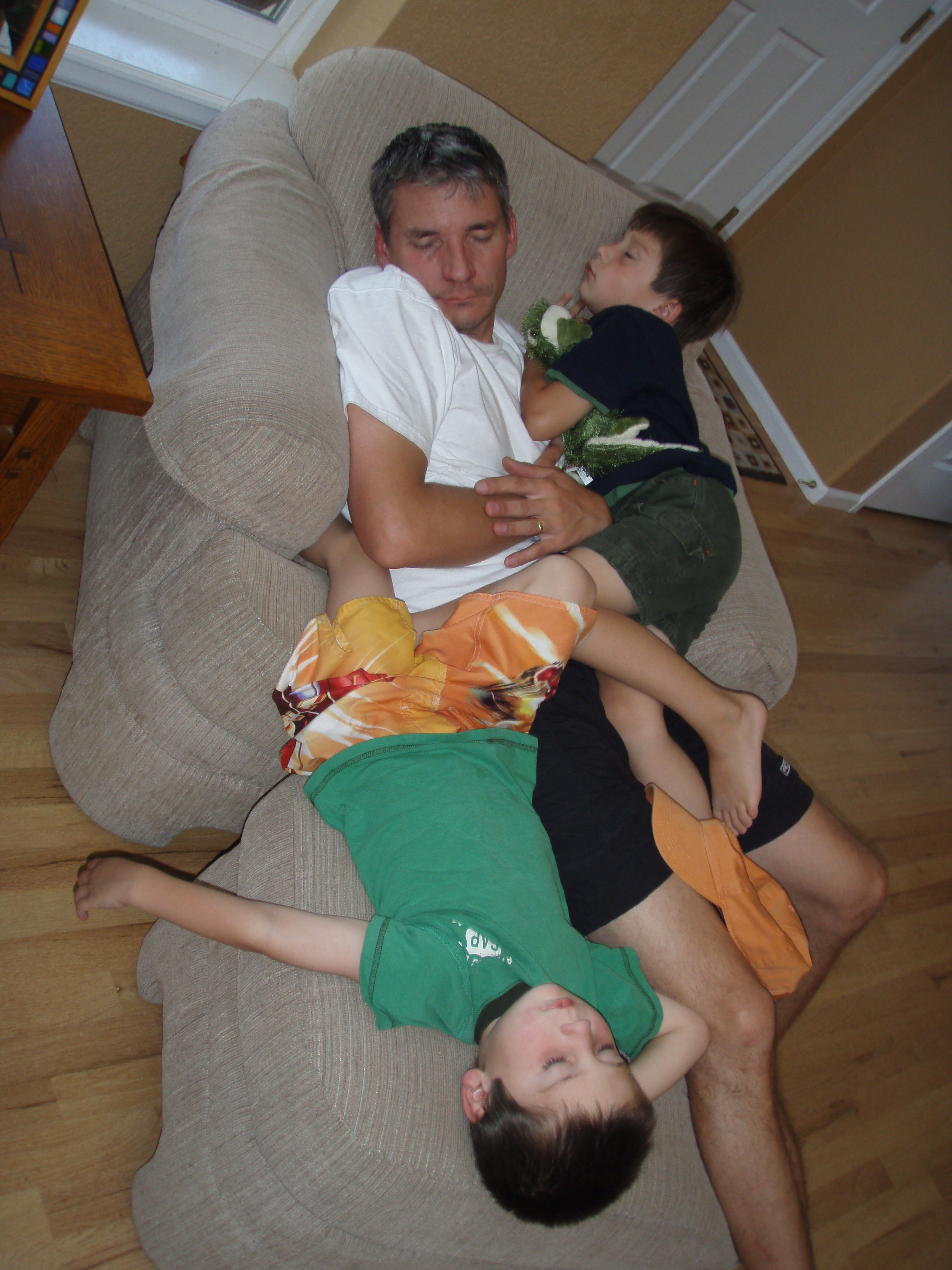
My three men…all wiped out together

The other night our double bedroom doors burst wide open at 1:03 a.m., startling both hubby and I awake. From the light in the hallway, I could make out that the perpetrator of our early morning wake up call was our youngest son, Luke.

“What’s up, Luke?” I asked, although I already knew the answer to this question.

Luke is our “good” sleeper. While his brother tosses and turns in the top bunk, Luke slumbers peacefully. He sleeps in cars, on planes, and in restaurants. When he’s down for the count, you usually don’t have to worry about him again.

“I had a nightmare,” he replied as he quietly closed the door behind him with sudden politeness.

“Really? What about?” I said.

As he began to climb onto our bed, he started recalling a dream wherein he was being chased in Roblox, which is some new video game he and his brother have been playing. He sat on the end of our already cramped, queen-size bed telling us about snakes (like Indiana Jones, he hates snakes) and death. He was visibly unsettled. Often he will just tell us about his nightmares, and then head back to his room. Sometimes, though, he needs real comfort. I could tell this was one of those times. Finished with his story, he finally crawled toward the top of the bed, pulled back the covers between me and hubby, and began to insinuate himself between us.

“So…sorry about this, guys,” he told us as he nestled in and began to settle down to get some more sleep.

When Luke was small, we experienced periods during which the only way he would fall asleep was in our bed. He slept in a bassinet in our room until he was four months old. He slept with us again off and on from 9 months to roughly 14 months. Sometimes he would fall asleep in our bed and we would transfer him. Sometimes we were so tired he ended up staying with us all night. When we would tell other people about Luke’s sleeping habits, most would cluck their tongues and tell us what a mistake we were making. We brushed it off.

In the house I grew up in, we were not allowed to sleep in my parents’ room. Ever. It simply was not done. My parents gave us our own rooms, and they expected us to be in them. End of story. When we had our children, I assumed that our kids would have the same experience that I did. But, our kids are not like my sisters and me. Our kids have vivid imaginations and stressful dreams. Joe sleepwalks. Luke, if aroused from sleep by an unexpected noise, is often unable to calm down enough to go back to sleep. We do what we can to get sleep when we can, and sometimes that only occurs when we let the boys sleep in our room. It is what it is. We have made our peace with it.

I flipped around as Luke was in our bed the other night, unable to go back to sleep. I could not get comfortable because what was once 20 pounds is now 55 pounds and takes up a lot more room. I was about to resign myself to taking Luke’s place in his bed while letting him rest peacefully with his dad when, out of nowhere, the announcement came.

“I think I’ll go back to my own bed now,” he said, grabbing his stuffed animal and climbing carefully over his father and out of the bed.

I walked with him down the hall and tucked him back into his bunk bed underneath his sleeping brother to make sure he was truly ready to settle down. He pulled his stuffed Husky dog, Shasta, towards him, curled into a little ball on his side, and closed his eyes. He was calm, and I knew I would not be seeing him again until the morning.

I’ve thought a lot about the way we “spoil” our kids by letting them do things like sleep in our room on occasion. Truth is that I don’t feel the slightest bit of remorse about it. I don’t think it’s undermined their confidence or made them any less capable of handling their fears. Instead, I think it’s allowed them to believe that when things get scary, they can turn to us. When they feel confident and relaxed, they always move forward without us. Sure. We’ve definitely lost some sleep with restless boys in our bed or on an air mattress in our room, but I think the trade off of knowing that they know they can count on us is worth it. Besides, these days are numbered. Someday they will be out of the house, and I will miss hearing that door burst open in the middle of the night and knowing that they need me. I’ll catch up on my sleep then.

My Kids Aren’t Cheap Circus Ponies

Portrait of our family

This past Thursday, prompted by recommendations from not one but two special education professionals, we trekked to Children’s Hospital so Luke and I could visit with a psychologist and determine whether he might (like his brother) have ADHD. Honestly, neither hubby nor myself were 100% convinced that Luke would be diagnosed. We thought that if he perhaps did have some of the markers, his symptoms at this point were mild. But, when we learned that ADHD and dyslexia occur together up to 25% of the time, we decided it was best to cover our bases.

During the course of the hour and a half we spent talking with the psychologist, she asked innumerable questions. Most of them were about Luke, but some were about our family life. When she asked me about how we discipline our boys, the strangest thing happened. I drew a blank. The more I sat there searching for an answer, the more shocked I was to realize that we don’t discipline our boys very often. I couldn’t decide where to go with that realization in terms of answering the psychologist’s question. I decided to come clean.

“This is going to sound strange, but we don’t discipline our sons very often. We set clear, realistic expectations, and our boys most often meet them.”

“Well, when you do have to discipline, what kind of discipline do you use?” she inquired.

“Most often we take things away from them…their iPads and video games, opportunities to play with friends, that sort of thing. But we’ve never done it for more than a day or two. They respond to that type of punishment fairly well and typically avoid having to repeat it,” I told her.

She seemed appeased by my answer and moved onto another question. Quietly, though, I wondered if she thought I was either a) lying to make our boys sound better than they are or b) simply another overindulgent parent with little control over her children. The test came when she asked our boys to sit on the floor across the hallway from her office while she asked me some questions. She told them it would be 10 minutes and that they needed to be quiet. At one point during the interview I started to become uncomfortable because it had been too long and they had been far too quiet. When she finally opened the door, I checked the time. They’d been out there for 20 minutes. I peered my head around the corner to see that Luke was shutting down the Dragonvale app he had been playing on my iPhone and Joe was putting his homework back into its folder. I felt vindicated. My 9 and 11 year old sons had sat alone quietly on the floor in a dull hallway without any adult supervision for upwards of 20 minutes without incident. See. They are good kids, just like I said.

Maybe it’s because our boys struggle so much with their issues that we go easy on them with other things. Their rooms are messy. The number of chores they’re asked to complete is minimal. As they’ve gotten older, we’ve chosen to let go of some things so that they can be kids. Their school work takes such an enormous amount of effort that we cut them slack in other areas; it’s not right when they break down in tears because they’re overwhelmed and miss their friends. We do expect things of them. We expect their best effort on their school work, but not A or B grades. We expect them to be polite, most of the time. We expect them to be kind and to try to get along with others. We expect them to work out their own differences and to recognize their own responsibility in a disagreement. We admonish them if we feel disrespected. In exchange for these things, though, we’ve given them a voice in our house and our trust. We ask their opinions. We let them make choices. And, yes, we pick our battles. We’ve decided that it’s better to give in on the things that don’t really matter so that when we ask them to yield on the things that truly do matter to us we’ll have the backing to gain their easy compliance. They understand that as part of a family sometimes they get what they want. Sometimes they don’t.

I don’t expect that our boys will never need more serious discipline. They’re boys. They’re getting older. They’re going to make bad choices. We all do. When I make mistakes with my sons (which happens far more often than I wish it did), I openly apologize to them. I show remorse. I make amends. I am not the Queen of Do-As-I-Say-Not-As-I-Do. I’m the Duchess of I-Try-To-Set-A-Good-Example. I told our boys the other day that my job is to make sure that they grow up to be the kind of men I still will want to spend time with, the kind I will invite into my home again once they’ve vacated. Discipline is important. My actual job as Mom, though, is to make sure they feel unique, important, and unconditionally loved, and not to ride them like cheap circus ponies. Just don’t tell them I said that. I’ll lose my edge.

A Mind Of Its Own

Gotta know where it is at all times.

I am the mother of sons. Although I had no say in the matter, the truth is that when hubby and I decided to have children I made it fairly clear that I expected him to give me sons and not daughters. Now, I know we had no say in the matter given that the general rule of conception, at least at this current moment, is “you get what you get and you don’t pitch a fit,” but I’ve always been a girl who knew what she wanted. You see, I am the oldest of three girls. And, while I know my mom enjoyed having young daughters, I remember what I was like as a teenager. I remember how I treated my mother. Furthermore, I remember what it was like living in a house with three teenage girls. Frankly, that amount of estrogen scares me. So, I put that part of my life behind me and gave it a firm “no thank you” when I considered my future and potential parenthood. I was thrilled when the Powers That Be determined that I should have not one but two darling little boys. Apparently, someone up there either understood what I wanted or figured I should parent what I was least likely to strangle. I have always understood why some animals eat their young.

Being the mother of sons is an interesting proposition, though. On the one hand, I never have to share clothes, make up, jewelry, or zero-calorie soft drinks. On the other hand, I am the problem child when it comes to camping and long car trips since I wasn’t built with an external pee hose for convenient potty breaks. All in all, though, being the only female in the house has been an ideal situation for me up until now. Now, my oldest son is now firmly in the throes of being a preteen. Situations in which I am asked to demystify the male anatomy are becoming more frequent. This might freak some women out, but I am not squeamish. I’ve never talked to my sons with baby talk about body parts. I’ll bet I utter the word penis at least five times in any given day, and I’m okay with that. I’m the one who gave my sons their first (very simplified) “sex talk” because 1) they had questions and asked me, 2) their dad was not interested in discussing it yet, and 3) I determined it would be better if they got the details from me than from one of their little friends who has erroneous information. Quite honestly, it’s been fun to hear the things my sons will tell me.

“Please put your penis in its house,” I requested of a not-quite-fully-clothed Joe who was standing in the hallway wearing nothing but a towel after his bath.

He looked down into the towel. “It’s not ready to get dressed yet,” he replied matter of factly.

I closed one eye, cocked my head, and pondered why it might not be ready to get dressed yet. Then I shuddered. Oh Good Lord. “It will be fine. It will fit into pajamas. Get dressed. I may not have a penis, but I know how they work,” I claimed.

“Trust me, Mom. They have a mind of their own.”

So I’ve heard.

You know, my whole life I thought that saying was a cop out. Turns out that even 11 year old boys know it to be true. The best part about being a mom to boys isn’t what I expected it would be. It’s not that no one is hogging the bathroom while doing their hair or that no one is breaking down into weepy, hormone-induced puddles, although those are both good things. It is instead the education I’m getting being able to see the male experience as it happens from birth. It’s given me an entirely new perspective on the male species. I still don’t truly understand men, but I’m getting closer. Apparently, it really is all about the penis.

Like Sands Through The Hourglass

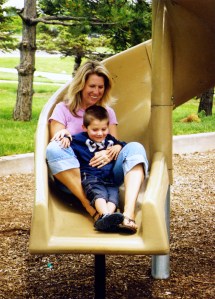
Me and my two-year-old Luke

Our youngest came down with a wretched cold on Sunday afternoon. By Sunday evening I knew he would have to be home with me on Monday. When our boys first started going to school, I would cringe and whine when they’d come down with a cold, not just because I knew I would be getting sick too but also because I knew that meant they would be home with me all day again. After all, I’d just gotten them into full day school and had begun to relish my emancipation from non-stop, boy-generated sound effects and full-day indentured servitude. I’d recently rediscovered the perfection in silence. I didn’t look forward to relinquishing it for even one day. That was years ago now, though, and yesterday I had a different experience when Luke stayed home with me. We ran a couple quick errands during which he was honestly helpful. Then, at home, we worked together on some of his school work. We read together. We watched Elf. Other than his constant hacking and my fear of getting in germs’ way, it was a wonderful day.

This morning while Joe was showering for school, Luke crawled into bed with me. He was crying. He didn’t want to go to school today. He was stuffy and not yet truly better, but he probably would survive the day. It was a sketchy call. If I were a parent who worked outside our home, he’d be going to school. End of story. But, I don’t work outside my home. I could tell his tears were real. He was stressed. He had so much to make up from Monday’s missed classes plus there was an additional large project he’d been working on and was hoping to complete. Last year, before I knew about his dyslexia, I would have mercilessly driven him to school despite his protestations and gone to yoga class unabated. Today, however, I really felt for him. I could understand how having all that work looming over his head at the end of a full day of school would seem an insurmountable task. I’m not afraid to admit it. I caved.

So today I spent my second full day this week alone with my youngest. We picked up a few groceries, selected a couple dress shirts for Christmas attire for them, and then we settled in at home with a goal of completing two days’ worth of school work as well as finishing most of his big project that is due Friday. I worked with him and, with just short breaks in between, we busted through all his work. By 2 p.m. I could see his shoulders raise as the weight of his heavy, third-grade world lessened on his shoulders. He was smiling more. I could tell he was feeling better. A couple times during the day I stopped to wonder if I had done the right thing, bailing him out of his nerves like that. Had I given him an easy way out? He probably would have benefited from the opportunity to fall behind and catch up slowly, finally realizing that the world did not come to a crashing halt because it took him a couple days to finish his work. Instead, I somewhat selfishly looked into his teary, hazel eyes and saw my two-year-old son, the one who used to climb into my lap every day to give me a hug and tell me he loved me. I gave into my emotions. I was weak.

At 2:20, he was starting to miss Joe so we hopped in the car to pick him up from his full day of school. On the way there, we chatted a bit. Then it got quiet. Out of nowhere, my 9 1/2 year old hit me with this.

“Mom?”

“Yeah, sweetie?”

“I’m going to miss you tomorrow. When is the next time we can have a full day together?”

With this remark, I no longer wondered if I had done the right thing keeping him out of school for an extra day. I had. I got to spend two, uninterrupted days with my youngest son. When Luke said he would miss me, I was the one who got misty. The time I have left with my boys is precious and quickly slipping through my grasp. The days when we will sit together on the couch watching movies and sharing Skittles are numbered. The passing of time is a necessary evil during this journey through life. I missed two days’ worth of yoga classes and alone time during which I could have accomplished much during this busy holiday season, but it was so worth it. Luke got his peace of mind, and I got to have two-year old Luke back. You can’t put a price on the rare opportunity to flip the hourglass over even if only for a moment with your children. I have no regrets.

Yep…They’re Special All Right

IMG_5889
Definitely our special kids!

A couple days ago I had to do something I’ve been dreading doing for a while now. I had to visit the principal at the boys’ small, private school and tell her that it’s likely that our boys won’t be returning next year. I had to tell her this now, months in advance of fall registration, because I need to pass along some evaluation requests about our boys from the school in which we’re hoping to enroll them next year. I wasn’t dreading this conversation because I thought I would get grief or because I eschew conflict (which I truly do). I was anxious about this conversation because for the past eight years this school has been a safe haven for our boys, a place where they felt loved even though they knew they weren’t exactly like all the other kids. It’s been a place where they’ve always felt special.

When Steve and I first received Joe’s ADHD diagnosis, the psychologist told us he might benefit from a more specialized learning environment or, at the very least, a school with special education services. We looked at our bright, articulate son and couldn’t even begin to imagine him at a special school because the term special somehow implied slow. Jokes from our childhood about the short bus began driving through our head. We considered switching him to a public school but, after talking with several special ed professionals, we determined that Joe might not even qualify for special ed assistance in a public school because the need is so great. I couldn’t imagine transferring him to our local public school, where the class size would be double the class size at the private school he was in, on the off chance that he’d receive enough services to make up for the deficit in personal teacher attention. So, we kept him where he was because at least there we knew they would accommodate his needs, and we knew he felt comfortable.

Turns out, though, that his comfort level isn’t enough of a reason to keep him at the school he’s always known. He and Luke, we’ve discovered, will benefit greatly from placement at a school that specializes in teaching students with learning differences. I recently read that 1 in 7 people have some type of learning difference. These type of issues often run in families. They are not indicative of lower intelligence, although most people seem to think they are. The truth is that a learning difference is just that, a different way the brain processes information. Because schools have to cater to the majority, most teaching is done in the systematic way that works best for most students. Our sons are not in the most category. It’s taken us a while to accept that they’re different. It’s taken us even longer to acknowledge that putting them in a special school doesn’t mean that there is something wrong with them.

So, we’ve at last arrived at the place where we’re ready to make a big leap and switch them to a special school. As parents we’re finally able to admit that our boys are different and to believe that, although their differences are difficulties now, someday those differences will be valued as strengths. When I began to explain to the boys why they struggle the way they do, I wanted to put a positive spin on it for them. So, I did some research. I told them about Richard Branson, Albert Einstein, Charles Schwab, Bill Gates, and Steven Spielberg. I told them how thinking differently made those men special in a good way and how their differences made them successful. I told them that while they may struggle greatly on the front end learning a new task, in the long run they may be better off for the unique perspective. Funny how the more I did research to try to help my boys feel better about themselves, the more I found myself feeling better about them and their potential. I no longer look at dyslexia as a life sentence (although Luke will have it for life), nor do I look at ADHD as an impenetrable road block. Do they make things a bit more difficult for my guys? Absolutely. But, as Luke told me after we watched The Big Picture: Rethinking Dyslexia with them a few weeks ago, maybe true success requires a special brain, the kind of brain he knows he has. Go ahead. Call my kid special. I dare you. He’s just different enough to understand it’s a compliment.

Selling My Sons To The Gypsies

Don’t let them fool you. They are not this quiet!

My weekdays begin in pretty much the same way every day during the school year. I don’t need to set an alarm because my boys, early risers that they are, wake me up by busting into our bedroom sometime between 6:15 and 6:45 a.m. They do this because years ago, when Joe was in preschool, we let him shower in our bathroom before school. Our brilliant logic was that 1) our shower is enclosed in glass, which meant less mess, 2) I’d have just one shower to clean instead of two, and 3) while he was showering I’d be able to lounge in bed and ease my way into my crazy day a bit more slowly. The arrangement continued to work great when Joe was in kindergarten and Luke began preschool. Two showers for the price of one, and I could be getting ready while that happened. Fast forward six years, though, and suddenly this arrangement is slightly less than ideal. Now they alternate showers, which means they’re using all my hot water. They also bicker about fairness like old ladies accusing each other of cheating at canasta. And, they’re doing all this in the space where I am trying to sleep. Not cool.

This morning was Groundhog Day all over again. Just starting on my sixth hour of sleep, the bedroom door flies open and as if the house is on fire the boys rush in fussing and yelling.

“I called it first!” Joe yelled.

“You were first yesterday,” Luke retorted. “It’s my turn to go first.”

“But, Luke, I got out of bed first so I could be the first in the shower.”

“It’s not your turn, Joe!” Luke complained.

I was livid. Well, I was as livid as an exhausted person who is barely awake can be. It’s not bad enough that I must wake up before 7 so the boys will be on time to the private school I chauffeur them to. Apparently, I’m meant to wake up to a noisy parade of foot stomping, whining, and caterwauling.

“Boys! Boys! Boys!” I yelled, without flipping over. “Please shut it. I don’t want to wake up to your fighting! Joe, it’s Luke’s turn today. Sorry.”

At that point, I rolled over to see at exactly what ungodly hour they had disrupted my REM sleep. It was 6:25. Are you kidding me? Twenty minutes earlier than my alarm was set? Then I noticed that Steve was still in bed. What the? He usually leaves for work by 5:30.

“Why are you still in bed?” I asked. He sat straight up.

“Why am I still in bed?” he asked right before he flew out of bed and headed toward the shower, boys still bickering over who was going to shower first.

“Your father. Your father is going to shower first because he’s late. Then, Luke will shower because you were first yesterday, Joe. End of story. Now stop fighting or I’m kicking you out.”

The rest of the getting ready process went smoothly. Steve was gone in a flash. Luke got through his shower quickly because his brother pestered him from outside the glass enclosure the entire time. I sat in bed waiting for them all to get out of the room so I could get ready and then make myself a latte, which I desperately needed. When I was a kid and we misbehaved, my mother used to threaten to sell my sisters and I to the gypsies. Are there still gypsies? If so, will they still hand out cash in exchange for random children? I try not to make empty promises, like the one where I threaten to sign away my legal rights to them if they don’t stop fighting. I mean, I’m fairly sure they know I wouldn’t really do that. At least, I don’t think I would. But, if they come in tomorrow morning yelling at each other before 7, I just might have to check into that gypsy thing a bit more seriously. Unless, of course, you know of someone who is in the market for a couple mostly sweet, slightly used, early rising children? You should know I’m not a great negotiator. I’m positive you could get a bargain. History suggests that I might be entertaining offers from serious buyers as early as 6:30 tomorrow morning. Only 24 days shopping days left until Christmas, you know.

Drawing The Box To Think Outside Of

They’re notes about Ben Franklin, obviously.

Kids come home with school papers every single day. When the boys were in kindergarten, I tried to save everything. Every paper seemed too precious to toss. Each drawing was a work of art. Each handwritten page a portent of the amazing stories yet to be told. By the end of Joe’s kindergarten year, I had a stack higher than I could manage. I promised myself I would go through them, select no more than 5 (or maybe 10 or perhaps 20 at the most) and toss the rest because I knew I could not keep every one of them. I’m pragmatic. I understood that if I saved everything we would have to move in three years’ time. Now that they’re older, the pieces of schoolwork I save are even fewer. I’m more likely to save an honor roll award or an awesome watercolor than I am a piece of their graded work. I’ve somehow created categories in my head of which work is somehow more important and trumps another piece of paper for the valuable space in the Save box.

Yesterday as I was going through Luke’s school folder, I came across a piece of notebook paper with Luke’s writing on it. In addition to words, there were drawings. I looked at it briefly and acknowledged that they were notes, but I couldn’t tell what exactly they were about.

“What is this paper?” I inquired.

“Notes for my Ben Franklin test,” he answered.

“When is the test?”

“On Thursday.”

“Oh. So these are your notes so you can study for the test?” I clarified.

“Yes. But, I don’t need them. I know it all already,” he replied.

I didn’t doubt him. He has a fairly good memory because, as I’ve said, he’s a great listener. What he’s not great at, though, is taking notes. As I glanced over the paper, I realized I could not understand at least a full two-thirds of what he had written. Luke’s spelling and handwriting are horrific which, I am now learning, is caused by dysgraphia. Dysgraphia is to writing what dyslexia is to reading. So, in Luke’s bi-weekly tutoring sessions, he’s working on cursive letter formations. I didn’t understand it at first, why he was writing when he should be learning to read, but it’s all interconnected.

I have to admit that when I saw Luke’s notes yesterday, I cringed. Joe used to bring home papers like Luke is writing now. When Joe brought those papers home, I cried. I only cringed yesterday because I know it gets better. I’ve seen progress in Joe’s work. It’s been slow, but it’s perceptible if you look closely enough. So, I know someday Luke’s written work will get better too. Still, when you look at a paper like that with your third grader’s work and you register that it looks like something a first grader would do, it’s sobering.

I shared Luke’s paper with a friend when I was looking over it yesterday. She tried to assure me that her daughter’s paper wasn’t much better and that she believed that, as her daughter reported, the teacher talks so fast during the note-taking, review portion of the class that it’s hard to keep up and be neat. Good friend that she is, she tried to help me believe that Luke’s notes were probably not that far off the notes of other children in the class. I appreciated her trying to make me feel better, but I wasn’t convinced. Then, tonight, she texted me this:

“I looked at Luke’s paper again now that I know more about Ben Franklin. And, it was really smart of him to draw the pictures. He knew what they meant. The lighting rod, the fireman, etc.”

When I’d looked at Luke’s paper yesterday, I was seeing only the writing. I looked past the drawings because Luke is always drawing. He’s been very artistic for as long as I can remember. He’s done elaborate battle scenes where he attaches page after page of lined notebook paper to each other so that he creates a mural that stretches 15 feet long. Luke always sees the big picture. He draws it too. Heather was right. His notes were filled with drawings, but they weren’t doodles as I had originally thought with my overly critical, left-brained parental eye. They were part of the notes. There on the page were the kite and the lightning bolt, a candle to represent his working in his brother’s candle shop, and a fireman to denote his work as a volunteer firefighter. Luke doesn’t think in words. He thinks in pictures. He knew he would have difficulty reading his notes, so he drew pictures so he would not forget. It was quite clever, actually, because what could be more difficult than asking a dyslexic kid who also suffers from dysgraphia to read notes he took with his own hand? Is that some sort of a cruel joke? That’s more painful than eating salt and vinegar chips when you have a mouth sore.

I am continually amazed by the way my sons have creatively adapted themselves to fit into the traditional school model that caters not at all to children with learning differences and difficulties. For all the days when I’m sad because they struggle so much, there are days like today that fill me with pride and wonder at their ability to think outside the box and see the big picture. And, you’d better believe that Luke’s note page with its innumerable spelling errors and non-existent grammar is going into the Save box. That paper taught me more about my son than any test ever could. I have no reason to be concerned about Luke. He’s light years ahead of his old mother. Not only is he able to think outside the box, but he can draw it first.

I Found The Silver Lining

Luke and a juvenile red-footed booby in the Galapagos.

When our youngest was assessed a few weeks back as having dyslexia, I have to admit that it wasn’t a total shock. Luke had never shown any interest in reading. Working with him on it had been a drag. He wheedled to get out of it, wiggled when we made him sit down, and then winced his way through it. And, honestly, we whimpered as he messed up words like “that” and “what” and “there” and “where.” We put him through four weeks of reading tutoring in between first and second grade. In second grade, Luke’s teacher kept him after school once a week for six weeks to review phonics with him. The kid struggled. But, he was doing so well with other things and he was making progress, so we reasoned that sooner or later he would turn that magic corner and all would be fine. What we didn’t understand then was that for Luke and all people with dyslexia there is no magic corner.

The school psychologist who tested him had very specific instructions for us when she gave us his test results. We were to get him a dyslexia tutor who specialized in a multi-sensory approach to teaching reading. We were not to penalize him for misspellings (which is a good thing because his spelling is appalling). And, to keep him up at grade level literature when he can’t read well enough to comprehend books at his grade level, we were to allow him to listen to books on CD rather than to force him to read them. One thing that struck me from our conversation with the psychologist was that, although Luke’s reading skills are about two years behind where they should be, his listening skills are more than two years ahead of most children his age. It’s not unlike that quote from The Sound of Music, “When the Lord closes a door, somewhere he opens a window.” Luke may not be the world’s greatest reader, but he is a phenomenal listener.

In preparation for Luke’s book report, which is due this week, we finished listening to his chosen book report book tonight. The four of us sat in the family room listening to The Mouse and The Motorcycle on our Bose home entertainment system. As we sat there, I thought about the days before television when people would gather around their radio to listen to the latest news, music, or program. When you use your ears and not your eyes, you’re more present with the other people in the room. There is something magical about hearing a story and noticing the acknowledgment and reaction in the faces of others. You’re present to share in their understanding. You’re simply more tuned in to the story and to each other. It’s pretty cool.

When I’ve mentioned to people that an accommodation we’re making with Luke now is allowing him to listen to books rather than actually attempting to read the book, I register a Hey…no fair look in their faces. Why should my kid get to listen to a book while their child actually has to read the book? I get where they’re coming from. I can see how it seems not right. Then I explain that although Luke can read words, he’s not truly reading. He spends so much time trying to figure out each and every sound in each and every word that he is unable to grasp the meaning of the sentence as a whole. Imagine trying to sound out “superficially” and then by the time you’ve finished sounding it out properly you have no idea what words preceded it. There is no fluidity. There is no comprehension. There are words, difficult, solitary, and devoid of collective meaning. Yes. He can read. But he can’t read.

I tell you what, though, that kid can listen. During our audio program tonight, I would pause the player every couple chapters to ask Luke comprehension questions. These were not easy, yes/no questions. These were designed to elicit specific contextual details from the story. What did the mouse do with his tail when he rode the motorcycle? What was the boy’s hotel room number? What killed the mouse’s father? Name some foods the boy brought back for the mouse and his family. Luke answered every question in great detail without missing a beat. When we sit and he reads text, he fidgets and squirms and has no clue regarding what he’s very clearly recited aloud. When Luke listens to a story, even when he appears to be checked out, he’s still getting it. This is the boy I’ve always known, the one who appears to be in his own world and yet when asked can repeat verbatim what was just said. Reading is an important skill. In fact, it’s crucial to becoming a successful adult. But, listening is a dying art. Luke will learn to read, but how many youth of today will learn to be effective and empathetic listeners? Luke may be living with the cloud of dyslexia, but that cloud’s silver lining may just make it worth the trouble.

The End Of The Tunnel

No one was harmed in the making of this lunch. How incredibly awesome is that?

Since my sons were born, I’ve spent more of my waking hours caring for them than I’ve spent caring for myself. I don’t mention this as a complaint. It’s just what is. It is the nature of the beast of parenting. When you decide to bring another life into this world, you change the course of your own irrevocably. With our recent revelations about our sons and their learning difficulties, I’ve spent more time doing things for them than I have in a while. My life has been a blur of paperwork, interviews, conversations, and applications. Because my husband is already a full-time, paid, paper-pusher elsewhere, these tasks fall to me. While all the filling in blanks and checking off boxes is tedious work, it’s infinitely preferable to all the nose and butt wiping I’ve managed to leave behind as the boys have gotten older. I’m still doing things for my boys, but at least the things I’m doing are becoming less odious. I’ve always felt it was a parent’s duty to do all they can for their children to give them a leg up in this world. Tonight I realize I was at least partially wrong.

As the hours inched on toward bedtime, I realized I needed to make Luke’s lunch. I didn’t want to. I just did not feel like it. As a rule, not feeling like it is not ample enough excuse to avoid the task, so I suck it up. Tonight, I was happily lazing on the sofa researching spring break options and watching Sunday Night Football. Making lunches sounded like a dismal reason to get off my expanding hindquarters. So, at 9:15, when my son should have been headed up to bed, I made a lazy parent decision.

“Luke,” I bossed, “go make your lunch.” There. No longer my problem.

“You want me to do it?” he asked, surprised.

“Yep. You know how you like your sandwich. You will make it better than Dad or I could, anyway. Get busy.”

At this point, I was certain I would encounter verbal backlash or, at the very least, a small whimper or whine. But, none came. Luke simply marched into the kitchen and started gathering his materials. In five minutes he had assembled his lunch: a PB&J (crusts jettisoned, of course), a plastic sleeve filled with organic yogurt, a small container of Goldfish crackers, a “healthy” (read: no food coloring or high fructose corn syrup) fruit roll-up, and an organic vanilla milk. He shoved it carefully into his Star Wars: The Clone Wars lunch box and was about to flee the scene when I called him back and made him clean up the mess, which he also did without fuss. Then he headed upstairs to play a round of Draw Something with me on his brother’s iPad while I stood there, jaw hanging open and hand scratching my head.

Years back, I had allowed our sons to make their own lunches one time. It was only one time because they had assembled lunches filled with Halloween candy, cans of soda, and a measly sandwich. In the process, they had turned our kitchen into a replica of the food fight scene from Animal House, and I’d had to shoo them out and start over but with twice the amount of work. I chalked it up to immaturity and boyhood. I figured they weren’t ready. In fact, I wondered if they might never be ready. Tonight, though, our 9 year old son made his own lunch and it was no big deal. There was no whining. There was no colossal mess. I was tempted to look around for the hidden camera. He’d completed the entire task without drawing blood or destroying the kitchen. And….and…the best part was that I hadn’t even had to get off the sofa for it all to happen. Perhaps it wasn’t the best lunch in the history of lunches and yet it was because I hadn’t had to make it.

It got me to thinking. My boys might be a lot more capable than I’ve previously thought. I started to wonder if I’m doing too much for them. Perhaps they’re at the ages now when they are ready to take on greater responsibility. Not only would it save me some work, but it would also give them an opportunity to experience all they are capable of. It will build their esteem. It will increase their skill set. Holy cow! I’ve been robbing my children of the gift of self-sufficiency. Well, no more, I say. There are so many things I should not be doing for my boys. The possibilities are endless. Wait. Just ahead. Do you see it? That light? It must be the end of the tunnel.


My Boys: Like The X-Men Only Not

I asked them to create their own X-Men/superhero character. This is what I got. Monkey-cat man and a pants-less king/robber dude. I’m at a loss. 

After school today, I had to stop to talk to Luke’s teacher about some accommodations we need to get in place for him for his schoolwork while we begin his tutoring for dyslexia. On the way home after my conversation, the boys and I were talking about how much they dislike having people know that they’re struggling. They don’t want to feel different than their classmates and they don’t want their classmates looking at them differently. Luke hadn’t even wanted me to talk to his teacher, but I convinced him that she needed to understand his difficulties so she could help him. Even at that, he was insistent that we find a way to help him in which no one in his class need ever find out about his dyslexia. Since I just last night wrote about the boys and how grateful I am that their struggles are occurring earlier in their lives rather than later, I thought I would take the opportunity to reinforce my thoughts on the subject by talking to them about it.

“You need to step back and look at the bigger picture on this, Luke. You’re having some difficulties on the front end, but these things you’re going through will just make you stronger in the long run.”

“I just don’t want any of my classmates to know I’m different,” he replied.

“Why?” I asked.

“I’m afraid they’ll think I’m weird,” he said.

“They already think you’re weird,” I added.

“I don’t want this to make me unpopular,” Luke continued, unabated in his concern for his reputation as class clown.

Unpopular? Seriously? The kid is 9 years old. Is he already planning on being Homecoming King?

“Seriously, Luke?” Joe asked. “Everyone loves you because you’re so cute and funny. I don’t think they’ll stop liking you because you can’t read. I told my classmates about my ADHD and they don’t even get what it is. I don’t think your classmates will care.”

“I don’t want them to know,” Luke insisted.

“Luke, sweetie, you’re looking at this all wrong,” I tried again. “All these struggles you’re having now are going to help you later in life. You’re going to be able to face anything because you’ve had to be so brave and dedicated through all this. Dyslexia is not a problem. It’s a gift.”

“It’s not a gift,” he whined. “It’s a curse.”

It got quiet while I tried to figure out how to convince Luke that his embarrassment now at not being able to read as well as the other kids is actually a good thing for him. Then, out of nowhere, Joe piped up.

“Luke…it’s like the X-Men. They have powers and abilities that other people don’t have. They want to keep them a secret because they feel like freaks. Some of them think their powers are a curse. But, they’re not. Their powers make them special. They’re different and it’s not bad. They can use their special abilities to do all kinds of things.”

“Exactly,” I replied. “What Joe said.”

Okay. Okay. So, my boys aren’t exactly the X-Men. I mean, they’re not telepathic, they can’t shoot people with a high-powered optic lasers, and they’re not exactly conjuring up storms to smash their enemies. On the flip side, though, they are special in their own right. They may wish now that they were just “normal” like other people. But, I hold out hope that someday they’ll see that the challenges of being different have been a gift and not a curse. Maybe someday they’ll be proud of their own accomplishments and maybe they’ll even think they’re cool, even if they don’t have retractable, razor-sharp claws like Wolverine.